Face Symmetry Test With Photo Online: A Practical Guide
Curious whether your face is symmetrical? A face symmetry test with a photo online is the quickest way to find out: upload a picture and get a visual overlay, a score, or both. It’s simple and free — but the result is only as meaningful as the photo and the method behind it.
This guide walks through the main types of online symmetry tests, how each one works, how to take a photo that gives a reliable result, and — most importantly — what your score actually means. If you want the deeper science behind symmetry and attraction, our facial symmetry page covers that; this one is all about the practical tests.
The 3 Types of Online Face Symmetry Tests
Not all symmetry tests work the same way. Most online tools fall into one of three categories.
1. Mirror and Grid Overlays
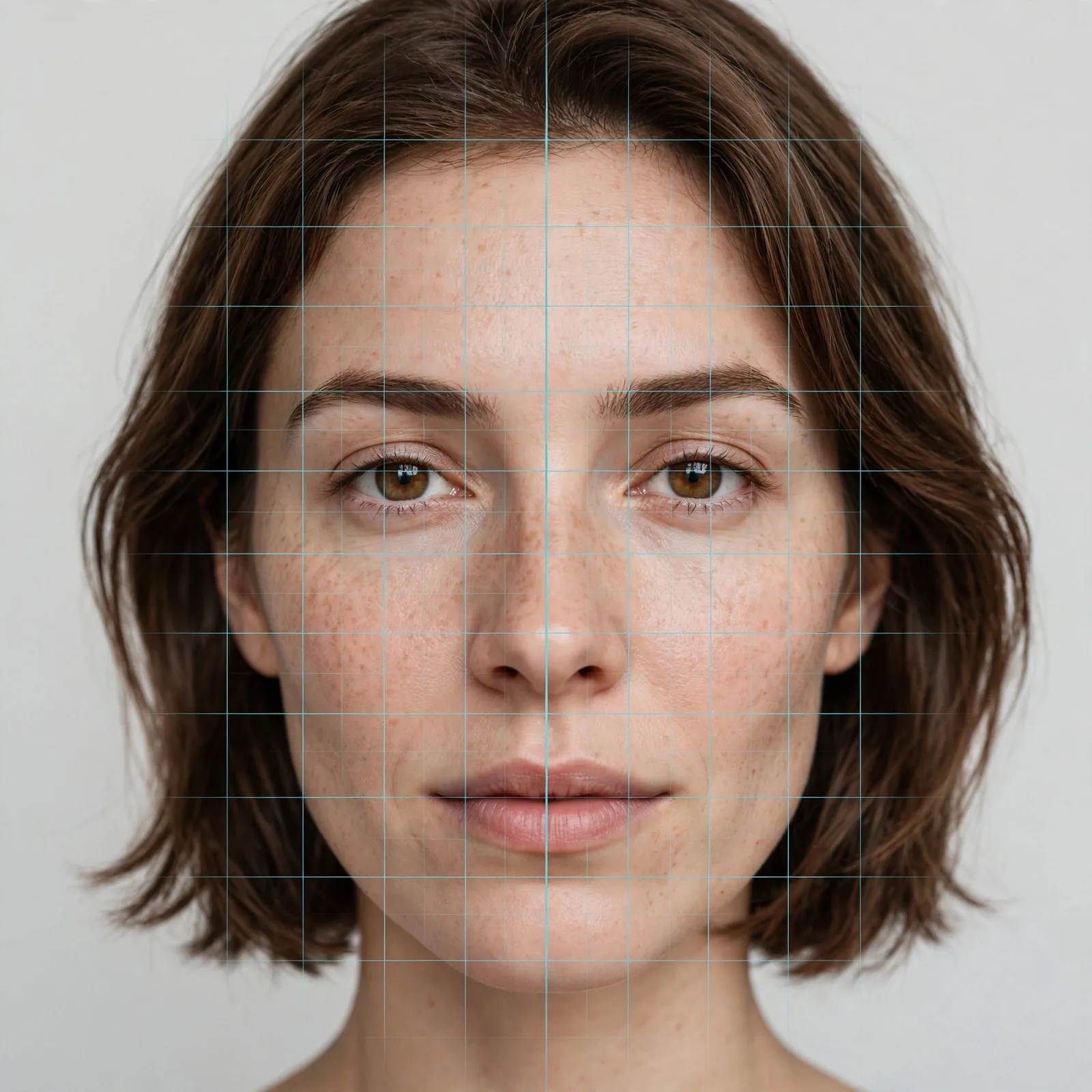
The simplest type. The tool draws a vertical line down your face’s center — or mirrors one half onto the other — so you can compare the left and right sides visually. Some add a grid to help you spot differences in eye height, jaw angle, or ear position.
These tests are qualitative rather than quantitative: they show you the asymmetry instead of scoring it. That’s a strength. A mirror overlay shows the differences are usually tiny — a slightly higher eyebrow here, a marginally fuller cheek there. No number is involved, so there’s nothing to misread as a verdict.
2. Landmark-Based Scoring Tools
These tools detect facial landmarks — the corners of your eyes, nose tip, mouth corners, jaw outline — then measure how closely the left-side landmarks mirror the right-side ones. The result is usually a percentage or a score out of 10 or 100.
Landmark-based tests are more consistent than eyeballing an overlay because the measurement is mathematical: the same photo should produce the same score every time. But “consistent” isn’t the same as “meaningful.” The score depends on which landmarks the tool measures, how it weights them, and how accurate the landmark detection was on your particular photo. Two tools can score the same face differently for the same reasons AI face rating apps disagree with each other: different methods, different reference points.
3. AI-Powered Symmetry Analysis
The newest type combines landmark detection with a trained model, sometimes presenting symmetry as one component of broader facial analysis — alongside proportions, face shape, and other measurements. These tools often give the most polished output: annotated images, detailed breakdowns, percentile-style scores.
The polish can be misleading, though. A slick report with decimal-point precision (“symmetry: 93.4%”) implies exactness the photo rarely supports. Tilt your head a few degrees and that 93.4 can become 88. The detail is real math applied to an imperfect input — impressive, but not as precise as it looks.
How to Take a Photo for a Reliable Result
Whatever test you use, the photo matters more than the tool. A sloppy selfie — especially one shot at close range, where focal length distortion creeps in — can make a symmetrical face look lopsided and vice versa. For the most reliable result:
- Face the camera straight on. Even a slight head tilt or turn exaggerates asymmetry. Imagine a line through the center of your face pointing directly at the lens.
- Keep a neutral expression. Smiling pulls one side of the mouth up more than the other in most people — that’s normal, but it inflates the measured asymmetry. Relax your face, lips gently closed.
- Use even, frontal lighting. A window in front of you works well. Side lighting casts shadows that shift where tools detect your features, especially around the nose and jaw.
- Hold the camera at eye level, arm’s length or farther. Shooting from below or very close up distorts proportions. Prop the phone up and use a timer if you can.
- Remove obstructions. Push hair off your forehead, take off glasses if they sit unevenly, and skip heavy filters or beauty modes — they literally reshape your features.
Take two or three photos and test each — our tips on reducing face asymmetry in photos help here too. If the scores cluster, you can trust the ballpark. If they swing wildly, the photo setup — not your face — is the problem.
What Your Symmetry Score Actually Means
So the test gave you 91%. Or 78%. Or “moderately symmetrical.” What does that tell you?
First, the honest baseline: perfect facial symmetry doesn’t exist. Every human face is somewhat asymmetric — it’s one of the most ordinary facts about human anatomy. Small differences between the left and right sides are the norm, not the exception, and they’re generally invisible in everyday interaction. Nobody you talk to is mentally mirroring your face.
Second, a symmetry score is a geometric measurement, not a beauty verdict. Symmetry is one of several facial measurements studied in relation to perceived attractiveness, but it’s a weak and inconsistent predictor on its own. Plenty of asymmetric faces are widely considered attractive. A single number can’t capture how a face reads in motion, with expression, grooming, and personality.
Third, the number is tool-specific. An 85 on one site and a 92 on another don’t mean your face changed — they mean the tools measure and scale differently. There’s no universal symmetry scale, so scores can’t be compared across tools.
Read your result as a rough description of your facial geometry, like knowing your face shape — a neutral fact about structure, not a grade — our guide on how to know if your face is symmetrical explains the checks. If the number bothers you, remember that the test measured a flat, still image under arbitrary conditions. You are not a flat, still image.
When Symmetry Tests Are Actually Useful
It’s easy to be cynical about these tools, but they do have legitimate uses:
- Tracking visible changes over time. Some people use periodic photos to monitor things like post-injury recovery or the effects of dental work. Consistent photo conditions matter enormously here.
- Art and photography reference. Artists and photographers use symmetry overlays to understand facial structure for portraits and character design.
- Satisfying curiosity. Let’s be honest — most people run the test because it’s fun. That’s a perfectly good reason, as long as the result stays in the “fun fact” category.
What they aren’t useful for: diagnosing anything medical, deciding whether you need cosmetic work, or ranking yourself against other people. If a symmetry result is making you anxious about your appearance, step away from the tools — and consider that the anxiety is the problem to address, not your face.
Frequently Asked Questions
What is the most accurate online face symmetry test?
No single test is definitively “most accurate,” since tools use different methods and scales. Landmark-based tools tend to be the most consistent for the same photo, but accuracy depends mostly on photo quality: straight-on angle, neutral expression, even lighting. A good photo on a simple tool beats a bad photo on an advanced one.
Why does my face look asymmetrical in the test but normal in the mirror?
You’re used to seeing your mirrored self — the mirror flips your face, so the version in photos (and the version other people see) looks slightly “off” to you. This is a well-known perception quirk. The test isn’t revealing a hidden flaw; it’s showing you the same face everyone else already sees and finds completely normal.
Can I improve my facial symmetry score?
You can improve the score by improving the photo: better angle, lighting, and a neutral expression. That changes the measurement, not your face — which is rather the point. Be wary of anything promising to change actual facial symmetry; most such claims lack credible support.
Is a low symmetry score bad?
No. Symmetry scores are geometric descriptions, not grades. Ordinary asymmetry is universal and generally unnoticeable in real life — and if it still bothers you, natural habits can help an asymmetrical face look more balanced. A low number from an online tool says nothing about how you look to other people.
Want to try it yourself? Run a free AI face analysis with a clear, front-facing photo on our homepage — and read whatever number comes back as a bit of fun, not a final judgment.