How to Measure Your Face Shape With a Tape Measure
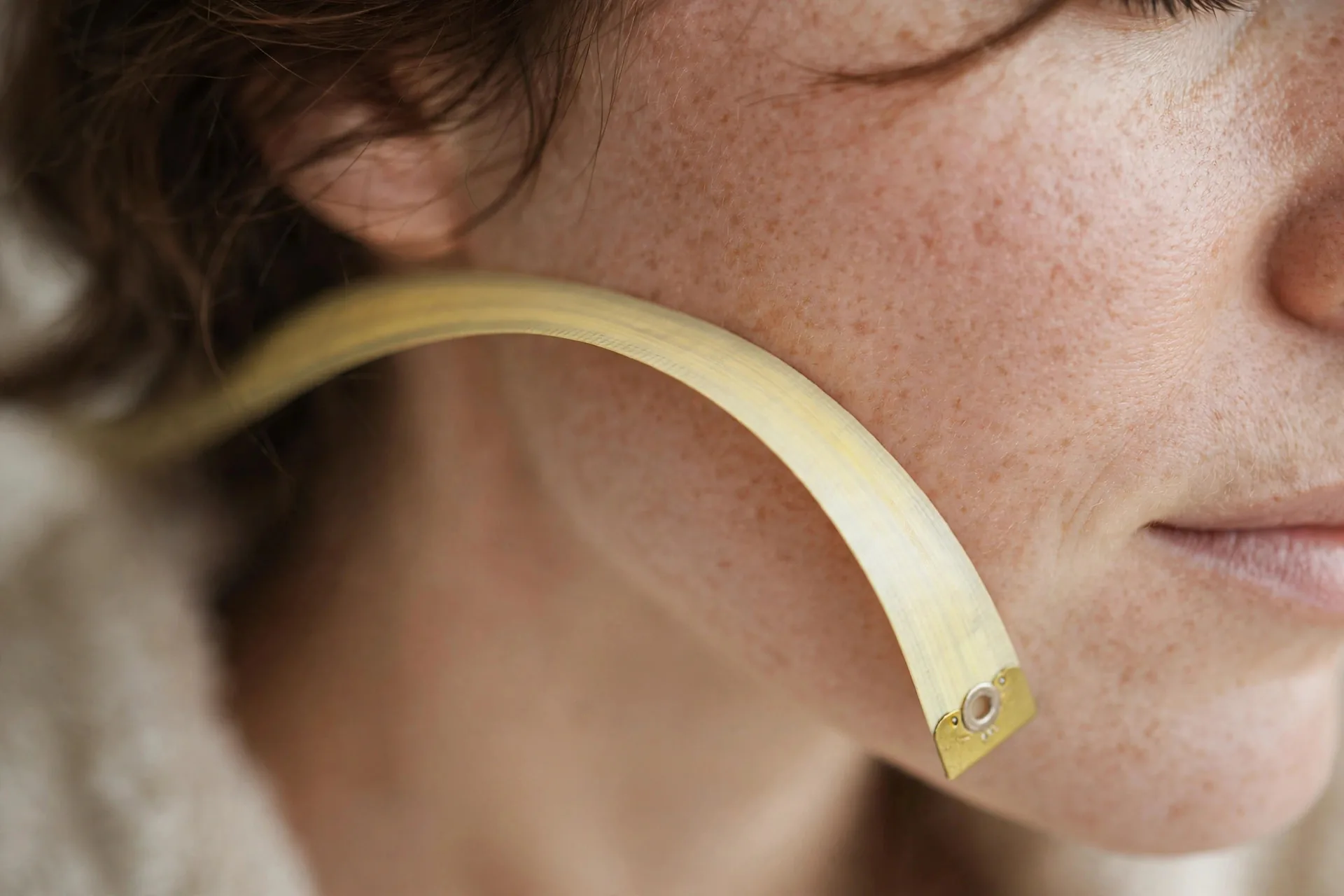
The tape-measure method is the oldest way to pin down your face shape, and it still works because it replaces guessing with numbers. Four measurements — forehead width, cheekbone width, jawline width, and face length — are enough to classify the six common face shapes. No photo, no app, no account. Just a soft measuring tape, a mirror, and the ratio chart below.
What you need and how to prepare
You need one thing: a soft (fabric) measuring tape, the kind used for sewing. It curves with the face, which is the whole point — a stiff metal tape or a ruler cannot follow the jawline. If you do not have one, a length of string plus a ruler works: press the string along the landmark, pinch it, and measure the string.
Preparation matters more than people expect:
- Hair completely back. Tie or pin hair off your forehead and tuck it behind your ears. A hidden hairline or covered jaw angle is the most common source of wrong readings.
- Neutral expression, jaw relaxed. Lips closed, teeth unclenched. A clenched jaw reads wider than it is; a smile does the same for the cheeks.
- A mirror in front of you so you can see the tape placement without turning your head.
Step 1: Measure your forehead width
Place the tape across the widest point of your forehead, roughly midway between your hairline and your eyebrows. Hold the tape flat against the skin and keep it level — not arched up toward the hairline or sagging toward the eyes. Note the number.
The forehead is measured at its widest, not at the hairline itself. The hairline can dip or peak at the centre, which is why the midway point gives a truer reading of the actual forehead width.
Step 2: Measure your cheekbone width
Find the widest point across your cheekbones — usually just below the outer corner of each eye, where the bone feels most prominent under the skin. Run the tape from one cheekbone to the other across the bridge of the nose. Keep the tape level and snug, not pressing into the skin.
Take a moment to get this right. Cheekbone width is the landmark that separates heart and diamond shapes from the rest, so sloppy placement here is where most people misclassify themselves. If you are unsure where the widest point is, smile once to feel the bone rise, then relax before measuring.
Step 3: Measure your jawline width
Measure from the widest point of one jaw angle to the widest point of the other, running the tape under the chin line. The jaw angle is the bony corner you feel just below each ear. Run the tape around the front of the face rather than pressing straight across — the tape should follow the contour under the chin.
Keep your jaw relaxed and your teeth apart. Even slight clenching engages the masseter muscles and adds width that is not really there. Take the reading twice; if the two differ by more than a few millimetres, your jaw was not fully relaxed.
Step 4: Measure your face length
Hold the top of the tape at the centre of your hairline and run it down over the nose to the bottom of your chin. This is the one measurement taken vertically. Read the number where the tape meets the chin point.
If your hairline is uneven or receding at the sides, measure from the centre point where it meets the forehead. Consistency with this landmark is what matters, not the exact hairline shape.
The ratio chart: what your numbers mean
Now you have four numbers. It is not the absolute sizes that decide your face shape — it is how they compare to each other. Read across the rows and find the pattern that matches your measurements:
| Face shape | Forehead | Cheekbones | Jawline | Face length |
|—|—|—|—|—|
| Oval | Slightly narrower than cheekbones | Widest of the three widths | Narrowest of the three | About 1.5× the cheekbone width |
| Round | Similar to cheekbones | Widest, similar to forehead | Rounded, similar to forehead | Roughly equal to cheekbone width |
| Square | Similar to cheekbones and jaw | Similar to the other widths | Equal to forehead, angular | Longer than the width |
| Oblong | Similar to cheekbones and jaw | Similar to the other widths | Similar to forehead | Clearly longer than the width |
| Heart | Wider than the jaw | Wide, near the widest point | Narrowest, tapering to a pointed chin | About average, not extreme |
| Diamond | Narrowest of the three widths | Clearly the widest point | Narrow, tapering to the chin | About average |
Work through the chart in this order: first compare face length to width — that immediately separates round and diamond (length near width) from oval, oblong, and square (length clearly greater). Then compare the three widths to each other — equal widths point to square or oblong, a tapering jaw points to heart or diamond, and the forehead-to-cheekbone comparison separates oval (forehead narrower) from the rest.
Tips for accurate readings
- Measure twice, write it down. Tape placement shifts slightly each time; two readings per landmark, averaged, cut the error down.
- Stand still and look straight ahead. Tilting the chin down shortens the face-length reading; lifting it lengthens it.
- Compare ratios, not inches. What matters is whether your jaw is narrower, equal, or wider than your cheekbones — not the absolute numbers.
- Recheck borderline cases in a photo. If two rows of the chart fit, take a straight-on photo and trace the outline — the visual check often settles what the tape left ambiguous.
- Remember the bigger picture. These widths are one set of proportions. The facial thirds describe how the face divides vertically, and the anatomy glossary names every landmark used here.
Frequently Asked Questions
What kind of tape measure should I use?
A soft fabric or vinyl sewing tape. It follows the curves of the face, which is essential for the jawline measurement. A rigid metal tape or a straight ruler cannot hug the contour and will give you a chord distance instead of the true width. In a pinch, a length of string measured afterward with a ruler works just as well.
Does it matter who takes the measurements — me or someone else?
You can do it yourself with a mirror, and most people do. Having someone else hold the tape is slightly more accurate because your arms stay down and your posture stays natural, but self-measurement is fine if you keep your head straight and the tape level. Either way, measure twice.
My forehead is the widest measurement but my chin is pointed. Which shape is that?
Wide forehead with a tapering, pointed chin is the heart shape’s classic pattern. Double-check that the forehead was measured at its widest point midway between hairline and brows, not at the hairline, since a peaked hairline can inflate the reading.
Should I measure in centimetres or inches?
Either. The face shape is decided by the ratios between your four numbers, not their absolute values, so the unit is irrelevant as long as you use the same one throughout. Millimetres give the finest resolution if your tape shows them.
Can I skip the tape and do this from a photo instead?
Yes — photo landmark measurement uses the same four points and the same ratio logic. If you would like the measuring done automatically, upload a straight-on photo to the free AI face-analysis tool on the Russella homepage; it detects the landmarks and classifies the shape without any signup.