How to Measure Canthal Tilt From a Photo (Step-by-Step Guide)
Canthal tilt is one of the most talked-about facial measurements online — and one of the easiest to check yourself. All you need is a straight-on photo of your face and about five minutes. This guide walks you through the exact photo method, explains what positive and negative tilt mean in degrees, and shows you how to read your result.
What Is Canthal Tilt?
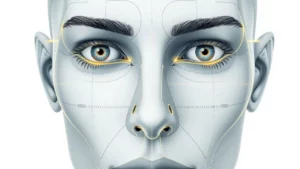
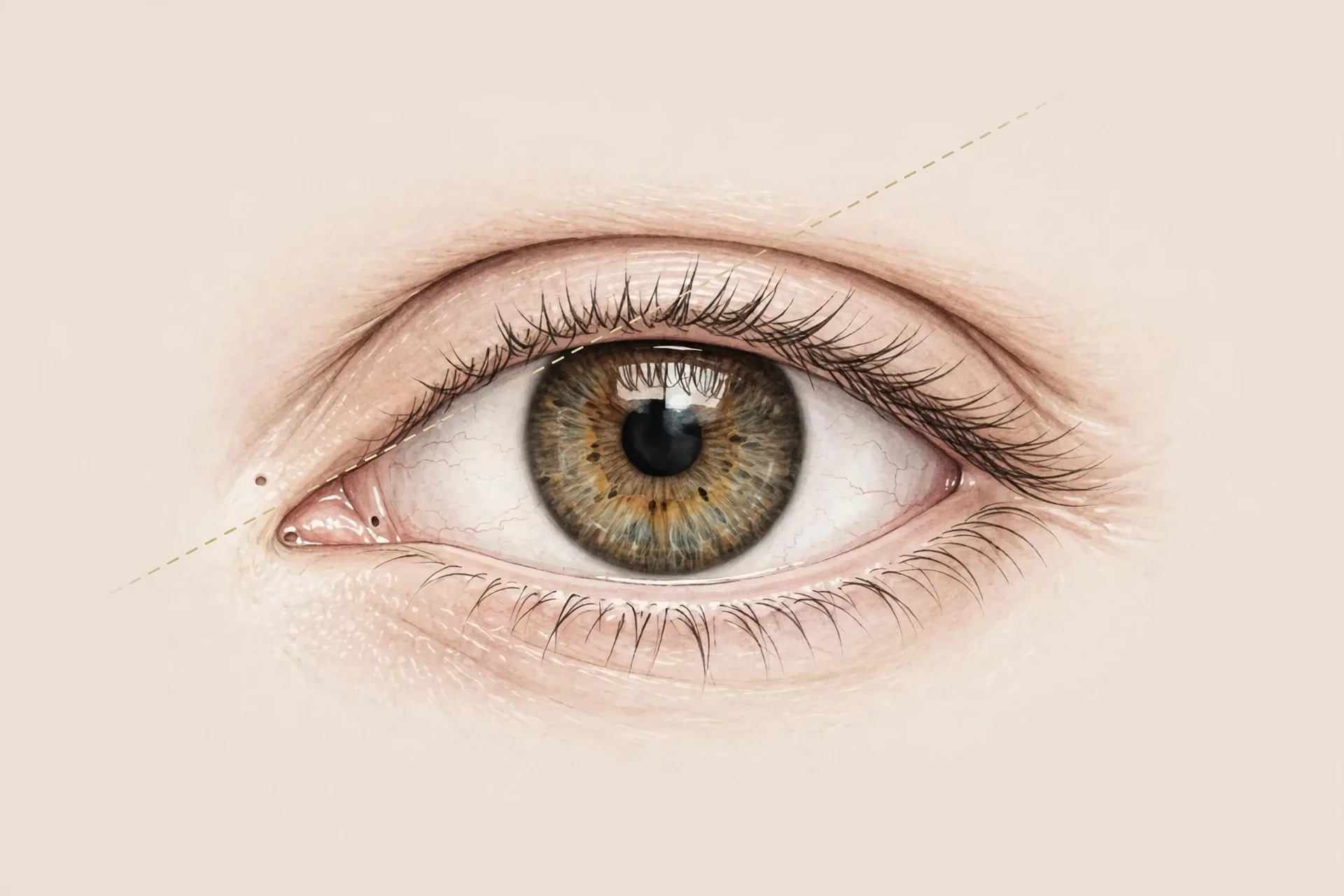
Each eye has two corners: the medial canthus (the inner corner, near your nose) and the lateral canthus (the outer corner, near your temple). Canthal tilt is the angle of the line connecting these two corners, measured against a horizontal reference line.
- If the outer corner sits higher than the inner corner, the line slopes upward — that’s positive canthal tilt.
- If the outer corner sits lower than the inner corner, the line slopes downward — that’s negative canthal tilt.
- If both corners sit roughly level, the tilt is neutral, around 0 degrees.
The result is expressed in degrees. A mild positive tilt — roughly +3° to +6° — is the range most often described as “positive” in aesthetics discussions. Readings clearly below zero count as negative.
One honest note before you start: canthal tilt is a single measurement, not a beauty verdict. It’s one data point among many, alongside facial symmetry and facial thirds. If you want the fuller picture of how this metric fits into facial analysis, our canthal tilt explainer covers the science behind it.
Positive vs Negative Canthal Tilt: What the Degrees Mean
Positive tilt (+1° to +8° or so): the outer eye corners lift slightly upward. In aesthetics communities this is generally described as giving the eyes a more “alert” or lifted look. Most people fall somewhere in the low positive range without ever knowing it.
Neutral tilt (around 0°): the inner and outer corners sit at roughly the same height. This is completely normal and common.
Negative tilt (below 0°): the outer corners droop below the inner corners. This can make the eyes look heavier or more tired in photos — though lighting, eyebrows, and eyelid shape influence that impression far more than the raw angle.
Keep in mind that published “ideal” ranges come from small studies and community discussion, not from any universal standard. A measurement of +2° versus +5° says nothing meaningful about how good anyone looks.
How to Measure Canthal Tilt: The Photo Method
Step 1: Take a proper frontal photo
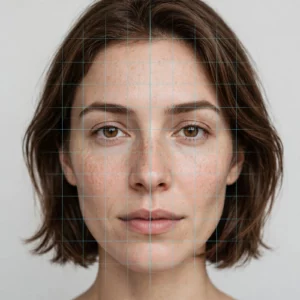
Accuracy starts with the photo. Stand facing the camera directly:
- Hold the phone at eye level, about an arm’s length away (or use a tripod/timer from 4–6 feet).
- Keep your head straight — no tilting left, right, or chin up/down. Even a 3° head roll will corrupt the measurement.
- Look directly into the lens with a neutral expression. Don’t smile, squint, or raise your eyebrows.
- Use soft, even lighting (facing a window works well). Harsh overhead light creates shadows that hide the eye corners.
Our guide on selfie camera accuracy explains why lens distance and angle distort facial measurements — worth a read if your result looks surprising.
Step 2: Mark the two landmarks
Open the photo in any image editor or markup tool on your phone. Zoom in on one eye and place a dot on:
- Medial canthus — the innermost corner of the eye, where the upper and lower lids meet near the nose.
- Lateral canthus — the outermost corner, where the lids meet near the temple.
Do this for one eye at a time. Use the same eye for your final reading, then repeat on the other eye to compare — most people have slightly different tilts on each side, which is normal.
Step 3: Draw the line and measure the angle
Draw a straight line through the two dots. Then compare it against a horizontal reference:
- Phone method: most phones have a built-in level or markup protractor; alternatively, screenshot the marked photo into a free protractor app and read the angle of your line versus horizontal.
- Desktop method: open the image in any editor with a ruler/protractor tool (even free ones), draw the canthal line, and read the angle.
- Quick visual method: draw a perfectly horizontal line through the inner corner. If the outer corner sits above it, you’re positive; below it, negative. This won’t give you degrees, but it answers the positive/negative question.
Record the angle in degrees, noting the sign: e.g. +4° (positive) or −2° (negative).
Step 4: Repeat and average
Measure both eyes separately, then average the two readings. Single measurements are noisy — your head position, the exact pixel you picked for each corner, and lens distortion all introduce error. Two or three measurements averaged together give a far more trustworthy number.
Step 5: Interpret your result
- +3° to +6°: typical “positive” range discussed in aesthetics literature.
- 0° to +3°: neutral to mildly positive — very common.
- Below 0°: negative tilt. Worth re-measuring carefully before concluding anything, because head tilt is the #1 cause of false negative readings.
Common Mistakes That Ruin the Measurement
Head tilt. This is the biggest one. If your head rolls even slightly to one side, one eye will read falsely positive and the other falsely negative. Use the phone’s level, or align your pupils to a horizontal grid line in the camera app.
Smiling or squinting. Any expression moves the eye corners. Duchenne smiles (the real, eye-crinkling kind) pull the outer corners up and can fake several degrees of positive tilt.
Camera too close. Wide-angle phone lenses at close range distort the face — the center (nose) inflates and the periphery compresses. Measure from at least arm’s length, ideally further with zoom.
Picking the wrong pixel. The canthus is where the lids actually meet, not the edge of the eyeliner or the tear duct. Zoom in and be precise.
Judging from a mirror. Mirrors flip your face and your brain auto-corrects what it sees. Always measure from a photo, not a mirror.
Canthal Tilt vs Other Eye Measurements
People often confuse canthal tilt with related terms:
- Eye spacing / intercanthal distance: how far apart the eyes are — a different measurement entirely.
- Palpebral fissure length: the horizontal length of the eye opening.
- Upper eyelid exposure: how much lid shows above the eye, which is about the brow and eyelid, not the corners.
Canthal tilt only describes the slope between the two corners. It says nothing about eye size, spacing, or shape.
A Faster Way: Let AI Measure It
Doing this by hand is a good learning exercise, but landmark detection does it in under a second. Russella’s free AI face rating tool analyzes 478 facial landmarks — including both canthi — directly in your browser, with no signup and no photo upload (everything runs on-device, so your image never leaves your phone). It reports canthal tilt alongside symmetry, thirds, and golden-ratio metrics, which saves you the protractor work and removes human marking error.
FAQ
What is a normal canthal tilt?
Most people measure somewhere between 0° and +6°. Mild positive tilt is the most commonly reported range. There’s no medically “correct” value — it’s an aesthetic observation, not a health metric.
Can canthal tilt change over time?
The underlying bone and soft-tissue structure is stable in adulthood, but your measured tilt can vary photo to photo based on head position, expression, and camera angle. If you re-measure, standardize the photo setup.
Is negative canthal tilt bad?
No. It’s simply a description of eye-corner geometry. Makeup, eyebrows, and lighting change how it reads far more than the raw angle does. Plenty of people with neutral or negative tilt have striking eyes.
How accurate is measuring canthal tilt by hand?
Within about ±2° if your photo setup is careful — good enough to tell positive from negative and get a rough magnitude. For sub-degree precision you’d need standardized clinical photography, which is overkill for personal curiosity.
Does canthal tilt differ between the left and right eye?
Usually, yes, by a degree or two. Facial asymmetry is normal — almost nobody has identical measurements on both sides.