How to Know If Your Face Is Symmetrical (5 Reliable Tests)

Wondering how symmetrical your face is? You’re not alone — it’s one of the most searched facial-analysis questions. The good news: you can get a solid answer at home with nothing more than a mirror, a phone camera, and a few minutes. Here are five reliable tests, from quickest to most precise.
But first, the single most important fact in this article: nobody has a perfectly symmetrical face. Not models, not actors, not you. Studies of 3D facial scans consistently find measurable left-right differences in everyone. Small asymmetries are the norm, not a flaw — they’re part of what makes a face look natural and human. These tests satisfy curiosity; they don’t diagnose anything.
Test 1: The Mirror Check (30 seconds)
Stand in front of a mirror in even lighting and look straight ahead with a neutral expression.
- Compare your eyebrows: is one arch higher or thicker?
- Check your eyes: does one sit slightly higher, or open a touch wider?
- Look at your nostrils and the corners of your mouth at rest.
- Notice your jawline on each side.
You’ll probably spot small differences immediately. That’s expected. This test is useful for a rough impression, but it’s the least reliable method — mirrors flip your face, and your brain has spent your whole life auto-correcting what it sees, so you’re literally not perceiving your face objectively.
Test 2: The Photo Flip Test (2 minutes)
This is the classic symmetry check, and it’s dramatically more revealing than the mirror.
- Take a straight-on photo: phone at eye level, arm’s length or further, neutral expression, even lighting.
- Open it in your phone’s photo editor and duplicate it.
- Flip one copy horizontally (mirror it).
- Put the original and flipped versions side by side and compare.
Most people are surprised — the flipped version looks like a slightly different person. That “different person” feeling is your brain noticing the asymmetries it normally filters out. Pay attention to which features shift most: usually the nose, mouth corners, and jawline.
Pro tip: crop the photo tightly to just your face before flipping. Hair and background give your brain reference points that mask the differences.
For why photos reveal what mirrors hide — and how lens distortion can exaggerate asymmetry — read our guide on selfie camera accuracy. A surprising number of “asymmetry” complaints turn out to be camera artifacts.
Test 3: The Split-Face Composite (5 minutes)
This one shows you what each half of your face would look like mirrored into a full face:
- Take your straight-on photo and find its vertical center line (through the middle of the nose).
- Copy the left half, mirror it, and join it to itself — that’s your “left-left” face.
- Do the same with the right half — your “right-right” face.
- Compare the two composites.
The two composites usually look like siblings rather than twins. Free apps can do this in one tap (search “symmetry face app”), or you can do it manually in any photo editor with copy, flip, and paste.
This test is fun but easy to over-interpret. The composites look strange partly because real faces were never meant to be mirrored — the weirdness you feel is partly an artifact of the method, not proof of dramatic asymmetry.
Test 4: The Grid / Landmark Method (10 minutes)
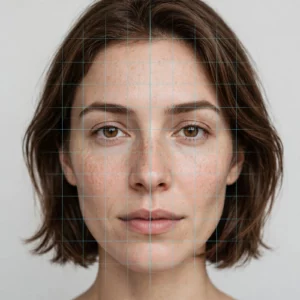
For a more measured answer, overlay a grid on your photo:
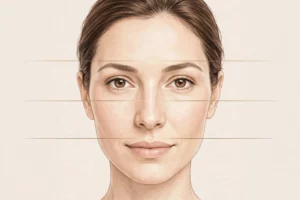
- Use your straight-on photo. Draw a vertical line down the exact center of the face (through the glabella between the brows, the nose tip, and the chin).
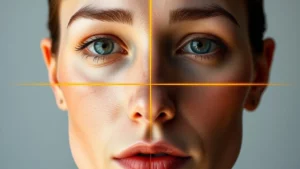
- Draw horizontal lines through key landmarks: the pupils, the base of the nose, the mouth corners.
- Compare distances: left pupil to center line vs right pupil to center line; left mouth corner to center vs right mouth corner to center.
Measure in pixels with any editor’s ruler tool. Differences of a few percent are completely typical. This method is the closest a DIY approach gets to how facial symmetry analysis software works — it just does the landmarking automatically across dozens of points instead of the handful you can mark by hand.
Test 5: AI Landmark Analysis (1 minute)
The most precise home option: let software place the landmarks. Russella’s free AI face rating tool maps 478 3D facial landmarks from a selfie and computes bilateral symmetry by comparing mirrored landmark pairs across your facial midline — the same principle as the grid method, minus the manual labor and human error. It runs entirely in your browser with no signup, and your photo never leaves your device (processing is on-device, so there’s nothing to upload or store).
AI measurement removes the two biggest error sources in DIY tests: imprecise landmark placement and inconsistent photo setup. It won’t tell you anything a mirror can’t hint at, but it quantifies it.
What Counts as “Asymmetrical”?
Here’s some perspective, because numbers without context cause unnecessary worry:
- Under ~3% side-to-side difference in landmark positions: essentially unnoticeable. The vast majority of people land here.
- 3–7%: noticeable if you look for it (photo flip test), invisible in normal life.
- Above ~7–10%: may be noticeable to others in person — and still usually just natural variation.
Also remember that dynamic asymmetry (how your face moves) matters more socially than static asymmetry. A crooked smile you make a thousand times a day registers more than a 2mm difference in cheekbone position that only a grid can find.
When Asymmetry Is Worth a Professional Opinion
Normal asymmetry is just variation. But consider talking to a doctor or dentist if you notice:
- A sudden change in symmetry (new drooping, swelling, or shifting over weeks/months)
- Asymmetry paired with pain, numbness, jaw clicking, or bite changes
- Very pronounced unevenness present since childhood that bothers you
These are medical/dental matters, not cosmetic ones — and no online test or article can evaluate them. Everything in this guide is for curiosity and self-knowledge only.
FAQ
Is it normal for one side of my face to look different?
Yes — completely. Everyone has some degree of facial asymmetry. It’s so universal that researchers treat perfect symmetry as a theoretical reference, not something real faces achieve.
Why do I look more asymmetrical in photos than in the mirror?
Three reasons: mirrors show you flipped (which you’re used to), phone lenses at close range distort the face, and photos freeze a single instant of your expression. Check your camera distance and angle before concluding anything about your actual symmetry.
Can sleeping on one side cause facial asymmetry?
There’s no strong evidence that sleep position meaningfully reshapes adult facial structure. What it can do is cause temporary morning puffiness on one side, which looks like asymmetry in early photos but fades within an hour or two.
Do filters that “fix” symmetry show my real face?
No — they show a mathematically mirrored face, which looks uncanny precisely because no real face looks like that. Don’t use filtered symmetry as a standard for your actual appearance.
How often should I re-test?
Adult facial structure changes very slowly. If you test once with a good photo setup, re-testing monthly won’t show real changes — only measurement noise. Save the curiosity for once in a while.