How to Know Your Face Shape Online Free: A Practical Guide

“What’s my face shape?” Knowing whether your face is oval, round, square, heart-shaped, or something else makes choosing hairstyles, glasses, beards, and even makeup contouring much easier. The good news: you can work out how to know your face shape online free with nothing but your phone camera or a bathroom mirror and a few simple measurements.
This guide walks you through two reliable DIY methods — photo tracing and mirror measuring — plus how to read your numbers and match them to the six common face shapes. No paid apps, no sign-ups. And if you would like an AI second opinion afterward purely for fun, we will point you to one.
What You’ll Need
Gather these before you start — the whole process takes about ten minutes:
- A phone camera (the rear camera is best; front cameras distort proportions)
- Good, even lighting on your face — a window in daytime works perfectly
- A mirror, a flexible tape measure or ruler, and something to write with
- Your hair pulled fully back off your face and a neutral, unsmiling expression
One tip that improves everything: shoot from at least an arm’s length away — or better, prop the phone up and use the timer from four to six feet back. Close-up selfies exaggerate the center of your face and skew your measurements.
Method 1: The Photo Tracing Method
This is the quickest visual method, and it works well if you find numbers fiddly.
Step 1 — Take a straight-on photo. (Our guide to finding your face shape from a photo walks through this in detail.) Face the camera directly, chin level, neutral expression, hair pulled back. Use the rear camera and a timer from four to six feet away in even light. No smiling — a smile widens the cheeks and changes your outline.
Step 2 — Trace your outline. Open the photo in any free markup or drawing tool and trace the outline of your face, from the hairline down around the jaw to the chin. Some people do this on a printed photo with a marker; the principle is identical.
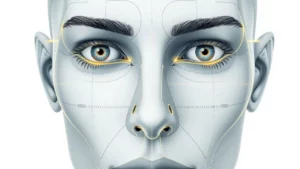
Step 3 — Study the tracing, not the photo. Ignore your features; look only at the outline. Where is the face widest — forehead, cheekbones, or jaw? Is the jawline rounded or angular? Longer than wide, or roughly as wide as long? Your answers point to one of the six shapes below.
Step 4 — Sanity-check with a second photo. Repeat with one more shot on a different day or in different light. If both tracings agree, you can trust the result.
Method 2: The Mirror Measurement Method
Prefer numbers to tracings? This classic method is very reliable. Stand before a mirror and take four measurements with the tape flat against your skin — see our tape-measure face-shape method:
- Forehead width: measure across the widest part of your forehead, usually midway between eyebrows and hairline, temple to temple.
- Cheekbone width: measure across the fullest part of your cheeks, from the outer edge of one cheekbone to the other.
- Jawline width: measure straight across the widest part of your jaw, from just below one ear to just below the other.
- Face length: measure from the center of your hairline straight down to the tip of your chin.
Write all four down in the same units. Don’t pull the tape tight enough to indent skin, and keep your face relaxed — clenching inflates the jawline number.
Reading Your Numbers: The Ratios That Matter
Absolute numbers do not matter — a large oval face and a small oval face share the same proportions. What matters is how the four measurements compare — the same principle behind anthropometry, the science of human body measurement:
- Face length vs. width: if face length clearly exceeds your widest width, think oval, rectangle, or possibly heart. If length and width are roughly equal, think round, square, or diamond.
- Forehead vs. jawline: a forehead noticeably wider than a narrower jaw suggests heart; forehead, cheekbones, and jaw all similar suggests square or round — jawline shape (angular vs. soft) decides.
- Cheekbones as the widest point: cheekbones clearly widest? Diamond is the likely answer.
- Jaw shape: run a finger along your jawline. A softly curving jaw with no sharp corners leans round or oval; distinct corner angles lean square or rectangle.
For an extra vertical-balance check, our guide to the facial thirds explains the forehead, midface, and lower-third divisions — handy once you know your overall shape.
The Six Common Face Shapes
Oval: Length clearly exceeds width; forehead slightly wider than jaw; chin softly rounded. Often called the most balanced shape — most hairstyles and glasses suit it.
Round: Length and width close to equal, full cheeks, soft curved jawline with no sharp angles. Volume on top and longer styles tend to flatter it.
Square: Forehead, cheekbones, and jawline measure similarly, with a strong angular jaw. Softer layered styles and rounded glasses balance the angles.
Rectangle (oblong): Like square but noticeably longer — similar widths throughout, angular jaw. Styles adding width at the sides usually work well.
Heart: Wider forehead tapering to a narrower, sometimes pointed chin; cheekbones often prominent. Side-swept styles and chin-length cuts are classic pairings.
Diamond: The rarest of the six — narrow forehead and jawline, cheekbones clearly widest, tapering to a defined chin. Styles adding width at forehead and jawline flatter it.
Remember: most real faces are blends. If you sit between two shapes, go with the one that matches most of your measurements — and treat every “best hairstyle for X face” list as a guideline, not a rule.
Common Mistakes That Give You the Wrong Shape
- Smiling in the photo. A smile widens cheeks and narrows eyes — always use a neutral expression.
- Hair covering the sides of your face. Even slight coverage hides your true outline and width.
- Tilting your head. Chin up shortens the face; chin down lengthens it. Keep it level.
- Using a close-up selfie. Wide-angle distortion at arm’s length exaggerates the midface. Step back or use the timer.
- Measuring over clenched jaws or tensed cheeks. Relax your whole face first, or your numbers will lie.
Frequently Asked Questions
What is the most accurate free way to determine my face shape?
Combine both methods: trace a photo and take the four mirror measurements. When tracing and numbers agree, you have a solid answer. For an automated second opinion purely for fun, see our face shape detection guide and AI face rating tool — treat any AI score as entertainment, not a verdict.
Can my face shape change over time?
Bone structure is stable in adulthood, but the visible shape can shift: weight changes fullness, aging affects skin and fat distribution, and facial hair can dramatically alter the perceived jawline. Re-measure if your appearance changes notably.
What if I seem to be between two shapes?
That is completely normal — most faces do not fit textbook categories perfectly. Pick the shape matching the majority of your traits, and remember that styling advice for either neighboring shape will usually still work for you.
Do I need exact measurements, or are estimates okay?
Ratios matter more than absolute numbers. Whether your face length is 19 or 20 cm is irrelevant — what matters is that it clearly exceeds your 14 cm width. Consistent technique beats precision.
The Bottom Line
Knowing your face shape needs no expensive tools or expert eyes — just a camera, a mirror, a tape measure, and ten honest minutes. Once you know it, hair, glasses, and grooming decisions get much simpler.
Want a quick AI cross-check? Try our free AI face analysis tool and compare its read with your own measurements. Built for fun and curiosity — your mirror measurements are the real answer.