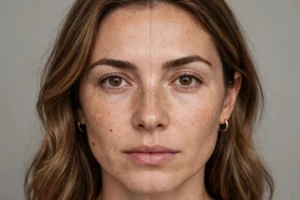
FWHR Calculator: How to Measure Your Facial Width-to-Height Ratio Step by Step
The facial width-to-height ratio — FWHR for short — is one of the most talked-about proportions in facial aesthetics. It is a single number: the width of your face divided by the height of its upper portion. Researchers have measured it in published studies, and looksmaxxing communities debate it endlessly, which is why so many people want to know their own number.
If you have already read our overview of the midface ratio and FWHR, you understand what the ratio describes. This guide is the hands-on companion: a step-by-step manual for measuring and calculating FWHR yourself, from an ordinary photo, with nothing more than a ruler or a free image editor.
One honest note before we begin. An FWHR value is a measurement, not a verdict on your face. Faces vary enormously, ordinary asymmetry is completely normal, and no single ratio decides attractiveness. Treat this as a fun measuring exercise — face scores are entertainment, not medical fact.
What Exactly Is the Facial Width-to-Height Ratio?
FWHR compares two distances on the face:
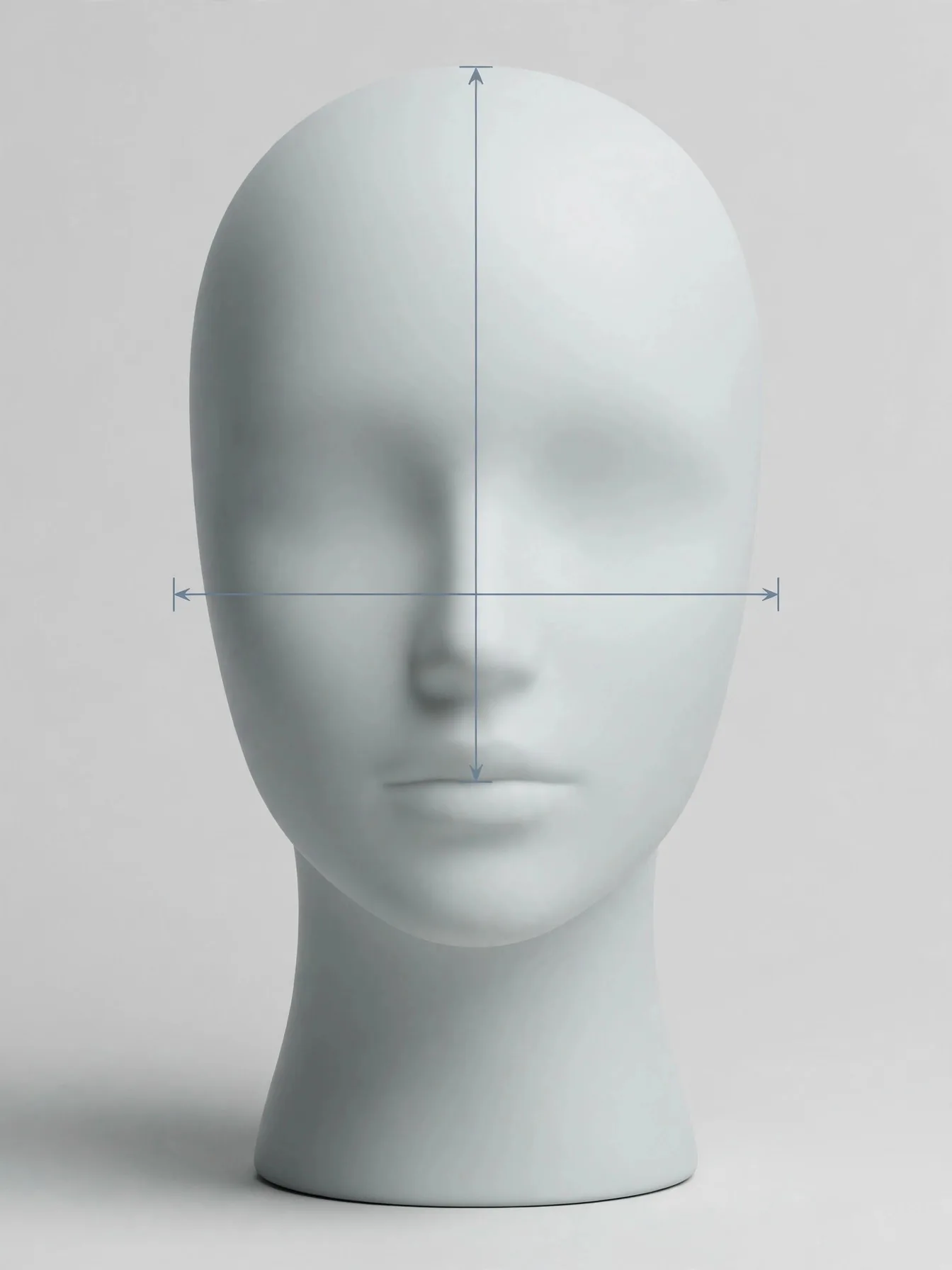
- Bizygomatic width — the horizontal distance between the widest points of your cheekbones (the zygomatic arches on each side).
- Upper facial height — the vertical distance from the brow line (roughly between the eyebrows) down to the top of the upper lip, where the lip meets the skin below the nose.
The formula is about as simple as math gets:
FWHR = facial width ÷ upper facial height
Because it is a ratio, the units do not matter. Centimeters, inches, or pixels all produce the same number, which is exactly why the manual method works: measure a printed photo with a ruler or count pixels in any image editor and you will arrive at the same result.
What You Need Before You Start
- A front-facing photo of your face, taken at eye level with the camera about 1.5 to 2 metres away. Distance matters: a close-up selfie distorts proportions, and you can read more about why in our guide to selfie camera accuracy.
- A neutral expression — mouth closed and relaxed, not smiling, because smiling moves the upper-lip landmark.
- Hair pulled back so the cheekbones and brow are visible.
- Even, frontal lighting and a plain background.
- A ruler and pen if you print the photo, or any image editor or phone markup tool to draw and measure lines on screen.
Step-by-Step: How to Calculate Your FWHR
Step 1 — Take the right photo
Stand facing the camera directly, head level, looking straight ahead. Keep the camera at eye height — not above or below — and step back far enough that your whole head fits comfortably in the frame with space around it. Take the photo in soft, even light and avoid tilting your head even slightly; a few degrees of tilt is enough to skew the horizontal measurement.
Step 2 — Mark the landmark points
On the photo, locate the two measurement lines. First, the width: find the widest point of each cheekbone and imagine a straight horizontal line connecting them. Second, the height: find the brow line between the eyebrows and the top of the upper lip (the highest point of the lip’s edge). Draw both lines lightly — the width line horizontal, the height line vertical — so they form a cross over the face.
Step 3 — Measure both distances in the same units
Measure the width line and the height line using the same units. On a printout, a millimetre ruler works well; on screen, note the pixel distances in your image editor. Precision matters less than consistency — being off by a millimetre shifts the result only slightly.
Step 4 — Divide width by height
Plug the two numbers into the formula. If your cheekbone width is 14.2 cm and your brow-to-lip height is 7.1 cm, then FWHR = 14.2 ÷ 7.1 = 2.00. Round your answer to two decimal places; anything more precise is false precision on a hand measurement.
Step 5 — A full worked example
Let us walk through a complete example. Suppose your printed photo measures 11.8 cm across the cheekbones and 6.4 cm from the brow line to the top of the upper lip. Step one: write down both numbers. Step two: divide — 11.8 ÷ 6.4 = 1.84375. Step three: round to 1.84. That is your FWHR — a perfectly ordinary result, since most hand-measured values land somewhere between about 1.6 and 2.2.
Common FWHR Measurement Mistakes
- Smiling or talking. Any mouth movement shifts the upper-lip landmark and shortens the height measurement.
- Tilting the head. Even a small tilt makes the “horizontal” width line diagonal, inflating it.
- Using a close-up selfie. Wide-angle phone lenses stretch the centre of the face; step back and zoom instead.
- Measuring the jaw instead of the cheekbones. The width landmark is the zygomatic arch — the widest point of the face — not the jawline.
- Measuring to the chin. FWHR uses the top of the upper lip, not the chin. Chin-to-brow is a different measurement entirely.
- Forgetting asymmetry. Most faces are slightly wider on one side; pick the widest points honestly and remember that ordinary asymmetry is normal.
What the Numbers Mean in Aesthetics Research
Published research generally reports average adult FWHR values in the region of about 1.8 to 2.2 for men, with women typically measuring somewhat lower. Some studies have discussed links between higher FWHR and how traits like assertiveness are perceived — but these are population-level tendencies with plenty of exceptions, not rules about any individual.
Crucially, no research has ever established an “ideal” FWHR, and a ratio alone says nothing about harmony, expression, or any of the dozen other proportions that shape a face — such as facial symmetry or classic proportional ideals. Treat published ranges as interesting context, not targets.
The Limits of the Manual Method
A ruler on a photo is an approximation. A few degrees of head rotation, slightly different landmark choices, or lens distortion can all move the number by a tenth or more — which is fine for curiosity, but it means you should not compare your hand-measured result too seriously against someone else’s.
If you want a consistent, landmark-precise reading without the manual work, let software do it. Try the free AI face-analysis tool on the Russella homepage: upload the same photo and get your FWHR plus symmetry, facial thirds, and other proportions in seconds — no signup and no manual math required.
Frequently Asked Questions
What is a good FWHR?
There is no officially “good” value. Published averages cluster around 1.8–2.2 for men and slightly lower for women, but attractiveness research treats FWHR as one small data point among many. A number near the average is simply typical — nothing more, nothing less.
Is FWHR the same as the midface ratio?
No. FWHR divides face width by upper facial height (brow to upper lip), while the midface ratio typically relates the height of the midface to the distance between the eyes. They describe different proportions, which is why our FWHR and midface ratio overview covers both.
Can I measure FWHR from a selfie?
You can, but results are less reliable. Phone cameras distort proportions at arm’s length, so a photo taken from farther away with the rear camera is better. Our guide to selfie camera accuracy explains the distortion problem in detail.
Is a manual FWHR measurement accurate?
Roughly. A careful manual measurement is usually within about a tenth of the true value — good enough for curiosity. If you need consistency, automated landmark detection (like the free tool on the Russella homepage) measures the same points the same way every time.