Golden Ratio Face: 1.618 Calculations, Science, Myths

An evidence-based deep dive into the divine proportion (Phi), facial width-to-height ratios, plastic surgery benchmarks, and modern AI landmark analysis.
For centuries, artists, mathematicians, and aesthetic surgeons have chased a singular mathematical formula purported to define universal human beauty: The Golden Ratio (1.618…). From Leonardo da Vinci’s classical Renaissance sketches to contemporary viral TikTok beauty calculators, the concept of a “Golden Ratio Face” continues to captivate our collective imagination.
Does a face that aligns with the divine proportion truly look more attractive? How do facial plastic surgeons, orthodontists, and computerized facial analysis engines evaluate these proportions in reality? And can you calculate your own facial ratio accurately at home using a camera?
In this guide, we dissect the mathematical foundations of the Golden Ratio face, dispel widespread internet myths, explain how facial width and height dictate harmony, and show you step-by-step how clinical proportions are derived.
- Phi (Φ = 1.618) Is a Proportion, Not a Beauty Guarantee: The Golden Ratio represents organic visual harmony. While many attractive faces share proportions close to Phi, beauty is multidimensional and transcends single mathematical numbers.
- Ratio vs Symmetry: The Golden Ratio evaluates vertical and horizontal proportional spacing (e.g., forehead to nose to chin). Facial symmetry evaluates left-versus-right bilateral balance.
- fWHR Matters Immensely: The facial width-to-height ratio (bizygomatic cheekbone width compared to upper facial height) is often a stronger biological predictor of perceived attractiveness and facial compactness than strict Phi alignment.
- Photos Require Caution: Standard smartphone selfies introduce optical barrel distortion that falsifies nasal width and midface height by up to 30%, invalidating casual phone tests.
- Diversity Is Evolutionary: No single ethnic group or gender conforms to one rigid mathematical template; natural anatomical variation is a hallmark of human health.
Mathematical Foundations
What Is the Golden Ratio Face?
The Golden Ratio—often symbolized by the Greek letter Phi (Φ)—is an irrational mathematical constant approximately equal to 1.6180339887…. It emerges naturally from the Fibonacci sequence, where each successive number is the sum of the two preceding ones (1, 1, 2, 3, 5, 8, 13, 21…). When you divide any Fibonacci number by its immediate predecessor, the resulting quotient converges toward 1.618.
A Golden Ratio Face is defined as a human face whose anatomical dimensions—such as the ratio of total facial length to bizygomatic cheekbone width, or the distance between the eyes relative to nasal width—closely mirror this 1:1.618 proportion.
Throughout architectural history, biology, and art, forms that adhere to the Golden Ratio are instinctively perceived by the human visual cortex as balanced, organic, and easy to process. When applied to facial anatomy, the ratio suggests that key facial segments scale proportionally to one another in harmonious geometric steps.
Anatomical Benchmarks
What Is a 1.618 Face Ratio?
When aesthetic practitioners talk about a “1.618 face ratio,” they are specifically referencing geometric comparisons between vertical heights and horizontal widths across three key anatomical axes:
The vertical distance from the anterior hairline (Trichion) to the base of the chin (Menton) divided by the maximum width across the cheekbones (Bizygomatic diameter) equals approximately 1.618.
The horizontal width of the relaxed mouth from corner to corner (Cheilion to Cheilion) divided by the width of the nasal base (Alar base) approaches 1.618.
The distance from the center of the pupils down to the mouth line, divided by the distance from the mouth line to the bottom of the chin, ideally reflects the golden division.
In essence, a 1.618 face ratio means that the larger segment is approximately 61.8% larger than the adjacent smaller segment. This creates a nested hierarchy of visual scales across the upper, middle, and lower facial thirds.
Clinical Application
How Is the Golden Ratio Used in Facial Analysis?
In aesthetic medicine, orthodontics, and maxillofacial surgery, the Golden Ratio is not used as a rigid beauty law, but rather as an evaluative diagnostic guide. Surgeons and clinicians utilize computerized anthropometric mapping to assess structural relationships before performing reconstructive or cosmetic interventions.
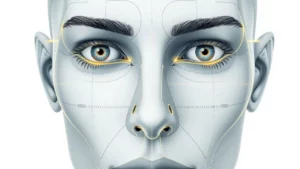
Historically, American plastic surgeon Dr. Stephen Marquardt developed the “Marquardt Beauty Mask”—a patented geometric grid built entirely from pentagons and golden decagons designed to represent ideal proportions. While Marquardt’s mask popularized the mathematical concept globally, modern clinical practice has evolved toward more flexible, biologically nuanced frameworks:
- Orthognathic Surgical Planning: Maxillofacial surgeons measure lower-face vertical ratios before moving the jaw forward or upward to ensure bite correction aligns with balanced aesthetic thirds.
- Rhinoplasty Angle Assessment: Nasofacial angles and the projection of the nasal tip relative to upper lip length are calculated to avoid overly projected or scooped “surgical” noses.
- Facial Volumization (Dermal Fillers): Aesthetic injectors evaluate the lateral projection of the zygomatic arch compared to the temporal hollow and jawline angle to restore age-depleted volume harmoniously.
Software & Computer Vision
Golden Ratio Face Calculator Explained
How do modern computerized “Golden Ratio Face Calculators” actually work? Rather than drawing manual lines with calipers, contemporary software relies on automated facial landmark detection models.
When an image is fed into a high-density landmark engine (such as Google MediaPipe or clinical photogrammetry suites), the algorithm identifies up to 478 three-dimensional coordinate points across your facial geometry. The calculator then executes a sequence of automated trigonometric calculations:
The engine pinpoints coordinates for the hairline, pupils, endocanthion (inner eye corners), alar base, philtrum, and chin point, rotating the image to correct head tilt.
Euclidean distances between specific landmark pairs are calculated across both horizontal and vertical vectors.
Each calculated ratio (e.g., face length ÷ face width) is divided by 1.618 to calculate variance percentage.
The tool aggregates all segment deviations into a weighted composite score (typically 0 to 100%) indicating proportional alignment.
Step-by-Step DIY Guide
How to Calculate Your Face Golden Ratio
You can calculate your primary facial Golden Ratios at home using a millimeter ruler, a high-resolution unreversed portrait photograph, and a simple calculator. Follow this 5-step measurement protocol:
Measure Total Face Length (Vertical)
Measure in millimeters from the center of your anterior hairline down to the lowest point of your chin (Trichion to Menton). Record this as Measurement A.
Measure Bizygomatic Face Width (Horizontal)
Measure across the widest points of your cheekbones, just below your outer eye corners. Record this as Measurement B.
Calculate Overall Face Ratio
Divide Measurement A by Measurement B (A ÷ B). If your result falls between 1.55 and 1.68, your overall facial canvas closely aligns with the Golden Ratio (1.618).
Measure Eye Spacing vs Nasal Width
Measure the distance between the outer corners of your eyes (Bi-ocular width) and divide it by the distance between your inner eye corners (Interpupillary distance). Compare the ratio to 1.618.
Measure Mouth Width vs Nasal Base
Measure your relaxed smile width from corner to corner, then divide it by the width of the nostrils at their widest flare. A ratio near 1.618 indicates classical proportional balance.
Scientific Scrutiny
Is the Golden Ratio Actually Used to Measure Beauty?
While social media often portrays the Golden Ratio as an absolute truth of attractiveness, academic and psychological research presents a much more critical perspective. Does science validate Phi as the definitive yardstick of human beauty?
Extensive psychological studies published in journals such as Perception and Plos ONE have tested human aesthetic preferences against mathematically generated Golden Ratio faces. The consensus findings reveal:
Evolutionary psychology demonstrates that humans are biologically drawn to koinophilia—the preference for faces that represent the population average. Averageness signals genetic heterozygosity and health far more reliably than a single mathematical constant.
The 1.618 template heavily prioritizes classical Caucasian craniofacial proportions. Applying it rigidly across East Asian, African, or Indigenous populations leads to inaccurate and biased assessments of natural beauty.
In short: while faces that naturally exhibit harmonious thirds and fifths often come close to 1.618, real-world attractiveness depends on dynamic vitality, eye clarity, skin texture, emotional warmth, and sexual dimorphism.
Comparative Analysis
Golden Ratio Face vs Facial Symmetry
Although commonly confused in everyday conversation, Golden Ratio Face and Facial Symmetry measure entirely different geometric dimensions of the human face:
| Diagnostic Metric | Golden Ratio Face (Φ) | Facial Symmetry (Bilateral) |
|---|---|---|
| Direction of Measurement | Vertical and horizontal proportional scaling. | Left-versus-right bilateral mirror reflection. |
| Core Geometric Focus | Relationship between different anatomical segments (e.g., nose height vs chin length). | Whether paired features (pupils, brows, ears, jaw angles) sit on identical horizontal planes. |
| Ideal Target Value | Ratio of 1 : 1.618 across adjacent features. | 0mm variance across the sagittal midline axis. |
| Occurrence in Nature | Many faces fall naturally between 1.50 and 1.70. | 100% perfection does not exist; mild natural asymmetry is universal. |
| Visual Role | Determines facial compactness, elongation, and balance. | Determines lateral balance and approachable, relaxed expressions. |
A person can possess flawless left-to-right bilateral symmetry while having a disproportionately elongated forehead that violates the Golden Ratio. Conversely, someone can exhibit ideal Golden Ratio vertical proportions while having a slightly crooked nasal dorsum or an elevated left eyebrow.
Classical Aesthetic Frameworks
Golden Ratio Face vs Facial Proportions
Before the Golden Ratio was popularized in modern cosmetic marketing, classical plastic surgery and fine art relied on the Rule of Thirds and Fifths. Understanding how these frameworks differ is crucial:
Divides the face into three equal 1:1:1 vertical segments: from hairline to glabella (upper third), glabella to subnasale (middle third), and subnasale to chin base (lower third). Clinicians consider this significantly more reliable than Phi.
Divides facial width into five equal columns, each exactly the width of one eye. The intercanthal distance between inner eye corners should equal the nasal base width.
While the Golden Ratio seeks an asymmetrical 1:1.618 hierarchy between adjacent parts, facial thirds and fifths seek balanced 1:1:1 equality. Modern aesthetic surgery combines both methodologies to achieve natural results.
Craniofacial Types
How Face Width and Height Affect Golden Ratio
Your skull morphology strongly influences how closely your face aligns with the 1.618 benchmark. Anthropologists categorize human skull architecture into three primary craniofacial phenotypes:
Characterized by wide cheekbones, a broad square jawline, and compact facial height. Overall ratio typically ranges from 1.30 to 1.48 (below Phi).
Harmonious balance between vertical length and horizontal cheekbone width. Overall ratio naturally hovers around 1.58 to 1.65 (closest to Phi).
Elongated facial structure with a narrower jaw and extended lower or middle third. Overall ratio often measures 1.72 to 1.90+ (above Phi).
Neither phenotype is objectively superior. Many of the most striking runway models possess sharp dolichocephalic bone structures, while high-impact cinematic actors frequently carry masculine brachycephalic jawlines.
Biometrics & Attractiveness
What Is the Ideal Face Width-to-Height Ratio?
In contemporary evolutionary psychology and facial modeling, the Facial Width-to-Height Ratio (fWHR) has largely superseded the classic Golden Ratio in empirical research. Unlike total face length, fWHR specifically measures:
fWHR = Bizygomatic Cheekbone Width ÷ Upper Facial Height (Distance from Eyebrows to Upper Lip)
| Category | Typical fWHR Range | Aesthetic & Evolutionary Perception |
|---|---|---|
| Masculine Optimal | 1.90 – 2.10 | Correlated with testosterone exposure during puberty, robust bone density, strength, and assertive attractiveness. |
| Feminine Optimal | 1.80 – 1.95 | Reflects youthful midface compactness, delicate chin tapering, and balanced cheekbone dominance. |
| Elongated Midface | < 1.70 | Often perceived as visually tired or aged, as an extended distance between eyes and lips drags facial weight downward. |
A compact midface with prominent lateral cheekbone projection creates the impression of vitality and youth across nearly all cultures.
Cultural & Aesthetic Case Studies
Golden Ratio Face Examples Explained
Over the years, several high-profile clinical studies have measured celebrity facial structures against the Golden Ratio. In widely cited research by London facial cosmetic surgeon Dr. Julian De Silva using computer mapping software, specific celebrities scored exceptionally close to 1.618:
Scored highest overall in automated landmark mapping, driven by near-perfect chin position, eye spacing, and nose-to-lip proportions.
Ranked at the top of male celebrity mapping due to exceptional jawline definition, eye position, and harmonious forehead-to-chin vertical balance.
Exhibited exceptional proportional harmony across forehead height, brow arch, and horizontal eye-width spacing relative to facial thirds.
These high scores do not imply that these individuals are universally agreed upon as the most attractive humans alive. Rather, they demonstrate how symmetrical bone development and balanced vertical thirds align closely with classical geometric expectations.
Demographic Realities
Does Everyone Have a Golden Ratio Face?
The simple answer is no, the vast majority of people do not possess a face that precisely matches the Golden Ratio across all landmarks.
Human genetics prioritize biological diversity and survival adaptations over single mathematical constants. Climate, ancestral dietary patterns, and natural selection have sculpted a wide range of healthy skull shapes. Expecting every person’s face to match 1.618 is like expecting every tree in a forest to grow branches at identical angles.
Furthermore, minor deviations from Phi are precisely what grant individuals their unique charm. Many iconic faces possess features that “break the rules”—such as slightly fuller lips, a narrower nose, or higher cheekbones—which actually elevate their aesthetic appeal above generic mathematical averages.
Sexual Dimorphism
Golden Ratio in Male vs Female Facial Proportions
The Golden Ratio is an ungendered mathematical number, but human facial anatomy is intensely sexually dimorphic. Men and women exhibit distinct proportional differences sculpted by sex hormones during adolescent development:
Wider gonial jaw angles (115°–120°), heavier supraorbital brow ridges, squarer chin width equal to the intercanthal eye distance, and a shorter, more compact midface.
Softer arched eyebrows resting above the orbital rim, fuller vermilion lip display (with a 1:1.6 upper-to-lower lip ratio), narrower chin base, and larger orbital aperture exposure.
A male face that adheres strictly to a delicate Golden Ratio template can appear insufficiently masculine, while a female face with overly broad jaw proportions can appear overly angular. Proportional harmony must always respect biological sexual dimorphism.
Technical Limitations
How Accurate Are Golden Ratio Face Calculators?
With dozens of mobile apps and web tools claiming to give you a “Golden Ratio Beauty Score,” how accurate are these calculations?
The accuracy depends entirely on whether the analysis is conducted in a controlled clinical setting or via a casual smartphone selfie. Most consumer apps suffer from severe technical shortcomings:
- Flat 2D Projection of a 3D Structure: Faces are complex, curved volumetric surfaces. A 2D photograph flattens bone depth, creating artificial proportional distortions.
- Sensitivity to Pixel Coordinates: Moving a facial landmark pin by just 2 pixels on a mobile screen can alter the calculated ratio by 5% to 8%, transforming an “ideal” score into an “imbalanced” one.
- No Accounting for Lighting Shadows: Contrast differences caused by room lighting alter where the edge of the cheekbone or jaw appears in automated pixel edge-detection algorithms.
Optics & Camera Reality
Can a Photo Calculate Facial Proportions?
A photograph can only calculate facial proportions accurately if strict optical portraiture protocols are followed.
If you take a standard smartphone selfie from arm’s length (30 to 45 cm), the camera’s wide-angle lens (24mm equivalent) produces severe barrel distortion. The center of the frame expands, making the nose look 30% wider and shrinking the apparent width of the cheekbones. In such a photo, any Golden Ratio calculation is completely meaningless.
To capture an optically valid photo for proportional measurement:
Stand at least 5 to 7 feet away from the camera using a telephoto lens (70mm to 85mm focal length equivalent) to flatten optical perspective and eliminate distortion.
Align your head so the line from the lower orbital rim to the top of the ear canal (the Frankfort plane) is perfectly horizontal to the floor.
Common Questions
Frequently Asked Questions
What does a Golden Ratio score of 80% or 90% mean?
In digital face analyzers, a percentage score represents the mathematical proximity of your facial landmarks to the 1.618 baseline. A score of 85% simply means your measured vertical and horizontal ratios deviate by an average of 15% from the theoretical model. It is a geometric index, not an absolute verdict on personal attractiveness.
Can you change your face Golden Ratio without surgery?
Yes, non-surgical adjustments can subtly harmonize proportions. Orthodontic alignment and palate expansion balance the lower third, while strategic hairstyle framing, beard grooming for men, and eyebrow shaping can visually balance forehead and midface ratios.
What is the most important facial ratio for attractiveness?
Contemporary empirical research indicates that the midface ratio (fWHR) and balanced vertical facial thirds correlate more strongly with perceived attractiveness than any single Golden Ratio calculation.
Did Leonardo da Vinci discover the Golden Ratio face?
Leonardo da Vinci did not discover the mathematical constant (which dates back to ancient Greece and Euclid), but he famously illustrated Luca Pacioli’s 1509 treatise De Divina Proportione. Da Vinci applied geometric proportions extensively in masterpieces like the Vitruvian Man and the Mona Lisa.
Does chewing on both sides improve my Golden Ratio?
Chewing equally on both sides primarily improves bilateral symmetry by preventing unilateral masseter muscle hypertrophy. It can also prevent crossbites and lateral jaw deviation, which directly protects lower-face proportional balance.
The Golden Ratio is an inspiring mathematical framework that provides valuable insights into visual balance and classical art. However, human beauty is never confined to a rigid 1.618 spreadsheet.
True attractiveness thrives in dynamic expression, eye vitality, healthy skin, and confidence. Appreciate the mathematics of your facial architecture, but celebrate the unique individuality that makes your face undeniably your own.