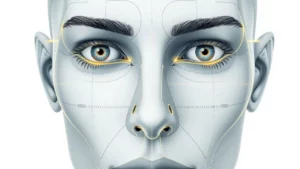
Facial Thirds Rule Explained: How to Measure Your Face Proportions
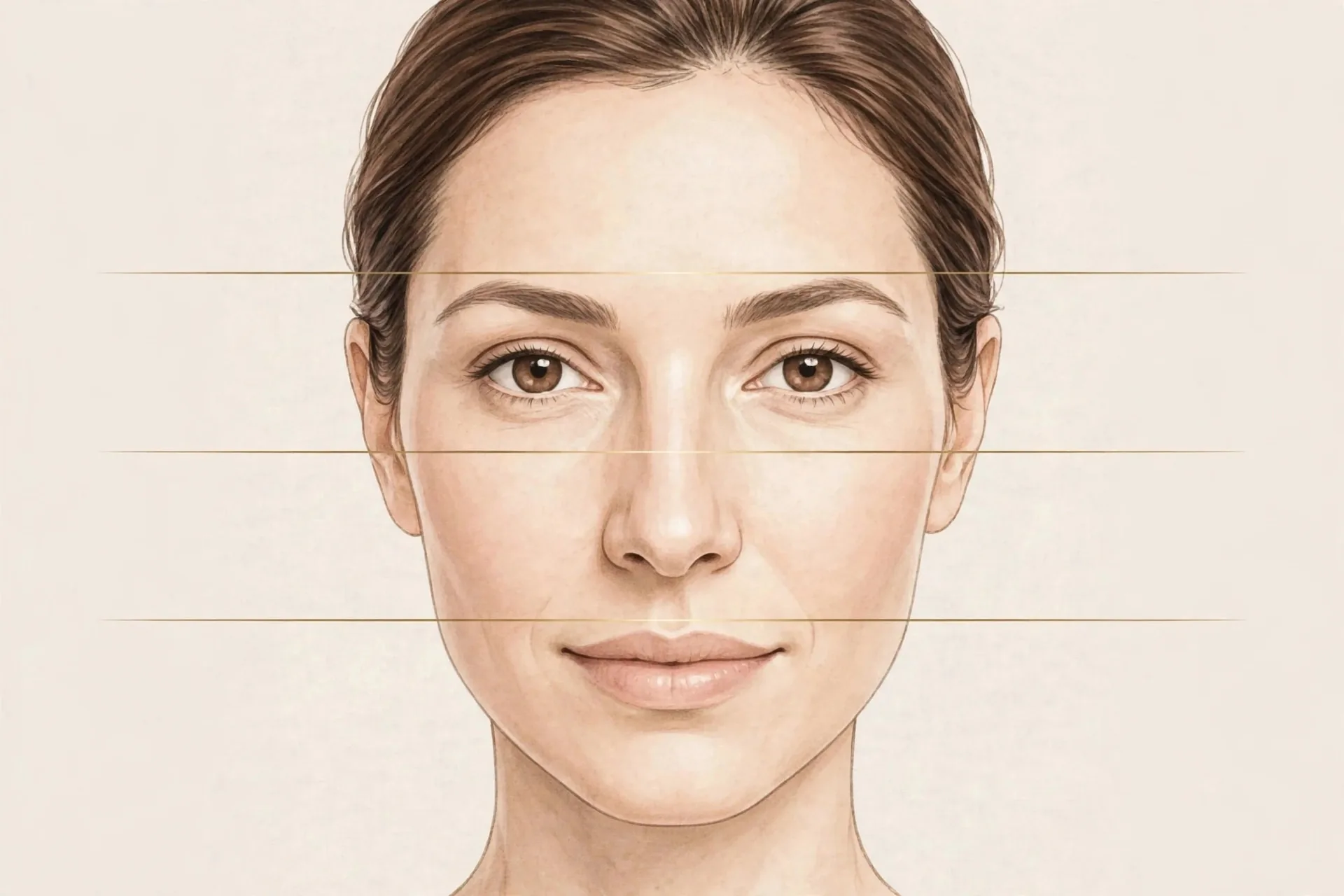
The facial thirds rule is one of the oldest ideas in facial aesthetics: divide the face into three equal horizontal sections, and balanced proportions mean the three sections measure roughly the same. Artists have used it for centuries; today, facial-analysis tools compute it automatically. Here’s what the rule actually says, how to measure your own thirds from a photo, and what your numbers mean.
What Are the Facial Thirds?
Draw two horizontal lines across the face to create three zones:
- Upper third — from the hairline (trichion) to the brow line (glabella, the point between the eyebrows).
- Middle third — from the glabella to the base of the nose (subnasale, where the nose meets the upper lip).
- Lower third — from the subnasale to the bottom of the chin (menton).
The classical rule states that in a well-proportioned face, these three distances are approximately equal — a 1:1:1 ratio. A longer middle third, for example, is often described as giving the face a “long” impression, while a short lower third can make the chin look recessed.
This is the same framework our facial thirds analysis uses — it measures the three zones from detected landmarks rather than by hand.
A Quick History of the Rule
The thirds concept comes from neoclassical artistic canons — Renaissance artists and later 19th-century anthropometrists formalized ideal proportions for drawing and sculpture. It was never a medical standard; it was an artist’s guideline for depicting harmonious faces.
Modern research treats it more carefully: population studies show real faces vary widely around the 1:1:1 ideal, and the “ideal” differs across ethnicities, ages, and sexes. The rule is best understood as a descriptive framework (a way to talk about proportions) rather than a prescriptive one (a target to hit).
How to Measure Your Facial Thirds From a Photo
Step 1: Take a standardized photo
- Phone at eye level, arm’s length minimum (further is better).
- Head straight, neutral expression, hair pulled back so the hairline is visible — this is essential, since the upper third starts at the trichion.
- Even, frontal lighting.
Step 2: Mark the four landmarks
Open the photo in any editor and mark:
- Trichion — the midline point of your hairline. (If your hairline is uneven, use the midline point.)
- Glabella — the smooth area between the eyebrows.
- Subnasale — the point directly under the nose where it meets the philtrum.
- Menton — the lowest point of the chin.
Zoom in and place each mark carefully — a few pixels of error at this stage skews everything downstream.
Step 3: Measure the three distances
Measure vertically (in pixels — the units don’t matter, only the ratios):
- Upper third = trichion → glabella
- Middle third = glabella → subnasale
- Lower third = subnasale → menton
Step 4: Compute the ratios
Divide each by the total face height (trichion → menton) and multiply by 100. In a textbook 1:1:1 face, each third is 33.3%. Real faces typically land within a few percentage points of that on each zone.
Example: if your measurements are 62px / 58px / 64px, your thirds are 33.7% / 31.5% / 34.8% — close to equal, with a slightly short middle third.
Step 5: Interpret (gently)
- All three within ~2–3% of 33.3%: textbook-balanced thirds.
- One third notably longer: that zone dominates the facial impression (e.g., a long middle third reads as a “long” midface).
- One third notably shorter: the adjacent zones appear more prominent by contrast.
Remember: these are observations about geometry, not grades. Deviations from 1:1:1 are normal and extremely common.
The Lower Third: A Useful Subdivision
Analysts often split the lower third further, because the chin and jaw carry a lot of visual weight:
- Upper lip to mouth vs mouth to chin: classical sub-canons suggest the chin (mouth → menton) should be roughly twice the upper-lip segment, though again, this is an artistic guideline.
- Chin projection and jaw width interact with thirds — a strong jaw can make a proportionally short lower third look balanced, and vice versa.
If this level of detail interests you, the golden ratio face guide covers how phi-based proportions relate to the thirds framework.
Common Measurement Mistakes
Hidden hairline. The #1 error. If bangs or hair cover the trichion, people guess — and usually guess too low, shrinking the upper third. Pull hair fully back.
Smiling. A smile shortens the apparent lower third (mouth widens, chin compresses visually). Neutral expression only.
Head pitch. Chin tucked down foreshortens the lower third; chin lifted elongates it. Keep the head level — the Frankfurt plane (roughly, eyes looking straight ahead) is the standard.
Confusing thirds with fifths. The facial fifths are the vertical divisions (face width split into five eye-widths). Thirds are horizontal; fifths are vertical. Both describe proportion, on different axes.
How the Thirds Relate to Other Metrics
Facial thirds don’t exist in isolation:
- Facial symmetry describes left-right balance; thirds describe top-bottom proportion. A face can be symmetrical but have uneven thirds, or vice versa.
- FWHR (facial width-to-height ratio) uses total face height — the same trichion-to-menton distance — as its denominator.
- Golden ratio (phi) analysis checks specific sub-proportions (like face height vs width against 1.618) that complement the thirds view.
Together they form a fuller picture than any single number — which is why automated tools report them as a set rather than cherry-picking one.
Facial Thirds in Art, Photography and Casting
The thirds framework didn’t stay in art studios — it quietly shapes several modern industries:
- Portrait photography: photographers instinctively compose with thirds in mind. A subject with a notably long middle third often photographs better at a slightly higher camera angle; a long lower third benefits from a lower one. Knowing your thirds helps you direct your own photos.
- Casting and character design: casting directors and animators use thirds (among other proportions) to build visual character — heroes skew toward balanced thirds, character roles toward exaggerated ones. It’s a storytelling shorthand, not a beauty ranking.
- Makeup artistry: contouring maps directly onto thirds thinking — shortening a long forehead with hairline contour, or lengthening a short chin visually with highlight. Our contouring guides apply the same geometry practically.
In all these fields, thirds are treated as a design tool, not a verdict on anyone’s appearance. That’s the healthiest way to use them personally, too.
Skip the Ruler: Get It Measured Instantly
Hand-measuring works, but landmark detection is faster and more consistent. Russella’s free AI face rating tool detects 478 facial landmarks from a selfie and computes your facial thirds automatically — along with symmetry, fifths, and golden-ratio metrics — entirely in your browser. No signup, no photo upload; everything runs on-device so your image never leaves your phone.
FAQ
What is the ideal facial thirds ratio?
The classical ideal is 1:1:1 — three equal sections. Real faces cluster around it with normal variation; there’s no evidence that hitting it exactly matters for how good someone looks.
Do facial thirds differ by ethnicity or sex?
Yes. Population averages for each third vary across groups, which is one more reason the 1:1:1 “ideal” should be treated as a rough artistic guideline rather than a universal standard.
Can you change your facial thirds?
The underlying bone structure is fixed in adulthood. What can change the apparent thirds: hairstyle (hairline illusion), eyebrows (brow position shifts the perceived glabella line), and camera angle. Cosmetic procedures exist but that’s a conversation for qualified professionals, not a blog post.
Why does my upper third measure short?
Usually the hairline landmark. A high or irregular hairline, or hair covering the trichion, throws the measurement off. Re-shoot with the hairline fully visible before concluding anything.
Are facial thirds the same as the golden ratio?
No, though they’re related ideas from the same classical tradition. Thirds compare three stacked zones for equality (1:1:1); golden-ratio analysis checks whether specific proportions approximate 1.618.