Selfie & Camera Accuracy: Focal Length Distortions, Angles
The definitive guide to wide-angle barrel distortion, camera distance, the mere exposure effect, lens compression, and taking accurate face analysis photos.
Almost everyone has experienced the disorienting shock: you look in the bathroom mirror, feel confident in your appearance, and then flip on your smartphone’s front camera—only to see a photo where your nose looks disproportionately large, your face looks wider or warped, and your features appear jarringly asymmetrical.
“Why do I look different in every selfie? Does a mirror or a camera show my real face?”
The answer is grounded entirely in optical physics, lens geometry, and cognitive psychology. Smartphone cameras are not objective mirrors; they are engineered with ultra-wide lenses that bend light and warp 3D objects onto flat 2D sensors. In this guide, we break down how focal length changes your facial shape and proportions, explain why selfies deceive you, and show you exactly how to capture an optically accurate photo for facial analysis.
- The JAMA Plastic Surgery Finding: Clinical studies confirm that smartphone selfies taken at arm’s length (12 inches) expand the nasal base by up to 30% and the nasal tip by 7% compared to portraits taken from 5 feet away.
- Distance Dictates Perspective: Perspective distortion is caused by camera distance, not the lens itself. Standing too close forces near objects (your nose) to expand while far objects (ears and jaw angles) recede.
- 24mm vs 50mm vs 85mm: Standard phone selfie cameras use ~24mm wide lenses that cause spherical “fisheye” bulging. A true portrait lens (85mm–105mm) flattens perspective and captures genuine anatomical bone structure.
- Mirror vs Camera: The mirror reflects your reversed self (the Mere Exposure Effect). An unreversed photo flips your natural asymmetries to the opposite side, triggering a psychological sense of unevenness.
- Calibration Protocol: Accurate facial analysis requires stepping back 6 to 8 feet, using 2.5x–3x telephoto zoom, maintaining eye-level height, and keeping a neutral expression.
Perceptual Optical Science
Why Do I Look Different in Every Selfie?
Does the Front Camera Distort Your Face?
Yes. Your smartphone front camera heavily distorts your face due to two interconnected factors: wide-angle lens curvature and close physical proximity.
Smartphone manufacturers equip front-facing cameras with wide-angle lenses (typically 22mm to 26mm full-frame equivalent) so users can fit group selfies or broad scenic backgrounds into the frame at arm’s length. However, wide-angle lenses are mathematically designed to bend incoming light spherically across the sensor.
When a wide-angle lens is held just 30 to 45 cm (12 to 18 inches) from your face, it produces severe barrel distortion. The center of your face balloons outward toward the glass, while your outer cheekbones, temples, and ears curve backward into the distance, dramatically altering your real proportions.
Foreshortening Mechanics
Why Does My Nose Look Bigger in Selfies?
Why Does My Face Look Wider on a Phone Camera?
In optics, the rule of perspective foreshortening states that objects closer to the camera appear exponentially larger than objects situated just a few inches further away.
When you take a handheld selfie, your nose is located approximately 12 inches from the sensor, whereas your ears and jaw angles sit 16 to 18 inches away. Because the nose is 25% closer to the lens than your ears, it is magnified disproportionately. In a widely cited study published in JAMA Facial Plastic Surgery, researchers calculated that selfies taken at 30 cm make the nasal base appear 30% wider than in clinical photography.
Conversely, why does your face sometimes look wider on a phone camera? When shooting from slightly further back or placing your face near the edges of a wide-angle frame, the lens stretches pixels horizontally to fill the wide sensor, broadening the jawline and midface.
Visual Psychology
Does a Mirror or Camera Show Your Real Face?
Neither a mirror nor a standard selfie camera shows you what other people actually see in real life:
What You See: A reversed 3D reflection. You view yourself continuously with dual binocular eyes, creating depth and natural motion. Your brain is conditioned to this flipped version via the Mere Exposure Effect.
What You See: An unreversed, flattened 2D snapshot captured through a single monocular lens. It freezes a single millisecond of micro-motion, eliminating depth and lighting nuances.
External observers see the unreversed orientation of your face, but they perceive you as a living, dynamic 3D being—never as the flat, frozen, wide-angle distortion produced by a selfie camera.
Orientation & Asymmetry
Why Does My Face Look Asymmetrical in Photos?
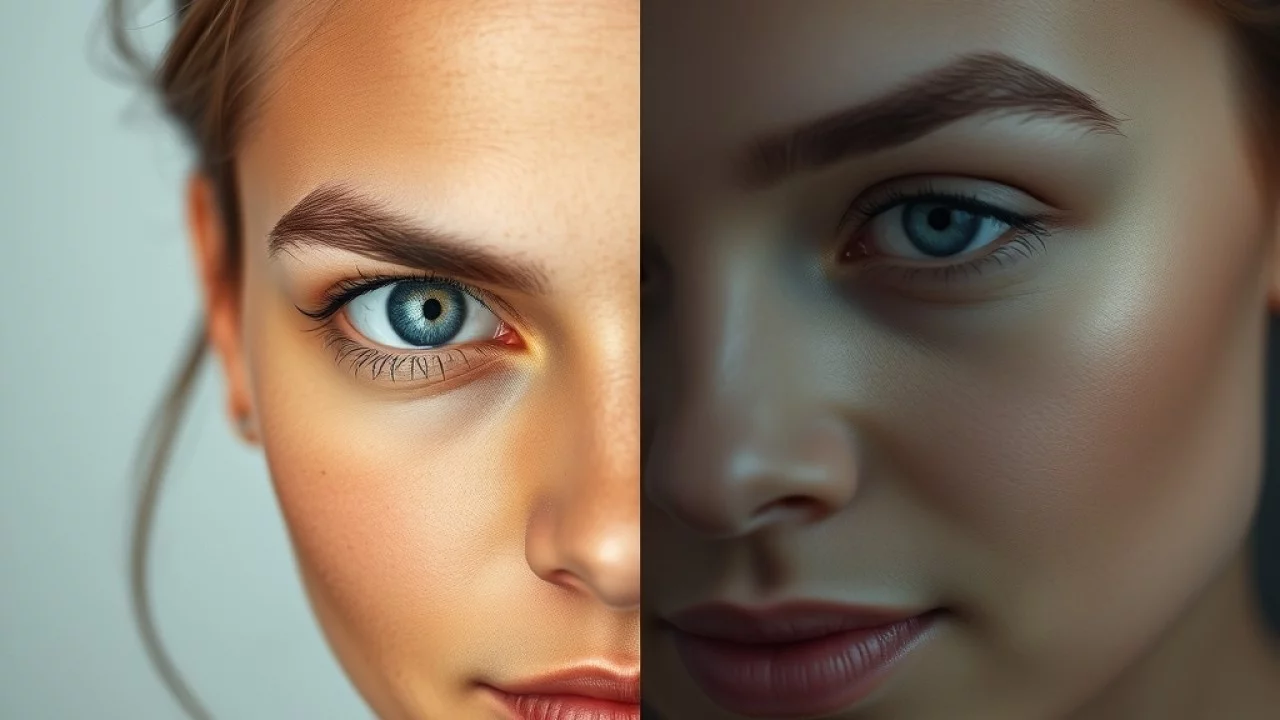
When you see an unreversed photo of yourself, your brain undergoes a momentary psychological shock. Any minor natural asymmetry you possess—such as your left eyebrow resting 2 mm higher or your smile pulling slightly to the right—is suddenly flipped to the opposite side.
Because your brain expects the mirrored blueprint, this sudden orientation swap causes your visual processing system to flag your familiar features as foreign and uneven. To external observers who see your unreversed face every day, you look completely normal and balanced.
Focal Length Optics
Does Focal Length Change Facial Proportions?
24mm vs 50mm for Face Photos
Focal length dictates how much optical compression occurs between the foreground and background of an image:
| Focal Length | Camera Type | Optical Effect on Face | Nasal & Cheekbone Distortion |
|---|---|---|---|
| 24mm – 28mm | Smartphone Front / Selfie | Wide-angle barrel distortion, center bulging. | Nose expands +30%, cheekbones recede, jaw thins. |
| 50mm | Standard “Nifty Fifty” Lens | Neutral perspective matching human eye field. | Minimal distortion when shot from 5–6 feet away. |
| 85mm – 105mm | Professional Portrait Lens | Gentle compression, flattens facial planes. | Zero distortion; captures true bone proportions. |
| 200mm+ | Extreme Telephoto Lens | Heavy flattening compression. | Face appears slightly wider and more flattened. |
A 24mm lens creates an artificial “fisheye” bulb on your nose, while an 85mm portrait telephoto lens flattens perspective, bringing your cheekbones and ears into their true anatomical alignment.
Computational Photography
Why Portrait Mode Looks Different From a Selfie
On modern smartphones, taking a standard selfie versus activating Portrait Mode produces noticeable aesthetic differences. However, the mechanism depends on your phone’s camera setup:
- Standard Selfie: Uses the primary wide-angle sensor (1x), capturing wide fields of view with optical barrel curvature.
- Telephoto Portrait Mode (2x / 3x): Switches to the secondary optical telephoto lens (50mm–77mm equivalent), forcing you to hold the phone further away and eliminating barrel distortion.
- Computational Bokeh: Portrait mode generates a synthetic depth map, blurring the background to separate your silhouette. This reduces distracting background perspective lines that accentuate asymmetry.
Calibration Standards
Best Camera Distance for Face Analysis
In clinical anthropometry, the ideal camera distance for facial analysis is 6 to 8 feet (1.8 to 2.4 meters). At this distance, optical rays entering the lens are nearly parallel, virtually eliminating perspective foreshortening.
Best Lighting for Facial Analysis
Directional shadows are the enemy of facial analysis. Light coming from a side lamp or a single window casts shadows across one cheek and beneath one eyebrow, tricking AI landmark detectors into flagging artificial asymmetries. The gold standard is soft, diffused, frontal lighting (such as two balanced 45-degree lights or standing directly in front of an overcast window).
Best Angle for an AI Face Scan
The camera must be positioned at exact eye level with 0° pitch, 0° roll, and 0° yaw. Your head must rest in the Frankfort Horizontal Plane, where an imaginary line from the lower edge of your eye socket to the top of your ear canal is parallel to the ground.
Expression & Head Pose
Does Head Tilt Affect Facial Symmetry?
Yes. A neck tilt of just 2 to 3 degrees shifts one pupil, eyebrow, and ear higher than the other on the 2D camera sensor, immediately causing computer vision engines to flag severe vertical asymmetry where none exists in bone structure.
Does Smiling Affect Facial Analysis?
Smiling drastically alters facial measurements. Contracting the zygomaticus major and minor muscles elevates the mouth corners, lifts the lower eyelid (altering canthal tilt), pushes the cheek fat pads upward, and compresses the vertical midface. For accurate proportional analysis, your face must remain in a completely relaxed, neutral resting state.
Step-by-Step Protocol
How to Take an Accurate Face Analysis Photo
Follow this 5-step clinical photo setup to eliminate camera distortion completely:
Mount Phone on a Stable Tripod
Never take a handheld selfie. Handheld shooting introduces involuntary arm tilt, shoulder elevation, and rotational bias.
Step Back 6 to 8 Feet
Physical distance eliminates perspective foreshortening and stops your nose from expanding.
Zoom to 2.5x or 3x Optical Zoom
Zooming optically narrows the field of view to ~70mm–85mm equivalent, capturing flat, true-to-life facial planes.
Align Height Directly at Eye Level
Position the lens parallel to your pupils. Do not angle the phone upward from the chest or downward from above.
Even Lighting & Neutral Expression
Illuminate both sides of your face with soft light, relax your lips without clenching teeth, and gaze straight into the lens. For testing, always choose private on-device AI facial analysis so your biometric scan never leaves your browser.
Common Questions
Frequently Asked Questions
Why do I look worse in selfies than in the mirror?
Because wide-angle front lenses distort facial geometry at close range (enlarging the nose by up to 30% and slimming the jawline), while capturing a frozen, unreversed 2D image that highlights normal asymmetries your brain isn’t used to seeing.
Does iPhone front camera flip photos?
By default, the iPhone camera preview displays a mirrored image (like looking in a bathroom mirror), but saves the final photo unreversed (how other people see you). You can toggle “Mirror Front Camera” in your iOS Camera Settings to save the mirrored version.
What is the best lens focal length for portraits?
In professional portrait photography, an 85mm prime lens is widely considered the gold standard. It provides ideal facial plane compression, zero barrel distortion, and beautiful optical depth separation.
Why do passport photos look so bad?
Passport booths frequently use harsh direct flash, flat white backdrops that eliminate contour, and wide-angle lenses in cramped spaces. Coupled with strict requirements for an emotionless expression and hair tucked behind ears, passport setups maximize perceived asymmetry.
How do lighting shadows create fake facial asymmetry?
Directional light illuminates one side while casting deep shadows on the other. Shadows carve out hollows, making one cheek appear narrower and one jaw angle appear sharper, misleading both human eyes and computerized AI detectors.
The next time a smartphone selfie makes you question your facial symmetry or proportions, remember the physics of optics. A wide-angle lens held at arm’s length was never built to represent anatomical reality.
Real human beauty is three-dimensional, living, and dynamic. Calibrate your photography with proper distance and lighting, trust your real-world reflection, and celebrate the authentic harmony of your face.