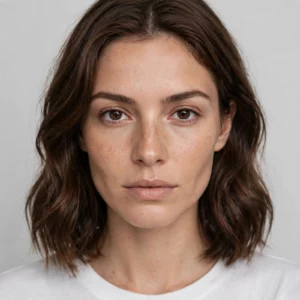
What Is Face Harmony? A Clear Guide to the Concept

“Face harmony” is one of those phrases that gets used constantly in beauty and looksmaxxing discussions and defined almost nowhere. Cosmetic clinics use it in marketing, TikTok filters claim to measure it, and AI face analysis tools report it as a score — but what does it actually mean? This guide gives you a straight, hype-free definition of face harmony, explains how it differs from attractiveness scores and the golden ratio, and shows how to think about harmony in your own face.
What Face Harmony Actually Means
Face harmony is the idea that a face looks “right” when its individual features — eyes, nose, lips, jaw, forehead — are well-proportioned relative to each other and to the face as a whole. No single feature dominates or looks out of place; everything sits in pleasing proportion. A face has harmony when the features work together as a set, regardless of what any individual feature looks like on its own.
This is why the concept is more useful than fixating on single traits. Someone can have striking eyes but a face that still feels “off” because the nose-to-lip proportions are unusual. Someone else can have completely average individual features but a face that reads as attractive because everything is balanced. Harmony is about relationships between features, not the features themselves.
It is worth saying plainly: face harmony is an aesthetic concept, not a medical diagnosis. There is no single agreed formula, and different cultures have had different ideas of harmonious proportions. Treat it as a useful lens, not a verdict.
Face Harmony vs Attractiveness Scores
AI face analysis tools often report a “harmony” score alongside or as part of an attractiveness score, which causes confusion. Here is the distinction: an attractiveness score is a prediction — trained on data about what large groups of people tend to rate as attractive — about how your face might be perceived. A harmony measure is descriptive — it is about the internal proportions of your own face, how evenly features are distributed and how balanced left and right sides are.
In practice they overlap heavily, because balanced proportions are one of the things people consistently find attractive. But they are not the same: an AI attractiveness score carries the biases of its training data, which is why we frame such scores as entertainment rather than objective truth. Look at a tool’s proportion and symmetry breakdowns rather than fixating on a single number — the breakdown is the informative part.
The Features That Create Face Harmony
Researchers and artists who study facial proportion tend to come back to the same handful of relationships:
Facial thirds. The face divides into three roughly equal vertical segments: hairline to brow, brow to base of nose, base of nose to chin. Faces where these thirds are close to equal are consistently described as balanced. Our guide to the facial thirds rule explains how to measure your own from a photo.
Facial fifths. Horizontally, the face is classically divided into five equal widths, each about one eye-width wide, with the eyes sitting roughly one eye-width apart.
Symmetry. Left-right balance matters, though perfect symmetry is neither common nor necessary — studies suggest that near-symmetry reads as healthy and attractive, while absolute mirror symmetry can look uncanny. Slight asymmetry is normal and universal. Our facial symmetry guide covers what is typical.
Feature sizing relative to the face. Nose width relative to face width, lip fullness relative to lower-face height, eye size relative to the midface — each feature has a typical range relative to its neighbours. Harmony breaks when one feature is far outside its typical range for that face, in either direction.
Profile balance. Harmony is not only a front-view concept. From the side, the relationship between forehead, nose projection, lips, and chin determines whether a profile looks balanced. A chin that sits well back relative to the lips, for example, changes the whole profile’s read.
Notice what is not on this list: any specific feature shape. Harmony does not require a particular nose shape, eye shape, or jawline. It requires features that fit the face they are on.
How Face Harmony Differs from the Golden Ratio
The golden ratio (phi, roughly 1.618) gets invoked constantly in discussions of facial beauty, and it is often conflated with harmony. They are related but different ideas. The golden ratio is a specific mathematical proportion that some researchers have found approximating certain facial relationships in faces rated attractive. Face harmony is the broader, looser concept of features being well-proportioned to each other.
The golden ratio’s role in facial beauty is also frequently overstated. The research is mixed, the “ideal” ratios shift between studies, and the ratio was popularised more by marketing than by decisive evidence. Harmony is the more honest framing: it describes balance without pretending a single magic number explains beauty.
How to Assess Your Own Face Harmony
You do not need a clinic consultation to get a rough read on your own proportions. Here is an honest DIY approach:
-
Take a proper photo. Rear camera, 4–6 feet away, straight on, neutral expression, even frontal lighting. Most “disharmony” people think they see is actually lens distortion or bad lighting. Our accurate face analysis photo guide has the full checklist.
-
Check the thirds and fifths. Measure the three vertical segments and the five horizontal divisions on your photo. Note where you deviate — the point is awareness, not a grade.
-
Check symmetry. Flip the photo horizontally and compare halves, or use a symmetry overlay. Remember that everyone is asymmetric; you are looking for whether anything is notably outside the normal range.
-
Look at relationships, not features. Instead of “is my nose big,” ask “is my nose wide relative to my face width?” Features only have meaning in context.
-
Get an objective second read. Self-assessment is warped by familiarity — you have seen your face ten thousand times, which distorts judgment in both directions. Running your consistent photo through our free AI face analysis tool on the homepage gives you measured proportions and symmetry numbers without the emotional static. Treat the output as data about geometry, not a judgment of worth.
What Face Harmony Can’t Tell You
Harmony’s limits are worth stating. It says nothing about skin quality, expression, grooming, or presence — all of which dominate real-world perception. It says nothing about how you look in motion, which is how people actually experience your face. And it cannot account for taste: the faces people find most striking are often the ones that break some proportional rule in an interesting way.
Also be cautious about where you encounter the term. Cosmetic clinics use “face harmony” as a consultation buzzword — a vague, flattering-sounding concept that conveniently leads to treatment recommendations. A harmonious face does not need fixing, and an “analysis” that always finds something to treat is a sales pitch, not an assessment.
Frequently Asked Questions
What is face harmony in simple terms?
Face harmony means your facial features are well-proportioned relative to each other — no single feature dominates or looks out of place. It is about the balance between features, not about any one feature being a particular shape.
How is face harmony measured?
There is no single standard measurement. Common approaches include checking facial thirds and fifths, measuring left-right symmetry, and comparing feature sizes relative to overall face dimensions. AI face analysis tools combine several such measurements into a harmony-style score.
Is face harmony the same as being attractive?
Not exactly. Balanced proportions are one component of attractiveness, but skin, expression, grooming, trends, and personal taste all play large roles. Striking faces often break proportional rules.
Can face harmony be improved?
Mostly at the margins. Grooming, hairstyle, and styling choices change how proportions read. The underlying bone structure and feature sizes are genetic. Anyone promising to “fix your harmony” with a product deserves scepticism.
Do I need good face harmony to be attractive?
No. Harmony is one lens on facial aesthetics. Personality, expression, style, and confidence consistently outweigh small proportional differences in how people actually perceive each other.