What Focal Length Is Most Flattering for Portraits?
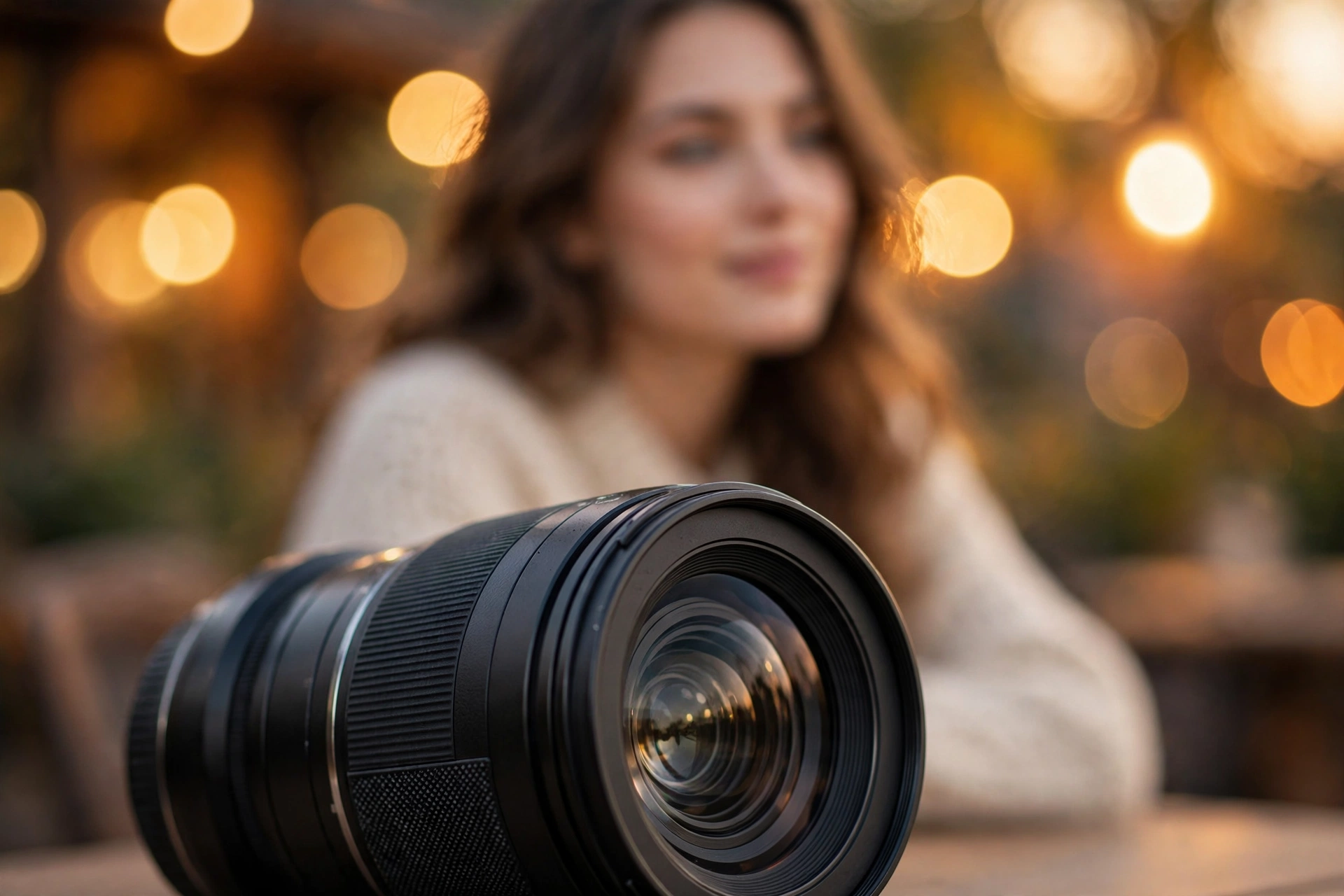
Photographers argue endlessly about the “best” portrait lens, but most of that debate is about gear. If you are on the other side of the lens — someone who just wants to look like themselves in photos — the question is simpler and more personal: what focal length makes a face look its most natural and flattering? The answer is well-established, the physics behind it is straightforward, and understanding it will change how you take every photo of yourself from now on.
What Focal Length Does to Your Face
Focal length, measured in millimetres, determines a lens’s field of view: how much of the scene it captures. But for faces, the number that actually matters is the knock-on effect — working distance. A wide-angle lens (short focal length) forces you close to fill the frame with a face. A telephoto lens (long focal length) lets you stand back. And camera-to-subject distance is what reshapes facial geometry.
When the camera is very close, perspective exaggeration kicks in: features nearest the lens (the nose, the centre of the face) render disproportionately large, while features at the edges (ears, jawline corners) compress. Step back and the exaggeration fades; facial planes flatten toward how they look to the naked eye from conversational distance. So “flattering focal length” is really a proxy for “flattering distance.”
The Unflattering Zone: Wide-Angle (24mm and Below)
Anything at or below roughly 24mm equivalent — which includes most phone front cameras and many phone main cameras at selfie distance — is the danger zone for faces. Shot from arm’s length, a wide-angle lens reliably makes the nose look larger, the face rounder, and the forehead more prominent. It is not subtle: controlled comparisons show the same face looking meaningfully different between a 24mm close-up and an 85mm portrait.
This is the entire reason selfie camera accuracy feels so poor. Your phone’s front camera is a wide-angle lens used at the worst possible distance. If your selfies bother you, the lens is guilty before your face is.
The Flattering Zone: 70–135mm
Ask portrait photographers for the classic answer and you will hear 85mm, over and over. The 70–135mm range (in full-frame equivalent terms) is the traditional portrait sweet spot, and the reason is distance: to frame a head-and-shoulders shot at 85mm, the photographer stands roughly 2–3 metres back. At that distance, perspective exaggeration is essentially gone. The nose renders at its true relative size, the face keeps its natural width, and the gentle compression of a mild telephoto is widely perceived as flattering — features look harmonious rather than exaggerated.
On a phone, this translates to the 2x–3x telephoto lens (roughly 48–77mm equivalent on most phones) used from 1.5–2 metres away. You will not hit a true 85mm on most phones, but the 3x lens from a proper distance gets you most of the benefit. The jump from a front-camera selfie to a 3x rear-camera portrait from six feet away is the single biggest upgrade available to how you photograph yourself.
Phone “portrait mode” is worth a mention here: it simulates the background blur of a longer lens but does not change the actual focal length or perspective. A portrait-mode shot from the wide main lens at close range still carries wide-angle distortion — the blur just makes it look more professional while the geometry stays warped. Distance first, blur second.
What About 50mm — the “Normal” Lens?
The 50mm lens is often called the most natural because its perspective roughly matches human vision. For faces, it is decent but not ideal: to fill the frame you still stand fairly close (around 1–1.5 metres for a tight portrait), so a touch of perspective exaggeration remains. It is far better than a wide-angle selfie and perfectly fine for environmental portraits, but for the most faithful, flattering face rendering, the longer end of the portrait range wins. Think of 50mm as honest and 85mm as honest-plus-kind.
Going Too Long: Beyond 135mm
Longer is not always better. Past about 135mm, the extreme compression starts to flatten the face noticeably — noses can look smaller than reality, and faces lose the dimensional modelling that reads as natural. Wildlife-length telephotos also force impractical distances for casual portraits. For face photography, there are diminishing returns past the classic portrait range, and eventually the cure becomes its own distortion.
What This Means for Your Face Analysis Photos
This is not just photography trivia — it directly affects any AI face measurement. Face analysis tools measure the geometry in your photo: nose width, eye spacing, face width-to-height ratio. A wide-angle close-up feeds them warped geometry, and the scores come back warped. This is why our accurate face analysis photo guide insists on distance: rear camera, 4–6 feet back, ideally using the phone’s 2x or 3x zoom rather than the wide main lens.
The practical rule is simple: the further the camera from your face (within reason), the more truthful the photo. Arm’s length is the enemy. Six feet with a mild zoom is the friend. Once you have a properly taken portrait, run it through our free AI face analysis tool on the homepage — with distortion out of the picture, the measurements finally mean something.
The One-Takeaway Version
If you remember nothing else: wide-angle plus close distance exaggerates the centre of your face; longer lens plus real distance renders you faithfully. Every unflattering photo you have ever hated was probably a physics problem, not a face problem. And if you want to see the difference yourself, compare a front-camera selfie with a 3x rear-camera shot from six feet — same face, same day, same lighting — and watch the “problem” disappear. For more on closing that gap, see our guide to reducing asymmetry in photos, which covers the angle and lighting half of the equation.
Frequently Asked Questions
What focal length is most flattering for faces?
The classic portrait range of 70–135mm (full-frame equivalent), with 85mm the most-cited sweet spot. It puts the camera 2–3 metres away, eliminating the perspective distortion that exaggerates the nose and rounds the face at close range.
Why do I look bad in wide-angle photos?
Wide-angle lenses used close up exaggerate perspective — the nose and centre of the face render larger while the edges compress. It is an optical effect of distance, not a reflection of how you look.
What is the best iPhone/Android setting for flattering self-portraits?
Use the rear camera’s 2x or 3x telephoto lens, prop the phone up, and stand 5–6 feet back using the timer. Face a window for even light. Avoid the front camera’s wide-angle lens at arm’s length.
Does focal length affect AI face rating scores?
Yes, significantly. Wide-angle distortion changes the facial landmarks AI measures — nose size, face width, eye spacing — so scores from close-up selfies reflect the lens, not your face. Always use a distortion-free photo from several feet away.
Is 85mm really better than 50mm for portraits?
For pure face rendering, yes — 85mm’s longer working distance removes the last traces of perspective exaggeration that 50mm retains at portrait framing distances. But 50mm is still vastly better than any wide-angle selfie.