What Is Interpupillary Distance (IPD)? Face Guide

Interpupillary distance — IPD — is the distance between the centres of your pupils. It is a real, standard measurement used by opticians every day to make glasses, and it has recently been adopted by looksmaxxing communities as a facial-proportion metric. This guide explains what IPD is, how to measure it yourself, what typical values look like, how it fits into facial proportions — and where the internet hype overstates its importance.
What Interpupillary Distance Is
IPD is simply the millimetre distance between the centres of your two pupils when you are looking straight ahead. Opticians measure it because lenses must be centred on your pupils; get the IPD wrong on a glasses prescription and the optics do not line up with your eyes. That is its original, practical purpose, and it remains the most important one.
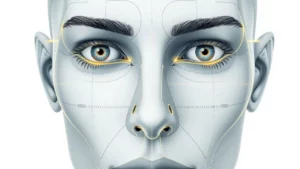
In facial aesthetics, IPD gets used as a proxy for eye spacing — how far apart your eyes sit relative to the rest of your face. Eye spacing matters because it anchors the facial fifths: in the classical proportion system, the face is divided into five equal horizontal segments, each one eye-width wide, with the eyes sitting one eye-width apart. IPD is the measurement version of that relationship.
One clarification: IPD is sometimes confused with “inner canthal distance” (the gap between the inner corners of the eyes) or “outer canthal distance” (between the outer corners). IPD is specifically pupil-centre to pupil-centre, which makes it more stable and standardised than corner-based measurements.
How to Measure Your IPD at Home
An optician’s pupillometer gives the gold standard, but you can get a reasonable estimate at home with the mirror method:
- Stand about an arm’s length from a mirror, looking straight ahead — not at your reflection’s eyes specifically, but straight forward as if looking into the distance. This matters: converging your eyes on a near target narrows the measurement.
- Hold a millimetre ruler flat against your brow, just above your eyes.
- Close your right eye. With your left eye, line up the ruler’s zero mark with the centre of your left pupil (visible in the mirror).
- Without moving the ruler, open your right eye and close your left. Read the millimetre mark at the centre of your right pupil.
- That reading is your approximate IPD. Repeat two or three times and average the results.
Accuracy tips: keep your head still, use a mirror rather than a selfie camera (phone lenses distort), and measure in good light so your pupils are small and their centres are easy to locate. Expect your result to be within a couple of millimetres of a professional measurement — good enough for curiosity, not good enough for ordering prescription lenses sight unseen.
Typical IPD Values
Adult IPD most commonly falls in the low 60s of millimetres for men (often cited around 62–66mm) and the high 50s to low 60s for women (often cited around 57–62mm), with wide individual variation. Children’s IPDs are smaller and grow with the head through adolescence. Values outside these bands are common and usually mean nothing on their own — IPD only gains meaning relative to overall face width, which is why raw millimetres are less informative than ratios.
That relativity point is crucial and widely missed. A 64mm IPD on a narrow face reads as wide-set eyes; the same 64mm on a broad face reads as close-set. The aesthetic question is never “what is your IPD” but “how does your eye spacing relate to your face width” — which is exactly what the facial-fifths framework captures. If you want to see your own spacing in proportional context, a straight-on photo analysed by our free AI face analysis tool on the homepage reports eye spacing relative to face width, which is the meaningful version of this number.
IPD in Looksmaxxing Culture
In looksmaxxing and PSL communities, IPD (or more often the IPD-to-face-width ratio) is treated as a significant attractiveness metric, with “ideal” ratios debated at length. The underlying intuition is sound — eye spacing that is proportional to face width reads as balanced, and the classical canons agree. But the forum treatment has the usual problems: cherry-picked examples, false precision (debating single millimetres on uncalibrated selfies), and the isolation fallacy — treating eye spacing as decisive when faces are judged whole.
There is also a measurement-reality problem. IPD ratios computed from casual selfies inherit all of selfie distortion: wide-angle lenses at close range change apparent eye spacing relative to face width. People have “discovered” IPD problems in themselves that were actually lens problems. Any proportion math needs a distortion-free photo — rear camera, several feet back — before the numbers mean anything. Our photo accuracy guide exists precisely for this.
IPD, Glasses, and Practical Uses
Beyond aesthetics, IPD has genuinely practical uses worth knowing. It is essential for ordering glasses online — most retailers ask for it, and an inaccurate IPD causes eye strain. It matters for VR headsets, which let you adjust lens spacing to match your IPD for comfort and image quality. And unusually large or small IPDs relative to head size can be clinically relevant in paediatric contexts, which is a matter for doctors, not forums.
If you wear glasses or are buying them, get your IPD measured professionally rather than relying on the mirror method. The stakes (eye strain, headaches from miscentred lenses) justify the five minutes at an optician.
The Honest Bottom Line
IPD is a legitimate, useful measurement with a real clinical purpose that has been drafted into service as an internet beauty metric. As a proportion — eye spacing relative to face width — it genuinely contributes to how balanced a face looks. As an isolated number obsessed over to the millimetre, it is mostly noise: uncalibrated photos, natural variation, and the fact that faces are judged whole all swamp small differences.
The healthy way to engage with it: understand the concept, measure roughly if you are curious, look at the ratio in the context of your whole face, and then move on. No single millimetre ever determined a face. For the broader picture of how eye-area features fit together, see our guides to canthal tilt measurement and facial thirds — proportion systems are more informative than any single metric.
Frequently Asked Questions
What is interpupillary distance in simple terms?
The distance in millimetres between the centres of your pupils when looking straight ahead. Opticians use it to centre lenses; in facial aesthetics it is used as a measure of eye spacing.
What is a normal IPD?
Most adults fall roughly in the high 50s to mid 60s of millimetres, with men averaging slightly higher than women. But the raw number matters less than eye spacing relative to your face width.
How can I measure my IPD at home?
Use the mirror-and-ruler method: ruler against your brow, align zero to one pupil’s centre with the other eye closed, then read the mark at the other pupil’s centre. Repeat and average. It is approximate — get a professional measurement for glasses orders.
Does IPD affect attractiveness?
Eye spacing proportional to face width contributes to perceived facial balance, which people generally find attractive. But it is one factor among many, and small differences are swamped by overall harmony, symmetry, skin, and expression.
Can IPD change?
IPD grows during childhood as the head grows and is essentially stable in adulthood. It is a skeletal measurement — no exercise or habit changes it in adults.