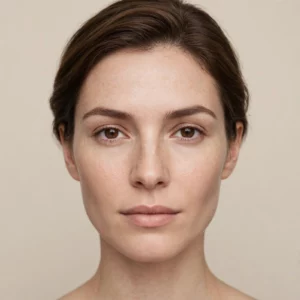
What Is My Face Shape? Take This Quiz for Men (8 Questions)
Walk into any decent barbershop and the first question is some version of “what are we working with?” Nearly all styling advice for men — haircuts, beard shapes, glasses — starts with face shape, and misidentifying yours ruins every recommendation after it. This quiz fixes that in three minutes: eight questions, a quick tally, your answer. No photo upload, no guesswork.
How This Face Shape Quiz Works
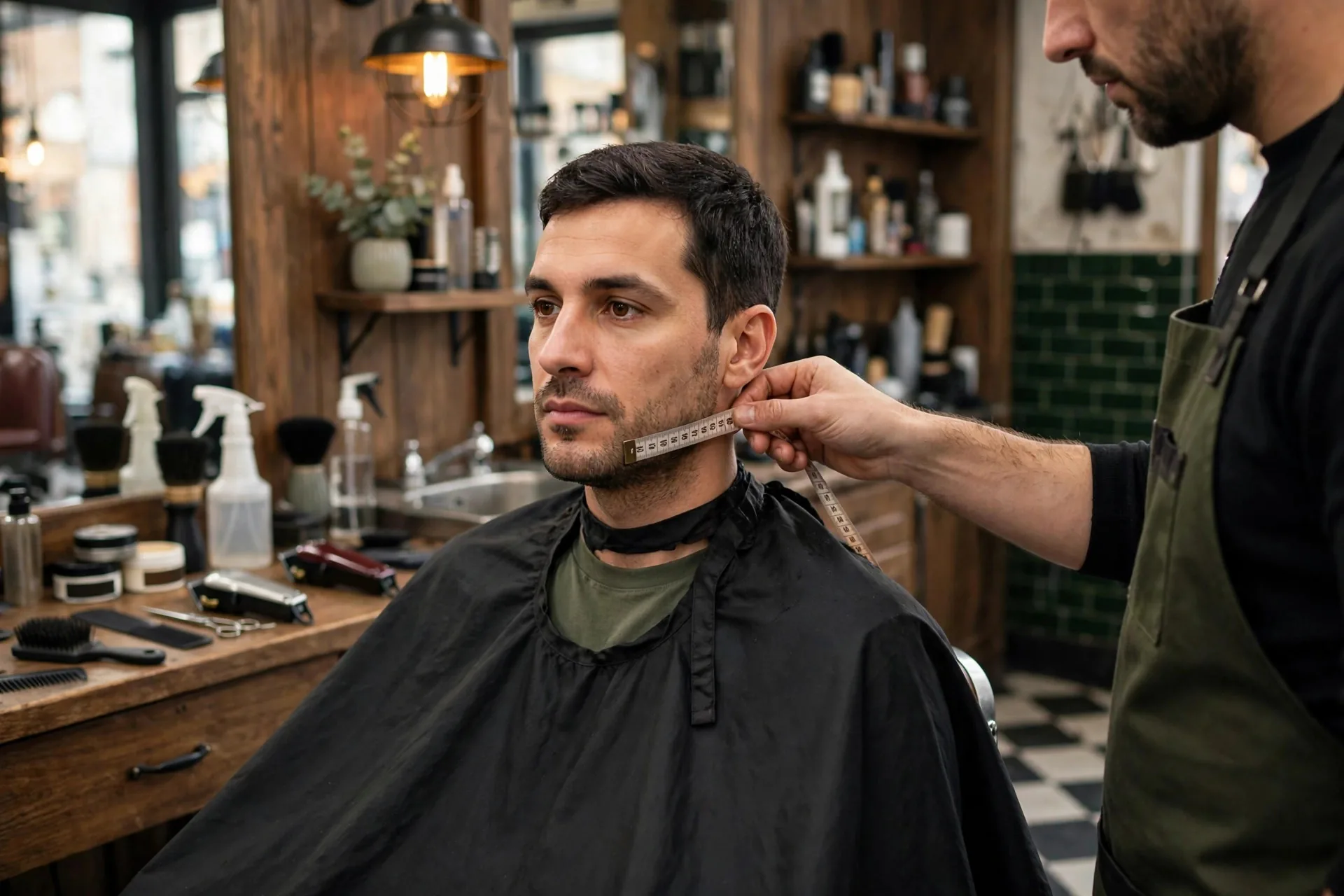
Stand before a mirror, hair pulled back, face relaxed — no smiling or posing. Answer each question, noting the best-fit letter. Each letter is one face shape: A = Oval, B = Square, C = Round, D = Oblong, E = Heart, F = Diamond. Count your letters at the end; the most frequent wins. (Prefer numbers to gut feeling? Measure your face shape with a tape measure for a data-driven cross-check.) Tied? Read both results — either set of advice will work for you.
The 8 Questions
Question 1: Where is your face widest?
Compare your forehead, cheekbones and jawline in the mirror.
- A. Forehead slightly wider than jaw; softly rounded overall.
- B. Forehead, cheekbones, jawline all about the same width.
- C. Cheekbones widest; features softly rounded throughout.
- D. Widths roughly equal, but the face looks long.
- E. Forehead clearly widest; chin looks narrow.
- F. Cheekbones distinctly wider than forehead and jaw.
Question 2: How would you describe your jawline?
Trace your jaw from ear to chin with a finger.
- A. Gently curved — not wide, sharp, or narrow.
- B. Strong, wide, angular; chin looks flat.
- C. Rounded and soft, blending toward the neck.
- D. Long and straight; chin sits a little low.
- E. Narrow, tapering to a pointed chin.
- F. Slim and angular; pointed chin, sharp cheekbones.
Question 3: How does face length compare to width?
Compare hairline-to-chin against cheekbone-to-cheekbone.
- A. Length about one-and-a-half times the width.
- B. Length and width balanced; defined jaw corners.
- C. Length and width roughly equal; all curves.
- D. Length clearly much greater than width.
- E. Length exceeds width; broad forehead on top.
- F. Length and width close; cheekbones jut widest.
Question 4: What does your chin look like?
Cover your mouth; study only the chin zone.
- A. Rounded — neither pointed nor flat.
- B. Square and flat across the bottom.
- C. Full and rounded, blending into soft cheeks.
- D. Long; lip-to-chin distance looks extended.
- E. Pointed or noticeably narrow.
- F. Pointed and narrow, under sharp cheekbones.
Question 5: How would you describe your forehead?
Push hair fully back; look at the whole forehead.
- A. Proportionate — neither dominant nor small.
- B. Wide and fairly straight across the top.
- C. Rounded, similar width to the cheeks.
- D. Long — a big share of face length.
- E. High and wide — the widest part.
- F. Narrower than the cheekbones.
Question 6: How prominent are your cheekbones?
Smile slightly, relax, and watch where light catches.
- A. Balanced; nothing stands out.
- B. Defined and angular, matching a strong jaw.
- C. Wide but softly rounded; full cheeks below.
- D. Long and flat rather than prominent.
- E. Subtle — face tapers from a wider forehead.
- F. Widest, most prominent feature on my face.
Question 7: What is the overall outline of your face?
Step back; see the whole silhouette, not features.
- A. Egg: rounded, slightly longer than wide, no corners.
- B. Brick: strong jaw corners, straight sides.
- C. Circle: curved all around, length roughly equals width.
- D. Upright rectangle: long, straight sides.
- E. Upside-down triangle: wide top, pointed chin.
- F. Kite: narrow forehead and chin, wide middle.
Question 8: What happens when you smile widely?
Grin widely; notice which features take over.
- A. Everything stays balanced and softly curved.
- B. Jaw corners look even more defined.
- C. Cheeks lift; look full and round.
- D. Whole face looks longer.
- E. Smile wide against a narrower chin.
- F. Cheekbones become the focal point.
Tally Your Answers and Get Your Result
Count your letters — the most frequent of A–F is your shape. Tied? You sit between shapes, which is common: shapes are categories on a spectrum, not sealed boxes. Read each tied result and blend the advice:
Mostly A: Oval
The balanced shape — forehead slightly wider than chin, rounded jaw, length ~1.5× width. Most haircuts work — see our best hairstyles for oval-face men — choose by texture and taste, avoiding heavy fringes that hide the forehead. Keep beards neat — short boxed styles or stubble. Glasses: frames slightly wider than your broadest point; skip oversized lenses.
Mostly B: Square
The strong-jawed shape — forehead, cheekbones and jaw similar in width, angular corners. Soften, don’t hide: height and texture on top (quiffs, side-swept styles); avoid short flat tops. Beards: short sides with chin length, or a fuller beard with a rounded bottom edge. Glasses: round or oval frames beat square ones.
Mostly C: Round
About as wide as long, with soft curves and full cheeks. Add definition and the illusion of length: height on top, shorter sides (textured fades, side parts); avoid bowl cuts with full sides. Beards: a goatee or boxed beard with chin length and clean cheeks carves out a jawline. Glasses: rectangular or angular; skip small round lenses.
Mostly D: Oblong
Distinctly longer than wide, balanced widths, extended length. Shorten visually: fringe or forward texture covers forehead length; keep volume off the top and fullness at the sides — skin fades with tall tops are the worst combo. Beards: full sides, no pointed styles, to add width. Glasses: wider frames; narrow frames exaggerate length.
Mostly E: Heart
A wide forehead tapering to a narrow, pointed chin. Balance the halves: medium-length cuts with volume around the jawline (longer sides, hair past the ears); slicked-back styles exaggerate the forehead. A fuller beard adds width exactly where the face is narrowest. Glasses: bottom-heavy or round frames; avoid top-heavy styles.
Mostly F: Diamond
Cheekbones headline — wider than forehead and jaw, with a narrow pointed chin. Soften them while adding width at forehead and jaw: fringe or texture across the forehead; avoid volume at the cheekbones. A full beard fills the narrow jaw. Glasses: oval or rimless; very narrow frames get lost.
Get a Second Opinion on Your Result
Quizzes are subjective — lighting, mirrors and self-perception all bias results. Cross-check with a straight-on photo through our free face shape detector, or try the free AI face-analysis tool for a broader read — our facial symmetry guide explains the measurements behind the classifications.
Frequently Asked Questions
How accurate is a face shape quiz for men?
A solid starting point, not a measurement. A quiz captures your honest perception — usually close — but mirrors flip your face, bathroom lighting flattens depth, and most people misjudge a feature or two. Treat the result as a strong hypothesis; confirm with photo-based analysis — or our free online face-shape guide — before a dramatic haircut.
What if my answers are tied between two shapes?
Then you genuinely sit between two shapes — extremely common, since shapes are categories on a spectrum. Read both results and blend the advice: haircut guidance from one, beard guidance from the other, as your mirror suggests. Borderline faces have the most flexibility.
Can my face shape change over time?
Bone structure changes little after your early twenties, but the perceived shape can shift a lot. Weight change, aging, even weeks of beard growth can move you between quiz results. Retake the quiz if your face has changed noticeably — old advice may not flatter you now.
Do I really need to know my face shape before a haircut?
Not required, but it makes the barber’s job easier and results more consistent. “Something that suits my face” is vague; “I’m oblong — avoid length on top” is a clear brief. Knowing your shape turns every haircut, beard trim and glasses purchase from a gamble into a decision.