Why You Look Different in Selfies vs Mirror (Explained)

You catch your reflection in a mirror and think you look fine. Then you open your front camera and the face staring back looks like a stranger — wider nose, uneven eyes, a lopsided smile. It is not your imagination, and it is not a sign that something is wrong with your face. You look different in selfies vs the mirror because a mirror and a camera show you two genuinely different versions of yourself. Here is exactly why.
Your front camera is a wide-angle lens held too close
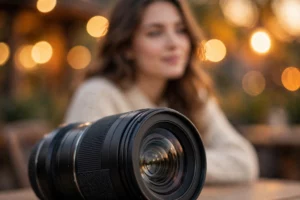
The biggest culprit is physics. The front camera on a phone is a wide-angle lens, and selfies are taken at arm’s length — far closer than anyone ever views your face in real life. At that short distance, wide-angle distortion stretches whatever is nearest the lens. Since the nose sits at the centre and closest to the camera, it looks bigger, while the ears and the edges of the face get compressed.
The result: your face looks rounder, your nose looks larger, and your proportions shift — none of which reflects how you actually look. This is the core reason selfie camera accuracy feels so unreliable. Step back a few feet and switch to the rear camera and the distortion largely disappears, because you are photographing your face the way other people actually see it.
The mirror shows you a flipped, familiar face
Here is the subtler half of the story. The face you see in the mirror is flipped left-to-right compared to the face everyone else sees — and the one your camera captures. You have spent your whole life looking at that mirrored version, so your brain treats it as the “correct” you. Psychologists call this the mere-exposure effect: we prefer what is familiar.
When a selfie shows you the unflipped version, your face suddenly looks off. The crooked smile you never noticed, the eye that sits a millimetre higher, the way your hair parts — all of these feel wrong, not because they changed, but because you have never really looked at them before. The selfie is showing you the version of your face that your friends have always seen, and that you are simply not used to.
A mirror is alive; a photo is frozen
A mirror gives you a moving, three-dimensional image. You tilt your head slightly, your eyes stay sharp, you adjust your expression in real time — you are always seeing yourself at your most flattering angle without even trying. A photo freezes one random instant: mid-blink, mid-breath, an expression that lasted a tenth of a second.
That single frozen frame also gets scrutinised in a way no mirror reflection ever does. You hold a mirror up, glance, and move on. You stare at a selfie for a minute, zooming in on pores and asymmetries. The medium invites over-analysis, and over-analysis always finds flaws.
Lighting makes the same face look different
Mirrors usually catch you in the same familiar light — your bathroom or bedroom, which you chose. Selfies get taken everywhere: harsh overhead fluorescents, side light from a car window, the blue glow of a screen at night. One-sided or top-down lighting deepens shadows under the eyes, carves lines into the nasolabial folds, and makes facial symmetry look worse than it is. Try this: take a selfie in your usual mirror light, then the same selfie under harsh overhead light. Same face, same camera — two very different photos.
Try this 30-second experiment
Take two photos right now. First, a normal front-camera selfie at arm’s length. Then set the phone on a shelf 5 feet away, switch to the rear camera, face a window, look straight into the lens with a neutral expression, and use the timer. Compare the two. The second photo is far closer to how other people see you — and it is the kind of photo any face-analysis tool needs for a meaningful reading. The difference between them is lens distortion and light, not your face.
Asymmetry is normal — photos just make it louder
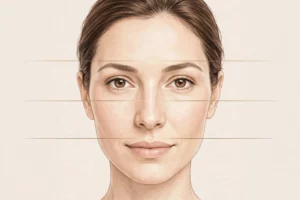
Almost no face is perfectly symmetrical, and slight unevenness is completely normal. In the mirror, your brain smooths over these quirks because it is looking at the familiar, moving, 3D you. In a flat, frozen, unflipped photo, every small difference is amplified: one eye marginally higher, one cheek slightly fuller, the nose angled a degree or two off-centre.
This is also why face-rating apps can return different symmetry scores for two photos of the same person. The face did not change; the photo did. Consistent lighting, distance, and angle are what make any AI face measurement meaningful.
So which one is the “real” you?
Neither the mirror nor the selfie is the truth. The mirror shows you a moving, flipped, angle-optimised version; the selfie shows you a flattened, frozen, possibly distorted version. The people around you see something closer to a blend: you in motion, in real 3D, from a normal conversational distance. If you like what you see in the mirror but dislike your selfies, trust the mirror’s general impression more — and remember that nobody else is comparing your two versions side by side the way you are.
If you are curious about your own symmetry, the honest way to check is with a consistent, distortion-free photo: rear camera, a few feet away, straight on, even lighting. Then run it through the free AI face-analysis tool and compare — and if you track looks-related metrics, our guide to the PSL scale and looksmaxxing explains what those numbers actually mean.
Frequently Asked Questions
Why does my nose look bigger in selfies?
Because of wide-angle lens distortion at close range. Your phone’s front camera sits about an arm’s length from your face, and wide-angle lenses exaggerate whatever is closest to the lens — which is your nose. Step back and use the rear camera and the effect mostly disappears.
Is the mirror or the camera more accurate?
Neither is perfectly accurate. The mirror shows a flipped, moving, self-optimised view; the camera shows a flat, frozen, sometimes distorted one. Other people see you in motion and in 3D from a normal distance, which is closer to a well-taken photo at a few feet than to either extreme.
Why do I look uglier in photos than in the mirror?
You almost certainly do not — you are just seeing the unfamiliar, unflipped version of your face, frozen mid-expression, often under bad lighting. The mere-exposure effect means your brain prefers the mirrored face it knows. The people in your life see the camera version every day and do not notice the difference.
Do I really look like my selfies to other people?
Roughly, yes — minus the wide-angle distortion. Other people see the unflipped version of your face in real life. But they see it in motion, in three dimensions, and at a natural distance, which is far more flattering than a close-up front-camera shot. A rear-camera photo taken from a few feet away is the closest a still image gets.
Can a bad photo affect my AI face rating score?
Yes. Close-range selfies with wide-angle distortion, bad lighting, head tilt, or beauty filters can all shift landmark detection and change your symmetry and ratio results. For a meaningful reading, use the rear camera from 4–6 feet away, face the lens straight on, keep a neutral expression, and use even frontal lighting.