How to Make Forehead Look Smaller With Makeup: Hairline & Contour Tricks

A larger forehead is a completely normal facial feature — many beautiful faces have one — but if you’d like yours to read a little smaller, makeup can genuinely help. The principle is the same one behind all contouring: shadow recedes, light advances. Shading the hairline and upper forehead pushes that area back visually, while keeping the mid-face bright and forward creates balance.
This guide covers hairline contouring, bronzer shading, brow placement, and the hairstyle tricks that multiply the effect — all with a natural finish, no mask-like heavy contour.
The hairline contour: your main technique
Hairline contouring is the single most effective makeup trick for a larger forehead. It works by diffusing shadow along the hairline so the forehead’s upper edge reads as starting lower than it does.
How to do it
- Choose a matte bronzer or contour powder one to two shades deeper than your skin, neutral to slightly warm (forehead shading looks more natural slightly warm than the cool tones used on the nose).
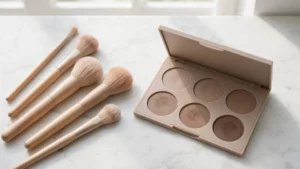
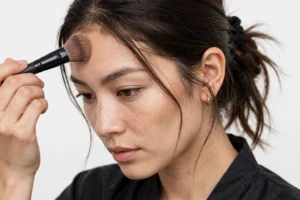
- With a large, fluffy brush, sweep the powder along the hairline — temples, the top edge of the forehead, and the upper corners — in soft circular motions.
- Blend downward about 1–2cm into the forehead, diffusing the edge until there is no visible line, only a gradient.
- Check in daylight: the shading should read as a soft shadow, not a brown band.
The key is diffusion. A visible line of contour at the hairline looks like a headband of dirt in daylight; a well-blended gradient is invisible as “makeup” and just reads as a naturally smaller forehead. For the core blending principles, our beginner’s guide to contouring a round face covers sheer layering in detail.
Cream vs powder at the hairline
Powder is easier here too — it blends over the forehead’s larger surface without streaking, and it sits well over foundation. Cream can work for precision at the temples, but it is harder to diffuse across the whole hairline without patchiness. Beginners should stay with powder.
Bronzer shading across the forehead
Beyond the hairline edge, a light wash of bronzer across the upper forehead adds to the receding effect:
- After hairline contour, take the same brush with whatever product remains and sweep it very lightly across the top third of the forehead.
- Keep the centre of the forehead and the brow bone area free of dark product — those areas should stay bright.
- Avoid shimmer bronzers on the forehead; shimmer brings areas forward, which is the opposite of what you want up top.
This is where bronzer earns its keep over pure contour: it warms and subtly deepens without the grey cast that cool contour can leave on a large area.
Brows: the frame that changes everything
Brow placement dramatically affects how large a forehead reads, because the distance between brow and hairline is what the eye measures:
- Slightly thicker, well-defined brows give the lower forehead visual weight, balancing the upper area. Over-plucked thin brows leave the forehead unanchored and larger-looking.
- A gentle arch adds structure; a completely flat brow can make the forehead read wider.
- Keep brows groomed but natural — the goal is presence, not Instagram-stamp brows.
If your brow shape needs work generally, start with our eyebrow shape guide for round faces — the mapping principles apply to every face shape.
Highlight strategy: where the light goes
Where you put highlight matters as much as where you put shadow:
- Do highlight the centre of the forehead lightly — a bright centre with shaded edges creates a rounded, forward read that contrasts with the receding hairline.
- Do highlight the brow bone — it lifts the eye area and shortens the brow-to-hairline read.
- Don’t highlight the upper forehead near the hairline — that brings the area forward and undoes your shading.
- Don’t over-highlight a large forehead all over — a shiny expanse reads larger, not smaller. Keep it matte-to-satin up top.
Hairstyle tricks that multiply the effect
Makeup works best paired with hair that cooperates:
- A fringe or curtain bangs physically cover the upper forehead — the most effective “trick” of all, and zero makeup required.
- A side part breaks the forehead’s symmetry and visually narrows it; a severe centre part on a large forehead emphasises width.
- Volume at the sides (waves starting at cheek level, layered cuts) balances a tall forehead by adding width lower down.
- Avoid slicked-back styles and high tight ponytails if minimising the forehead is your goal — they expose the full forehead.
The full routine in order
- Foundation and base as normal.
- Hairline contour with fluffy brush — temples, top edge, upper corners.
- Light bronzer wash across the upper forehead.
- Centre-forehead and brow-bone highlight.
- Brows defined and groomed.
- Check everything in natural daylight and blend any edges.
The whole routine adds about two minutes to your base once practised. Sheer layers beat heavy ones — buildable shadow looks natural, and you can always add more.
Making it last all day
Forehead shading sits on one of the oiliest zones of the face, so longevity needs a little planning:
- Prime the forehead. A mattifying primer across the forehead before foundation gives the shading something to grip and delays the midday shine that can dissolve powder contour.
- Layer powder over cream, not instead of it. If you want extra staying power, do a sheer cream contour at the hairline first, set it, then dust the powder contour over the top. The powder locks the cream in place.
- Blot before re-powdering. If shine breaks through in the afternoon, press blotting paper on the forehead first, then add a whisper of powder only where needed. Adding powder over oil without blotting builds a cakey layer that looks heavy in photos.
- Carry a mini fluffy brush. A quick re-blend at midday revives diffused edges far better than adding more product — most “faded contour” is actually contour that migrated, not contour that vanished.
Try it with your real proportions in mind
Makeup flatters most when it suits your actual face. For a neutral read on your features — including your forehead proportions — try our free AI face analysis tool on the homepage before you shade.
Frequently Asked Questions
Does contouring the hairline really make a forehead look smaller?
Yes — shading along the hairline makes the forehead’s upper edge read as starting lower, because shadow visually recedes. Diffuse blending is essential; a visible line ruins the illusion.
Should I use bronzer or contour on my forehead?
Bronzer (matte, neutral to slightly warm) usually looks more natural across the forehead’s large surface than cool-toned contour, which can look grey on a big area. Use contour for precise temple shading and bronzer for the broader wash.
Can eyebrows make my forehead look smaller?
Yes — well-defined, slightly thicker brows with a gentle arch anchor the lower forehead and shorten the brow-to-hairline read. Thin, over-plucked brows leave the forehead looking larger by comparison.
Where should I put highlighter if I want a smaller-looking forehead?
Lightly at the centre of the forehead and on the brow bone — never near the hairline or all over the forehead. Shimmer brings areas forward, so keep the upper forehead matte.
What hairstyle makes a forehead look smaller?
A fringe or curtain bangs cover the upper forehead directly; side parts break up width; volume at cheek level balances a tall forehead. Slicked-back styles expose the full forehead.
How do I avoid the contour looking like a dirt line at my hairline?
Blend downward 1–2cm into the forehead with a clean fluffy brush until no edge shows — only a gradient. Check in daylight, use sheer layers, and choose a shade only one to two tones deeper than your skin.