Facial Thirds: Proportions, Science, and Optical Distortions
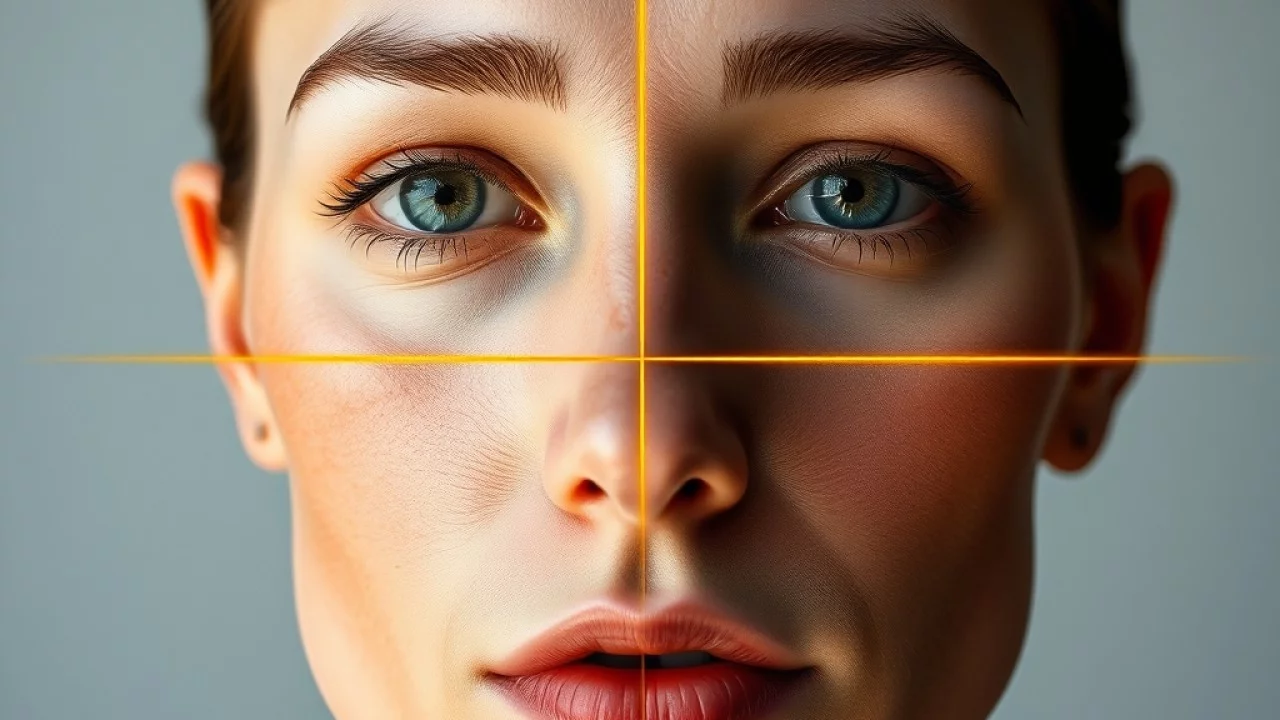
The definitive medical and photographic guide to the 1:1:1 rule of horizontal thirds, lower-face elongation, midface dominance, and camera angle effects.
Since the dawn of classical sculpture and Renaissance art, masters from Vitruvius to Leonardo da Vinci have noted a fundamental rule of human aesthetic harmony: the human face is vertically divided into three equal segments. In contemporary plastic surgery, maxillofacial reconstruction, and aesthetic dermatology, the concept of Facial Thirds remains the golden standard for evaluating facial balance.
What happens when your facial thirds are uneven? Why do some people develop a long lower third or an extended midface? How do smartphone cameras distort these vertical segments, and can smart hairstyle choices or beard grooming balance your proportions without surgery?
In this clinical guide, we explore the anatomical boundaries of facial thirds, contrast the 1:1:1 rule against facial fifths and the golden ratio, break down long versus short lower faces, and explain how automated facial thirds calculators analyze your image.
- The 1:1:1 Standard: Classical facial aesthetics divides the face into the Upper Third (hairline to brows), Middle Third (brows to nasal base), and Lower Third (nasal base to chin tip), each ideally occupying 33.3% of total face height.
- Uneven Thirds Are Universal: Pure 33.3% mathematical equality is extremely rare. Most attractive individuals possess natural variations, such as a slightly shorter upper third or a dominant lower third.
- The Lower Third Subdivision (1:2 Rule): The lower third itself is divided: the distance from nasal base to mouth opening should represent one-third (33%), while the distance from mouth to chin represents two-thirds (67%).
- Camera Angles Radically Distort Thirds: High camera angles exaggerate the upper third while shrinking the jaw, whereas low angles extend the lower third and neck.
- Styling Can Rebalance Proportions: Strategic haircuts, bangs, glasses, and beard contouring can visually adjust perceived vertical heights by several centimeters.
Anatomical Demarcation
What Are Facial Thirds?
In facial anthropometry, Facial Thirds refer to the horizontal zoning of the face along the vertical axis. Four fundamental anatomical landmarks define these boundaries:
Boundaries: From the Trichion (anterior hairline midpoint) down to the Glabella (the prominence between the eyebrows). Reflects frontal bone height.
Boundaries: From the Glabella down to the Subnasale (the junction where the nasal columella meets the upper lip). Encompasses the eyes, nasal dorsum, and cheekbones.
Boundaries: From the Subnasale down to the Menton (lowest bony point of the chin). Encompasses the upper lip, mouth, mandible, and chin pad.
Classical Ideal
What Is the 1:1:1 Facial Thirds Ratio?
The 1:1:1 Facial Thirds Ratio states that in an ideally balanced face, each of the three vertical segments comprises precisely one-third (33.3%) of the total distance from the hairline to the chin.
Furthermore, aesthetic surgeons evaluate the internal subdivision of the lower third, known as the 1:2 sub-ratio:
- Upper Lip Height: The distance from the subnasale to the stomion (where lips meet) should represent approximately one-third (33%) of lower-face height.
- Lower Lip & Chin Height: The distance from the stomion to the menton should represent approximately two-thirds (67%) of lower-face height.
When these proportions are maintained, the face appears balanced, rested, and structurally grounded, regardless of individual ethnic features.
Step-by-Step Protocol
How to Measure Facial Thirds
You can calculate your facial thirds at home using a calibrated frontal photograph and a simple ruler or image editor. Follow this 5-step measurement procedure:
Locate the Trichion (Hairline)
Mark the center of your forehead where your natural hairline begins. Record the vertical Y-coordinate.
Locate the Glabella (Brow Line)
Mark the most prominent point between your eyebrows above the root of the nose.
Locate the Subnasale (Base of Nose)
Mark the exact anatomical junction where your nasal septum meets the philtrum of your upper lip.
Locate the Menton (Bottom of Chin)
Mark the lowest boundary of your soft-tissue chin contour.
Calculate Segment Percentages
Measure: Upper = Trichion to Glabella; Middle = Glabella to Subnasale; Lower = Subnasale to Menton. Sum them to find Total Height. Divide each segment by Total Height × 100 to get your percentage distribution.
Optical Guidelines
How to Check Your Facial Thirds From a Photo
Checking facial thirds from a photograph requires strict control over perspective. A casual selfie held at arm’s length is completely invalid for measuring thirds because lens distortion and tilt compress some zones while elongating others.
For an accurate photo assessment:
- Maintain the Frankfort Horizontal Plane: The bottom rim of your eye socket and top of your ear canal must form a horizontal line parallel to the ground.
- Step Back 6 to 8 Feet: Use 2.5x to 3x telephoto zoom on your phone or an 85mm portrait camera lens to eliminate perspective compression.
- Neutral Expression: Keep your teeth gently apart, lips touching, and forehead unwrinkled.
Computer Vision Engineering
Facial Thirds Calculator
Modern web-based facial thirds calculators (such as the AuraFace landmark pipeline) replace manual rulers with automated deep neural networks. Here is how the automated engine calculates your thirds in milliseconds:
The algorithm detects 478 3D landmarks, pinpointing Landmark 10 (Trichion/Upper Forehead), Landmark 9 (Glabella), Landmark 2 (Subnasale), and Landmark 152 (Menton).
The software computes the head pose orientation matrix, rotating the 3D mesh to remove any forward or backward neck tilt.
The vertical pixel distance for each third is extracted along the true sagittal midline axis.
The calculator outputs your exact ratio (e.g., 31% : 35% : 34%) and calculates the deviation index from the 1:1:1 baseline.
Structural Variances
Uneven Facial Thirds Explained
Does having uneven facial thirds mean your face is unattractive? Absolutely not. In fact, over 95% of the global population has uneven facial thirds.
Uneven thirds arise from genetic skull development, pubertal hormonal influences, dental occlusions, and aging. Many of the most striking faces in entertainment and fashion feature intentional vertical dominance:
| Dominant Third | Typical Percentage | Aesthetic Impression & Characteristics |
|---|---|---|
| Dominant Upper Third | > 36% | High, intellectual forehead. Creates an open, expressive, and thoughtful demeanor. |
| Dominant Middle Third | > 36% | Prominent nasal bridge, strong cheekbone projection. Sophisticated, aristocratic aura. |
| Dominant Lower Third | > 36% | Strong masculine jawline, prominent chin, powerful presence and assertive jaw projection. |
| Harmonious Balanced | 32% – 34% each | Classical symmetry, universally harmonious, serene and approachable. |
Lower Facial Morphologies
Long Lower Third of Face
A Long Lower Third occurs when the distance from the base of the nose to the chin exceeds 36% of total facial height. This can stem from:
- Vertical Maxillary Excess (VME): Overgrowth of the upper jaw bone that pushes the lower jaw downward, often accompanied by a gummy smile.
- Macrogenia (Enlarged Chin): Excessive vertical development of the bony chin button.
- Skeletal Class III Malocclusion: An underbite where the lower jaw grows forward and downward.
In men, a slightly longer lower third is often perceived as powerfully masculine and authoritative, as seen in actors like Henry Cavill and Jon Hamm.
Short Lower Third of Face
A Short Lower Third occurs when the lower jaw and chin comprise less than 30% of total facial height. Common causes include:
- Microgenia / Mandibular Retrognathia: An underdeveloped or recessed lower jaw that pulls the chin back toward the neck.
- Deep Overbite (Class II Malocclusion): The upper teeth overlap the lower teeth excessively, causing the lower face to collapse vertically when the mouth is closed.
- Dental Wear and Tooth Loss: In older adults, grinding down molars reduces vertical bite height, shortening the lower third.
A short lower third creates a rounder, softer, and more childlike appearance, but can contribute to premature submental fullness (double chin) due to lack of skeletal support.
Diagnostic Distinctions
Long Midface vs Long Lower Face
People often confuse a long midface with a long lower face, but their clinical implications and visual impressions are drastically different:
Focus: Extended distance from eyebrows to nasal base.
Impact: Elongates the nasal bridge and spreads out the distance between eyes and lips. Much harder to alter surgically, but easily disguised with glasses and horizontal brow styling.
Focus: Extended distance from nasal base to chin.
Impact: Gives the jaw and chin vertical dominance. Routinely corrected or balanced clinically via orthognathic surgery, genioplasty, or orthodontic bite opening.
Aesthetic Frameworks Compared
Facial Thirds vs Golden Ratio
While the Golden Ratio seeks an asymmetrical 1:1.618 hierarchical progression between neighboring segments, the Rule of Thirds seeks 1:1:1 democratic equality across all three vertical tiers.
Facial plastic surgeons generally rely on Facial Thirds more frequently than the Golden Ratio because thirds correspond directly to surgical osteotomy planes (Le Fort I, II, and III maxillary and mandibular surgical lines).
Facial Thirds vs Facial Fifths
Facial Thirds and Facial Fifths represent the two perpendicular axes of classical facial proportion:
- Facial Thirds (Vertical): Divides facial height into 3 horizontal bands from hairline to chin.
- Facial Fifths (Horizontal): Divides facial width into 5 vertical columns, each matching the exact width of one eye aperture.
Together, Thirds and Fifths create a complete grid matrix that defines facial compactness and lateral symmetry.
Non-Surgical Styling
Can Hairstyles Change the Appearance of Facial Thirds?
Yes. Hair is the most versatile visual framing tool for rebalancing facial thirds without clinical intervention:
Curtain bangs, blunt fringe, or side-swept hair conceal the high trichion, instantly reducing the visual height of the forehead.
For men, growing a tapered box beard adds 10–15 mm of vertical chin length. For women, layered bobs that end at the collarbone draw the eye downward.
Wearing eyewear with bold, thick horizontal bridge bars cuts the vertical line of the nose in half, visually shortening the middle third.
Photography & Illumination
Does Camera Angle Affect Facial Thirds?
Camera angle drastically distorts vertical segment proportions through perspective foreshortening:
- High-Angle Shot (Camera Above Face): The forehead is closest to the lens and appears 20–30% larger, while the chin recedes and looks dramatically shortened.
- Low-Angle Shot (Camera Below Chin): The lower third and neck expand forward, making the chin look massive while compressing the forehead.
How Lighting Changes Facial Proportions
Lighting shapes how depth and vertical height are perceived. Harsh overhead light casts deep downward shadows beneath the brow ridge, nose tip, and lower lip, carving the face into exaggerated vertical blocks. Soft, diffused frontal lighting minimizes shadow boundaries, creating a smooth and harmonious transition across all three thirds.
Common Questions
Frequently Asked Questions
Can you change your facial thirds with exercise or face yoga?
No. Facial thirds are determined by underlying craniofacial bones (frontal bone, maxilla, and mandible). Facial exercises cannot alter bone length or move the hairline. Real structural changes require orthodontic bite alignment, orthognathic jaw surgery, genioplasty, or strategic dermal filler placement.
Which facial third is considered most important for attractiveness?
In aesthetic research, the middle and lower thirds carry the greatest visual impact. The middle third houses the eyes and nose, while the lower third defines jawline definition and youthful neck transition. The upper third is easily modified or concealed with hairstyles.
Does a receding hairline change my facial thirds?
Yes. Because the upper third is measured from the anterior hairline (Trichion), male pattern baldness or traction alopecia physically extends the upper third upward, throwing off the 1:1:1 ratio. Hairline lowering surgery, hair transplants, or micro-pigmentation are often used to restore classical thirds.
Why do my facial thirds look different in selfies compared to mirrors?
Selfie cameras held close to the face suffer from wide-angle barrel distortion and involuntary vertical tilt. Tilting your phone slightly up or down distorts vertical segment heights by up to 25%, creating false proportions that don’t match your real reflection.
What is the ideal lower third ratio between lips and chin?
In classical aesthetic surgery, the lower third is subdivided into a 1:2 ratio: the distance from the base of the nose to the mouth opening should be half the distance from the mouth opening to the bottom of the chin.
The 1:1:1 rule of facial thirds is a timeless aesthetic compass, but absolute mathematical equality is neither required nor typical in nature. Minor variations are what give faces individuality, character, and distinctive beauty.
Before judging your proportions through casual photos, account for camera distortion, lighting, and angles. Embrace your vertical balance and celebrate the unique architecture of your face.