Most Attractive Face Shape: What Science Actually Says

Ask the internet for the most attractive face shape and you will get confident, contradictory answers: oval, heart-shaped, square jawlines, V-shaped — depending on who is selling what. Ask the research literature and you get something more interesting and less marketable: there is no single winning face shape, but there are consistent patterns in what people across cultures tend to find attractive. Here is what the science actually says, framed honestly.
The Short Answer: Shape Matters Less Than Proportion
The most replicated finding in facial attractiveness research is not about a shape at all — it is about averageness and symmetry. Composite faces (digital averages of many faces) are consistently rated more attractive than most individual faces. The leading explanation is evolutionary: average features signal genetic health and developmental stability, and our visual systems are tuned to find prototypical faces easy to process — a phenomenon researchers call processing fluency.
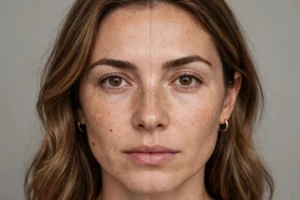
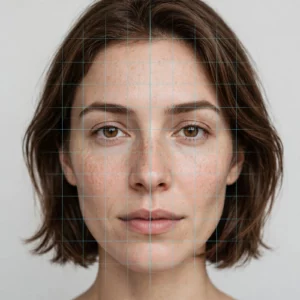
Symmetry runs a close second. Across many studies, more symmetrical faces are rated more attractive on average, likely for similar signalling reasons. But the effect is modest, not absolute — and perfectly symmetrical faces can look strange, which is why “near-symmetrical” is the real finding. Our facial symmetry guide covers the nuances.
What does this mean for face shapes? It means the attractive version of any shape — oval, round, square, heart, oblong — tends to be the balanced, proportional, near-symmetrical version of that shape. Research does not crown oval or heart or square; it rewards harmony within whatever shape a face has. That is a less exciting headline, but it is what the data supports.
What Studies Consistently Find Attractive
Beyond averageness and symmetry, a few patterns show up repeatedly:
Clear, even-toned skin. Skin quality is one of the strongest predictors of attractiveness ratings — often stronger than structural features. It signals health directly, and it is also the most modifiable factor on this list.
Sexually dimorphic cues. On average, raters prefer faces with clear sex-typical traits: relatively more masculine features (stronger jaw, brow) in male faces and more feminine features (fuller lips, larger eyes relative to face) in female faces. But preferences vary enormously between individuals and cultures, and the effect sizes are modest.
Balanced proportions. Faces with roughly equal facial thirds and well-distributed features are rated as more harmonious. The golden ratio’s specific claims are shakier than popular coverage suggests, but the general principle that balanced beats unbalanced holds.
Youthful cues. Features associated with youth — smooth skin, full lips, bright eyes — are widely preferred, though heavily moderated by the rater’s own age and culture.
Notice the pattern: these are qualities a face can have in any shape. A round face with clear skin, good symmetry, and balanced proportions will outscore a square-jawed face with poor skin and asymmetry in most studies. Shape is the container; these are the contents.
New Research Directions: 3D Face Scanning
One encouraging trend in recent years is the move from 2D photographs to 3D face scans in attractiveness research. Photographs flatten faces and introduce lens distortion — the same problems that make selfies unreliable — while 3D scans capture real facial geometry: actual projection, depth, and volume. Studies using 3D data can separate what is genuinely structural from what was photographic artefact, which makes their findings more trustworthy.
There has been fresh attention on this approach in 2026, with new 3D-scan-based attractiveness findings circulating in science media. The broad direction of these findings is consistent with the established literature — proportion, symmetry, and harmony mattering more than any single shape ideal — rather than overturning it. As with all early-stage findings, the details deserve the usual caution: single studies are starting points, not conclusions, and media coverage of attractiveness research reliably overstates what was actually shown.
What makes the 3D approach promising long-term is that it can finally test which 2D findings were real and which were photographic artefacts. If a preference disappears when lens distortion is removed from the data, it was never about faces — it was about cameras. Expect the next few years of this research to quietly revise some long-held claims, mostly in the direction of “faces matter less than we thought, and presentation matters more.”
Why “Most Attractive” Is the Wrong Question
Even the best research answers a narrower question than people think. Lab studies measure ratings of static images by strangers — a thin slice of real attraction, which involves motion, expression, voice, personality, scent, and context. The face that wins a photo-rating study is not necessarily the face that captivates a room. Expression alone can transform ratings: the same face smiling genuinely versus neutral can shift perceived attractiveness dramatically.
There is also the taste problem. Attractiveness research reports averages, and averages erase the people who love sharp cheekbones, or soft round faces, or strong noses. The most “scientifically attractive” face is a statistical composite — literally the average of averages — and nobody is actually drawn to a composite. Real attraction is specific, and specific means deviating from the average in ways someone finds compelling.
What This Means for Your Face
The practical reading of the science is liberating: you do not need a different face shape; you need the best version of the shape you have. The levers the research supports are unglamorous but real — skin health, sleep, body composition, grooming, posture, and honest photography. None of them requires changing your bone structure, and all of them outweigh shape in the data.
If you want to understand your own facial geometry — your symmetry, your thirds, your proportions as they actually are — the tool for that is measurement, not forum debate. Take a proper distortion-free photo (rear camera, several feet back, even light) and run it through our free AI face analysis tool on the homepage. It reports the proportion and symmetry numbers the research actually cares about. And remember the framing from our AI accuracy guide: these tools measure geometry as entertainment, not worth.
Frequently Asked Questions
What is scientifically the most attractive face shape?
No single shape wins in the research. Studies consistently favour balanced, near-symmetrical, average-proportioned faces — which can occur in any shape (oval, round, square, heart, oblong). Proportion and harmony matter more than shape category.
Is the oval face really the ideal?
The “oval is ideal” claim comes mostly from hairstyling and makeup guides, not from attractiveness research. Oval is versatile for styling because it is balanced, but studies do not show it beating other shapes on attractiveness.
Do men and women prefer different face shapes?
Research finds modest sex differences in preferred traits (e.g., jaw prominence in male faces), but individual and cultural variation is large. There is no universally preferred male or female face shape.
What does 3D face scan research add?
3D scans capture real facial geometry without the lens distortion and flattening of photographs, so findings about structure — symmetry, projection, proportion — are more reliable than photo-based studies. Recent 3D-based findings broadly confirm the established patterns rather than overturning them.
Can I change my face shape?
Bone structure is set by genetics and development. What you can change: body composition (which strongly affects how defined any shape looks), posture, grooming and hairstyle (which change how shape reads), and skin quality. Anyone promising to reshape facial bones without surgery is selling something.