
Facial Fifths: Horizontal Eye Proportions, Measurement Science
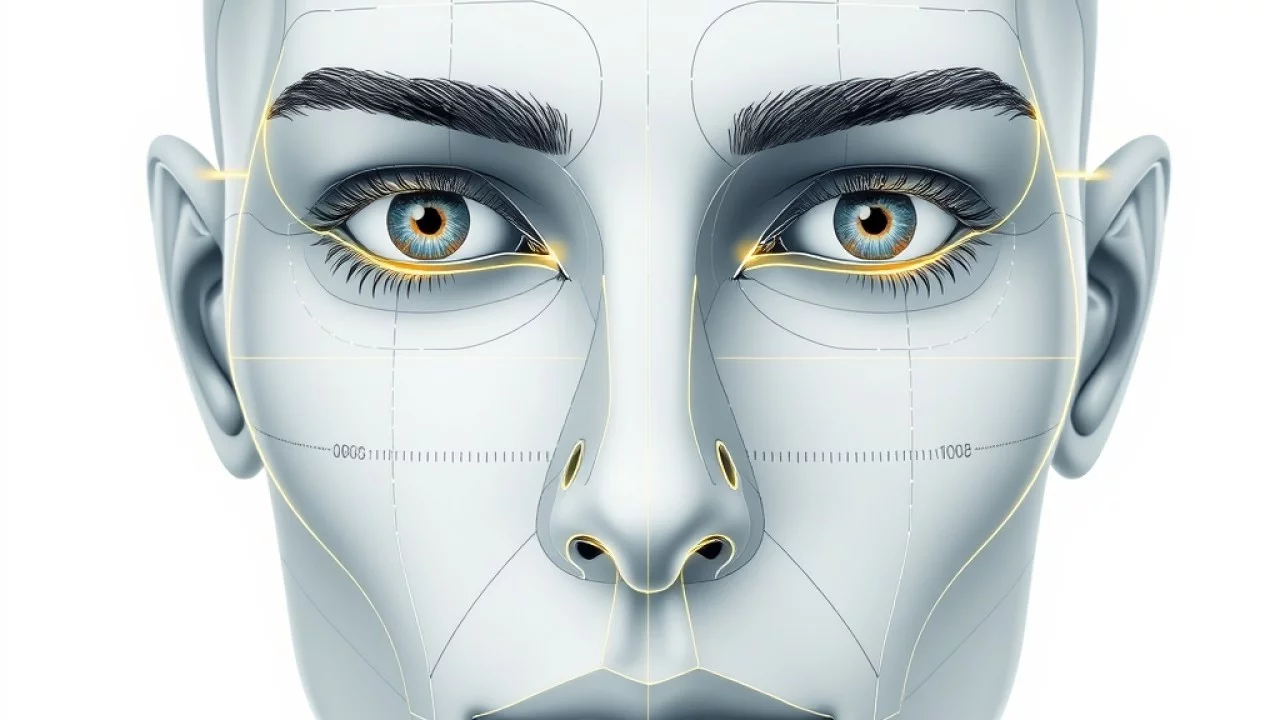
The definitive medical and photographic guide to the Rule of Fifths, intercanthal eye spacing, facial width architecture, and camera distance optics.
While facial thirds evaluate the vertical balance of your forehead, midface, and chin, the Rule of Facial Fifths governs the horizontal architecture of your face. Established during the Italian Renaissance and refined by modern maxillofacial surgery, the facial fifths framework posits that a harmonious human face is horizontally divided into five equal vertical segments—each precisely the width of one eye.
What does it mean if your facial fifths are uneven? How does the distance between your tear ducts (intercanthal distance) dictate your perceived nose width and eye spacing? Why do smartphone selfies distort horizontal fifths so severely, and how do automated landmark calculators measure these transverse dimensions?
In this clinical guide, we unpack the anatomical science of horizontal facial fifths, contrast them against vertical thirds, examine wide-set versus close-set eyes, and explain how camera distance changes perceived facial proportions.
- The 1:1:1:1:1 Ideal: Classical facial aesthetics divides facial width into 5 equal vertical columns: two lateral zones, two ocular widths, and one central intercanthal space between the eyes.
- Eye Width Dictates Spacing: In an anatomically balanced face, the distance between the inner corners of the eyes (intercanthal distance) equals the width of one eye aperture, which in turn equals the width of the nasal base.
- Uneven Fifths Are Normal: Over 90% of the population possesses unequal fifths. The outer lateral fifths are frequently narrower or wider depending on temple hollows and zygomatic arch projection.
- Close-Set vs Wide-Set Eyes: If the central fifth is narrower than the width of one eye, eyes are classified as close-set (stenocanthia). If wider, they are wide-set (telecanthus or eurycanthia).
- Camera Distance Is Crucial: Front-facing smartphone cameras held close to the face stretch the central fifth and shrink the outer fifths by up to 25%, creating an optical illusion of widely spaced eyes and a broad nose.
Anatomical Architecture
What Are Facial Fifths?
In plastic surgery, craniofacial orthodontics, and fine art, Facial Fifths describe the transverse (horizontal) division of the face into five parallel vertical columns. Six anatomical landmarks along the eye plane establish these boundaries:
From the lateral hairline / ear edge to the lateral canthus (outer corner of each eye). Reflects temple and zygomatic arch width.
The palpebral fissure width: from the lateral canthus to the medial canthus (inner corner) of each eye aperture.
The intercanthal distance: the horizontal span between the inner eye corners (tear ducts), directly housing the nasal root and dorsum.
Classical Aesthetic Standard
What Is the Ideal Facial Fifths Ratio?
The Ideal Facial Fifths Ratio is 1 : 1 : 1 : 1 : 1. Under this classical aesthetic formula, each of the five vertical columns occupies exactly 20% (one-fifth) of the total bizygomatic face width.
In clinical terms, this rule dictates two critical proportional relationships:
- Eye Width Equals Eye Spacing: The width of your left eye, the space between your eyes, and the width of your right eye should all be identical (e.g., 32mm : 32mm : 32mm).
- Nasal Base Alignment: The alar base (the widest flare of the nostrils) should align vertically with the medial canthi (inner eye corners), fitting cleanly inside the central fifth.
Measurement Methodology
How to Measure Facial Fifths
You can calculate your facial fifths at home using an unreversed, high-resolution frontal portrait and this 5-step measurement protocol:
Mark the Outer Lateral Edges
Mark the outermost edge of your facial silhouette at the level of the pupils (lateral zygomatic rim or temple hairline). Record Left Outer Point (L1) and Right Outer Point (R1).
Mark the Outer Eye Corners (Lateral Canthi)
Pinpoint the outer junction where your upper and lower eyelids meet on both eyes (L2 and R2).
Mark the Inner Eye Corners (Medial Canthi)
Pinpoint the tear duct junctions on both eyes (L3 and R3).
Measure All 5 Segments in Millimeters or Pixels
Measure: Segment 1 (L1 to L2), Segment 2 (L2 to L3), Segment 3 (L3 to R3), Segment 4 (R3 to R2), and Segment 5 (R2 to R1).
Calculate Column Proportions
Sum all five segments to find Total Width. Divide each segment by Total Width × 100 to calculate each column’s percentage (ideal = 20% each).
Computer Vision Engineering
Facial Fifths Calculator
Automated web tools (such as the AuraFace facial analysis engine) compute facial fifths in real time using 478 3D landmark coordinates. Here is the automated calculation workflow:
The neural network localizes Landmarks 234 & 454 (lateral zygomas), Landmarks 33 & 133 (left canthi), and Landmarks 362 & 263 (right canthi).
The algorithm de-rotates 3D head yaw and roll to ensure head tilt does not distort horizontal pixel distances.
Horizontal pixel widths of all five columns are derived across the transverse pupillary baseline.
The engine compares individual segments to the 20% baseline, reporting your intercanthal index and eye width balance.
Biometric Anatomy
Intercanthal Distance Explained
Intercanthal Distance (ICD) is the anatomical measurement between the medial canthi of the two eyes. In adults, the normal human biological range is typically between 30 mm and 34 mm (averaging ~31 mm in women and ~33 mm in men).
Clinicians distinguish between three anatomical conditions:
ICD equals the width of one eye aperture (~30–34 mm). The central fifth perfectly matches the adjacent ocular fifths.
Increased distance between inner eye corners (>35 mm), while the underlying bony orbit sockets may remain normally spaced.
A true congenital increase in the distance between the bony eye sockets themselves (interpupillary distance >68 mm).
Transverse Balance
Eye Width and Facial Proportions
Your eye aperture width (palpebral fissure length) acts as the biological ruler for your entire transverse face. The average adult eye fissure length is 28 mm to 33 mm.
If your eye width is smaller than average (e.g., 26 mm), a normal 32 mm intercanthal space will appear disproportionately wide by comparison, creating an optical impression of wide-set eyes even when nasal anatomy is completely standard. Conversely, wide eye apertures (34 mm+) make normal nasal bases look delightfully compact.
Perceptual Psychology
How Eye Spacing Affects Facial Proportions
Eye spacing fundamentally shapes facial character and beauty archetype:
Aesthetic Aura: Exotic, doll-like, ethereal, youthful, and open. Associated with high-fashion modeling (e.g., Gemma Ward, Anya Taylor-Joy, Kate Moss). Creates an approachable, innocent visual impression.
Aesthetic Aura: Intense, focused, piercing, and sharp. Associated with brooding cinematic presence (e.g., Ryan Gosling, Tom Cruise, Kristen Stewart). Emphasizes nasal bridge prominence.
Grid Matrix Comparison
Facial Fifths vs Facial Thirds
Facial Fifths and Facial Thirds represent the two foundational coordinate axes of craniofacial analysis:
| Proportional Metric | Facial Fifths (Horizontal) | Facial Thirds (Vertical) |
|---|---|---|
| Direction of Measurement | Transverse horizontal plane across eye line. | Sagittal vertical plane from hairline to chin. |
| Number of Segments | 5 vertical columns (each 20%). | 3 horizontal tiers (each 33.3%). |
| Key Anatomical Drivers | Eye width, intercanthal distance, cheekbone width. | Forehead height, nasal length, mandible / chin height. |
| Primary Surgical Relevance | Rhinoplasty, medial canthoplasty, zygoma reduction. | Orthognathic jaw surgery, genioplasty, hairline lowering. |
Together, thirds and fifths form a harmonious grid: thirds control vertical facial length and neoteny, while fifths control horizontal compactness and eye spacing balance.
Morphological Diversity
What Does Uneven Facial Fifths Mean?
Having uneven facial fifths does not mean your face is flawed. In fact, the strict 1:1:1:1:1 ratio is a neoclassical idealization rather than a biological rule.
In real human populations, the outer lateral fifths are almost always narrower (15–17%) than the ocular fifths (20–22%), because the head curves backward into the temples. Furthermore, slight asymmetries between the left and right outer columns occur naturally in over 85% of people due to differing zygomatic bone projection.
Optics & Camera Distortion
How Camera Distance Affects Facial Fifths
Camera distance is the single most influential variable altering how your facial fifths appear in digital photos.
When a smartphone camera is held close to the face (12 to 18 inches / 30 to 45 cm):
- Central Fifth Expansion: The nose and intercanthal distance sit closest to the lens and undergo spherical barrel distortion, expanding by up to 25% to 30%.
- Lateral Fifth Compression: The outer temples and cheekbones curve away from the lens, making the outer fifths appear artificially narrow and pinched.
This optical effect falsely makes people believe their eyes are set too far apart and their nose is too wide. Standing at least 6 to 8 feet away using optical zoom (70mm–85mm focal equivalent) flattens perspective, restoring true anatomical fifths.
Photo Protocol
How to Check Facial Fifths in a Photo
To assess your facial fifths accurately from a photograph:
- Ensure the camera is mounted on a tripod at exact eye level.
- Step back 6 to 8 feet and zoom in to 2.5x–3x optical zoom.
- Align your head in the neutral Frankfort Horizontal Plane with zero head turn (yaw = 0°).
- Use soft, balanced dual frontal lighting to prevent one-sided shadows from obscuring the outer temple borders.
Common Questions
Frequently Asked Questions
Can you change your facial fifths without surgery?
Bone structure and eye spacing cannot be moved without surgery. However, optical adjustments can be achieved through makeup and styling: applying darker eyeshadow toward the inner corners visually draws wide-set eyes closer together, while winging liner outward broadens close-set eyes. Eyewear frame width also rebalances horizontal fifths dramatically.
Is it better to have wide-set or close-set eyes?
Neither is objectively superior. Wide-set eyes convey youthful, ethereal, and open charm, frequently prized in high-fashion modeling. Close-set eyes project intensity, focus, and classic cinematic strength. Attractiveness depends on how well eye spacing harmonizes with cheekbone width and nasal base proportions.
Why do my eyes look closer together in rear camera photos?
Rear cameras are typically operated from a greater physical distance than handheld front-facing selfies. Increased camera distance eliminates wide-angle barrel distortion, restoring your true biological intercanthal spacing, which often looks narrower compared to stretched close-up selfies.
What surgery changes the central facial fifth?
In oculoplastic and plastic surgery, a medial epicanthoplasty removes epicanthic folds to expose more inner lacrimal lake, visually narrowing the intercanthal distance. Rhinoplasty can refine a broad nasal dorsum or alar base to align with the central fifth.
Does makeup contouring affect facial fifths?
Yes, contouring is highly effective at altering perceived fifths. Shading the outer temples visually narrows the lateral fifths, while highlighting the bridge of the nose and inner eye corners creates the illusion of narrower or wider intercanthal space depending on placement.
The Rule of Facial Fifths is a classical anatomical compass, but real-world beauty thrives in natural diversity. A millimeter of variation in eye width or intercanthal spacing is what creates your distinctive visual identity.
Before worrying about digital facial scores, remember that camera lens proximity distorts horizontal proportions more than almost any other feature. Appreciate your horizontal balance, trust your unique gaze, and celebrate your natural harmony.