Face Shape: Detection Science, Shape Comparisons, Styling

The complete aesthetic and biometric guide to identifying your face shape, understanding AI landmark detection, and styling haircuts and glasses to your contours.
Have you ever sat in a barber or salon chair wondering which haircut would truly suit you, or spent hours trying on eyeglasses that felt awkwardly mismatched with your jawline? The secret to effortless personal styling lies in understanding your fundamental Face Shape.
Your face shape is the two-dimensional silhouette formed by your underlying craniofacial bones: the forehead, zygomatic cheekbones, jawline angles, and chin. While everyone’s contours are unique, anthropometry categorizes human faces into six classical archetypes: Oval, Round, Square, Rectangle (Oblong), Heart, and Diamond.
In this definitive guide, we break down how to find your true face shape using objective biometric measurements, explain how AI face shape calculators analyze your geometry, compare overlapping shapes, examine camera lens distortions, and provide personalized haircut and eyewear recommendations tailored to your bone structure.
- Four Critical Measurements: Face shape is determined by comparing four biometric dimensions: Forehead Width, Cheekbone (Bizygomatic) Width, Jawline Width, and Total Facial Length.
- Shape vs Proportions: Face shape defines your perimeter bone silhouette (outer contour). Facial proportions evaluate internal feature spacing (facial thirds, fifths, and midface ratio).
- No Single “Best” Shape: While oval has traditionally been deemed versatile in styling, square jawlines convey authority and strength, heart shapes exude youthful charm, and diamond shapes project striking editorial drama.
- Selfies Falsify Face Shape: Wide-angle front camera lenses cause center barrel distortion, making jaws look narrower and foreheads look wider, often misclassifying oval or square faces as heart-shaped.
- Styling Principle of Contrast: The golden rule of haircuts and glasses is balance through contrast: angular frames soften round faces, while rounded curves balance square jawlines.
Biometric Protocol
How to Find Your Face Shape
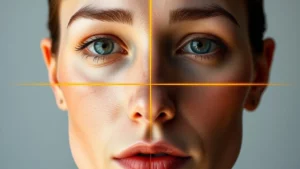
Rather than guessing in front of a bathroom mirror, determine your face shape objectively using a flexible measuring tape or calibrated digital photo. Record these four key measurements in millimeters:
Measure Forehead Width
Measure across the widest part of your forehead, halfway between your eyebrows and your hairline.
Measure Cheekbone (Bizygomatic) Width
Measure from the most prominent point of your left cheekbone, across the bridge of your nose, to the most prominent point of your right cheekbone.
Measure Jawline Width
Measure from the corner of your jaw beneath your ear along the jawline to the tip of your chin. Multiply by 2 to calculate total jawline width.
Measure Total Face Length
Measure vertically from the center of your anterior hairline down to the bottom point of your chin.
Shape Profiles
Heart Face Shape Explained
A Heart Face Shape is characterized by a broad forehead and cheekbones that gracefully taper down into a delicate, pointed chin. It often features a distinctive widow’s peak at the hairline, mimicking the silhouette of an inverted triangle.
Key Landmarks: Forehead width > Cheekbone width > Jawline width. The chin is visibly narrow and pointed. Prominent examples: Reese Witherspoon, Scarlett Johansson, Ryan Gosling.
Diamond Face Shape Explained
A Diamond Face Shape is the rarest craniofacial silhouette. It features high, dramatic cheekbones that represent the widest point of the face, flanked by a narrow forehead and an equally narrow, pointed jawline.
Key Landmarks: Cheekbone width is significantly greater than both forehead and jawline widths. Face length is slightly longer than wide. Prominent examples: Megan Fox, Cillian Murphy, Jennifer Lopez.
Rectangle Face Shape Explained
A Rectangle Face Shape (often termed an Oblong / Square Hybrid) combines the architectural sharpness of a square jawline with extended vertical facial length.
Key Landmarks: Face length is noticeably greater than width (aspect ratio > 1.6). Forehead, cheekbone, and jawline widths are nearly identical, with a strong, angular chin. Prominent examples: Henry Cavill, Gisele Bündchen, Arnold Schwarzenegger.
Shape Comparisons
Oval Face vs Round Face
While both oval and round faces feature soft, curved jawlines without sharp bony angles, their vertical aspect ratios set them apart:
Aspect Ratio: Face length is approximately 1.5 times the cheekbone width.
Contour: Forehead is slightly wider than the gently rounded jawline. Widely considered the most versatile canvas for styling.
Aspect Ratio: Face length and cheekbone width are almost equal (1:1 ratio).
Contour: Widest at the cheeks, with soft rounded curves along the jaw and chin. Conveys youthful neoteny.
Oval Face vs Oblong Face
An Oval Face maintains harmonious vertical balance (length ÷ width ≈ 1.4 to 1.5). An Oblong Face is noticeably elongated (length ÷ width > 1.65), with straight, vertical cheek lines and an extended midface or lower third.
Square Face vs Round Face
Both square and round faces share a 1:1 ratio of length to width. However, their perimeter geometry is completely opposite:
- Square Face: Defined by a sharp, chiselled gonial jaw angle (~90° to 110°), flat jawline baseline, and broad, straight forehead.
- Round Face: Devoid of sharp bony corners; the jaw curve transitions smoothly into the cheeks with soft tissue fullness.
Demographic Distribution
What Is the Most Common Face Shape?
Across global demographic studies, the Oval and Round face shapes are the most common worldwide. Craniofacial anthropologists note that regional genetics play a major role: East Asian populations naturally feature higher frequencies of round and square (brachycephalic) faces, Northern European populations frequently exhibit oblong and rectangular profiles, while Mediterranean populations display high prevalence of oval silhouettes.
The rarest face shape is the Diamond, as it requires the rare combination of high zygomatic arches paired with simultaneously narrow temporal bones and a tapered mandible.
Computer Vision Engineering
Face Shape Calculator From Photo
Modern web-based Face Shape Calculators allow users to upload a frontal photo and receive an automated classification within seconds. Rather than subjective visual categorization, automated engines measure mathematical ratios across facial perimeter nodes.
Face Shape Detector Explained
How does an AI face shape detector actually work under the hood? The AuraFace computer vision engine executes this 4-step pipeline:
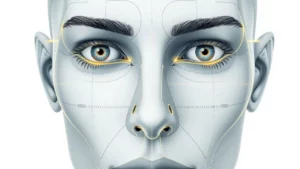
The neural network localizes 478 3D landmarks, isolating the contour boundary points along the forehead, zygomatic arches, gonial angles, and menton.
The software computes three primary ratios: (1) Length-to-Width Ratio, (2) Forehead-to-Cheekbone Ratio, and (3) Jawline-to-Cheekbone Ratio.
The engine calculates the curvature derivative of the lower jaw, distinguishing sharp bony angles (Square/Rectangle) from continuous curvature (Round/Oval).
The algorithm maps your measurements against clustering centroids, outputting your primary shape with confidence percentage.
Accuracy & Optics
How Accurate Are Face Shape Detectors?
AI face shape detectors are mathematically precise, but their accuracy is entirely contingent on optical input quality. In casual smartphone selfies, free mobile filters often misclassify face shapes due to head tilt and hair obstruction.
Why Does My Face Shape Look Different in Photos?
If your face looks heart-shaped in selfies but square in mirror reflections, you are experiencing wide-angle lens barrel distortion. Smartphone front cameras (24mm equivalent) held at arm’s length stretch the central nose while curving the lateral jawline backward, artificially narrowing the jaw and inflating the forehead. To capture your true shape, photos must be taken from 6 to 8 feet away using telephoto zoom (70mm–85mm).
Face Shape vs Facial Proportions
It is vital to understand the difference between Face Shape and Facial Proportions:
- Face Shape (Outer Boundary): The 2D silhouette formed by the edges of your skull (Oval, Square, Round). Dictates haircut framing and glasses shapes.
- Facial Proportions (Internal Features): The spatial relationship between eyes, nose, and lips (Facial Thirds, Fifths, Midface Ratio). Dictates facial harmony and perceived youth.
Practical Styling Guide
Best Glasses for Different Face Shapes
The fundamental styling rule for eyewear is geometric contrast:
| Face Shape | Recommended Glasses Styles | Frames to Avoid |
|---|---|---|
| Round | Angular rectangular, geometric square, wayfarer frames (adds definition). | Small circular or round frames (exaggerates roundness). |
| Square | Round, oval, wire-rimmed aviator frames (softens sharp jawline angles). | Boxy, thick rectangular frames (creates harsh boxy look). |
| Oval | Almost all styles: aviators, browline, cat-eye, geometric frames. | Oversized frames that overwhelm natural facial balance. |
| Heart | Bottom-heavy frames, oval wire rims, light-colored cat-eye glasses. | Top-heavy browline frames (widens the forehead further). |
| Diamond | Oval, rimless, cat-eye, or browline frames that accent cheekbones. | Narrow rectangular frames that clash with high cheekbones. |
| Rectangle / Oblong | Tall square frames, aviators, oversized frames with decorative temples. | Narrow horizontal frames that elongate the face further. |
Hairstyles Based on Face Shape
Use hair volume and texture to harmonize your natural bone structure:
High-volume pompadours, layered lobs, asymmetrical side parts. Keep sides cropped short to elongate the face vertically.
Soft, textured layers, curtain fringe, side-swept bangs. Avoid blunt, chin-length bobs that emphasize jawline sharpness.
Full blunt bangs, voluminous curls, medium-length bobs. Avoid extreme top volume that stretches facial length.
Common Questions
Frequently Asked Questions
Can your face shape change as you get older?
Yes. While adult skull bones do not grow significantly, aging causes facial fat pad descent, collagen loss, and skin laxity. An oval or heart-shaped face in youth often transitions toward a square or rectangular silhouette later in life as tissue pools along the lower jawline forming jowls.
Can weight loss change your face shape?
Substantial weight loss reduces buccal and subcutaneous facial fat, revealing underlying bone structure. Many individuals who believe they have a round face discover they have a sharp square, heart, or diamond bone structure once facial fullness diminishes.
What is the most attractive face shape?
There is no universally “most attractive” face shape. In women, oval and heart shapes are traditionally praised for elegance and youthfulness. In men, square and rectangular jawlines are prized for strength and masculinity. Real-world attractiveness is driven by healthy skin, facial harmony, and confidence.
Does chewing gum change your face shape?
Excessive chewing exercises the masseter muscles on the sides of your jaw. Over time, this can lead to masseter hypertrophy, widening the lower face and transforming an oval silhouette into a squarer contour. If chewed unevenly, it can cause facial asymmetry.
Can you have a combination of two face shapes?
Yes, hybrid face shapes are extremely common. Many people possess a combination such as a Square-Heart (broad angular jaw with a pointed chin) or an Oval-Round (soft curves with slightly extended vertical length).
Your face shape is the unique architectural canvas of your identity. Rather than attempting to force your contours into an arbitrary mold, use your shape as a styling blueprint to choose glasses, hairstyles, and grooming that enhance your best features.
Remember that photos distort contours through close-up perspective. Embrace your natural bone structure, celebrate your individuality, and wear your signature contours with confidence.