Canthal Tilt: Positive vs Negative Tilt, Facial Aesthetics
The definitive medical and photographic guide to palpebral fissure inclination, eye angles, canthoplasty anatomy, and digital landmark calculations.
In the realm of facial aesthetics, few features have gained more viral attention across social media, aesthetic forums, and modeling analysis than Canthal Tilt. Whether labeled in online beauty scales as the hallmark of “hunter eyes” or analyzed in oculoplastic surgery for eyelid rejuvenation, the inclination of your eye corners plays a powerful role in how alert, youthful, and striking your gaze appears.
What exactly is canthal tilt from an anatomical standpoint? How does positive canthal tilt differ from negative or neutral tilt? Can you accurately measure your eye angle from a casual smartphone photo? And how does camera lens distortion trick people into believing their eyes tilt downward when they actually don’t?
In this clinical and photographic guide, we unpack the anatomical science of the palpebral fissure, explain how AI landmark calculators measure eye inclination in degrees, examine the connection between canthal tilt, facial symmetry, and facial proportions, and show you how to evaluate your own gaze accurately at home.
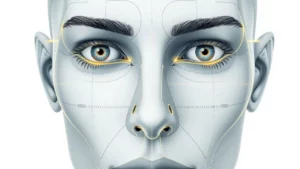
- Canthal Tilt Defined: It is the angle formed by an imaginary line connecting the inner corner of the eye (medial canthus) to the outer corner of the eye (lateral canthus), relative to a horizontal baseline.
- Positive Tilt Is the Biological Standard: The vast majority of healthy human populations naturally exhibit a slight positive tilt (+2° to +5° in men, +3° to +6° in women), meaning the outer corner sits slightly higher than the inner corner.
- Tilt vs Eye Shape: Canthal tilt is an angular vector, not an eye shape. You can have round eyes, hooded eyes, deep-set eyes, or almond eyes with either a positive, neutral, or negative tilt.
- Photos Greatly Distort Tilt: Tilting your head upward by just 3 degrees creates an artificial positive tilt, while tilting your chin down can create a false negative tilt in 2D photos.
- Attractiveness Is Comprehensive: Many legendary cultural icons possess neutral or negative canthal tilts. Facial harmony, orbit support, and eye clarity matter far more than an isolated angle.
Anatomical Definition
What Is Canthal Tilt?
In ophthalmology and oculoplastic surgery, Canthal Tilt (scientifically termed the palpebral fissure inclination) describes the axial slope between the two corners of the eye opening.
Every human eye aperture has two primary anchoring points formed by dense fibrous connective bands called the canthal tendons:
The internal junction of the upper and lower eyelids adjacent to the nasal bone and lacrimal drainage apparatus. It remains largely fixed to the frontal process of the maxilla.
The external junction of the eyelids anchored to Whitnall’s tubercle on the zygomatic bone. Its vertical elevation relative to the medial canthus determines your canthal tilt.
When a horizontal reference line is drawn through the medial canthus parallel to the pupillary axis, the angle at which the lateral canthus rests above, level with, or below that horizontal line defines whether your tilt is positive, neutral, or negative.
Angle Classifications
Positive Canthal Tilt Explained
A Positive Canthal Tilt (PCT) occurs when the lateral canthus (outer eye corner) sits visibly higher than the medial canthus (inner eye corner) along the horizontal plane.
In general human population studies, an upward slant between +2° and +8° is the anatomical norm. From an evolutionary and biomechanical perspective, a positive tilt facilitates efficient tear drainage toward the lacrimal sac at the inner corner and protects the cornea from foreign debris.
In contemporary aesthetic discussions and modeling scouts, positive canthal tilt is prized because it conveys youthfulness, structural tautness of the lateral retinaculum, and an alert, predatory gaze. In men, a positive tilt combined with deep-set orbital bones and low eyebrows produces what is popularly termed “hunter eyes.”
Angle Classifications
Negative Canthal Tilt Explained
A Negative Canthal Tilt (NCT)—clinically known as an antimongoloid slant—occurs when the lateral canthus sits lower than the medial canthus, causing the eye opening to slope downward toward the temples.
Negative tilt can stem from genetic craniofacial morphology, such as a lower position of Whitnall’s tubercle, hypoplasia of the zygomatic bone (underdeveloped cheekbones), or natural structural descent of the lateral canthal tendon. It is also a hallmark of normal physiological aging, as collagen degradation and gravitational soft tissue laxity cause the outer corner of the eyelid to drift downward over decades.
Visually, a pronounced negative canthal tilt can give the face a melancholic, gentle, tired, or “puppy-dog” expression. In medical contexts, severe negative tilt can lead to lateral scleral show or poor eyelid apposition, occasionally treated via a lateral canthopexy or canthoplasty to restore mechanical support.
Angle Classifications
Neutral Canthal Tilt Explained
A Neutral Canthal Tilt describes an eye alignment where the medial canthus and the lateral canthus sit on the exact same horizontal plane, resulting in an inclination angle of approximately 0° (±1°).
Neutral canthal tilt creates a balanced, classic, and grounded appearance. The gaze appears neither sharply angled upward nor drooping downward. Many acclaimed actors, classical portraits, and artistic sculptures feature neutral canthal tilts, where overall facial harmony is driven by strong eyebrow architecture, balanced bone structure, and clear sclera.
Visual Morphology
What Does a Positive Canthal Tilt Look Like?
When viewing a face with positive canthal tilt in frontal conversation, several distinct morphological characteristics stand out:
- Upward Winged Contour: The lower eyelid sweeps smoothly upward and outward toward the temple, resembling a subtle cat-eye or feline contour.
- Minimal Lower Scleral Show: Because the lateral tendon is held taut and elevated, the white of the eye (sclera) below the iris is completely concealed by the lower eyelid margin.
- Youthful Lateral Lift: The skin at the outer orbit appears firm, lifted, and compact, with strong underlying zygomatic support.
- Prominent Examples: Models like Bella Hadid, Adriana Lima, Sean O’Pry, and actor Ian Somerhalder are renowned for pronounced positive canthal tilts.
What Does a Negative Canthal Tilt Look Like?
A negative canthal tilt exhibits distinct visual traits that dramatically shift the character of the gaze:
- Downward Drooping Outer Corners: The lateral edge of the eye angles downward below the level of the tear duct, creating a gentle, puppy-eyed slope.
- Increased Lower Scleral Exposure: The descent of the outer tendon frequently allows a crescent of white sclera to show beneath the colored iris.
- Approachability and Warmth: While harsh aesthetic critics associate negative tilt with fatigue, it naturally softens a face, creating an endearing, trustworthy, and non-threatening demeanor.
- Prominent Examples: Celebrities like Jacob Elordi, Al Pacino, Anne Hathaway, Paul McCartney, and Marilyn Monroe have achieved legendary status with neutral-to-negative tilts.
Diagnostic Matrix
Canthal Tilt Variations Compared
| Tilt Category | Angular Range | Lateral Canthus Position | Visual & Aesthetic Character |
|---|---|---|---|
| Pronounced Positive | > +6° | Significantly elevated above tear duct | Feline, exotic, sharp, assertive “hunter eyes”. |
| Natural Positive | +2° to +5° | Slightly elevated (human biological average) | Youthful, rested, alert, harmonious balance. |
| Neutral Tilt | -1° to +1° | Exact horizontal level with medial corner | Calm, classical, timeless, grounded gaze. |
| Mild Negative | -2° to -5° | Slightly descended below tear duct | Gentle, approachable, artistic, nostalgic. |
| Severe Negative | < -6° | Noticeably pulled down toward cheek | Melancholic, tired, often linked to tissue laxity. |
Measurement Methodology
How to Measure Canthal Tilt
In clinical anthropometry, canthal tilt is measured using a goniometer or digital software calibrated against a standardized facial horizontal plane. You can measure your canthal tilt at home using a high-resolution, unreversed portrait photo and this 5-step protocol:
Establish the True Interpupillary Baseline
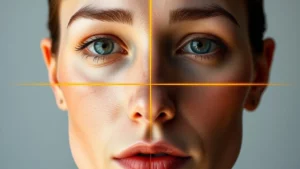
Draw a straight horizontal reference line connecting the center of both pupils. This ensures your baseline is independent of camera tilt or uneven shoulders.
Locate the Medial Canthus
Pinpoint the inner junction where your upper and lower eyelids meet, right at the corner of the tear duct (caruncle).
Locate the Lateral Canthus
Pinpoint the outer corner where the eyelid skin folds meet at the temple side.
Construct the Canthal Vector
Draw a straight line directly connecting the medial canthus through the lateral canthus.
Measure the Angle in Degrees
Using an on-screen digital protractor, measure the angle between the canthal vector and your horizontal baseline. An upward angle is positive; a downward angle is negative.
Optical Accuracy
Can You Measure Canthal Tilt From a Photo?
You can measure canthal tilt from a photo, but only if the photograph adheres strictly to medical cephalometric standards. In everyday smartphone snapshots, photographic measurements are frequently inaccurate.
Why? Because a human eye is a three-dimensional curved sphere embedded in an orbital cavity. When captured in a flat 2D photograph, small head rotations (even 2 to 3 degrees of pitch or yaw) distort the apparent height of the outer eye corner relative to the inner corner.
To capture a photo suitable for measurement:
- The camera must sit exactly at eye level on a tripod.
- The subject must stand 6 to 8 feet away to eliminate lens barrel distortion.
- The head must rest in the Frankfort Horizontal Plane (an imaginary line from the lower eye rim to the ear canal parallel to the floor).
- Facial muscles must be completely relaxed without squinting or smiling.
Computer Vision Engineering
Canthal Tilt Calculator: How It Works
Modern web-based Canthal Tilt Calculators (like the AuraFace landmark engine) employ advanced deep learning facial mesh algorithms rather than manual pixel drawing.
Here is the technical pipeline executed in real-time inside the browser:
The neural network localizes 478 3D landmarks, isolating specific nodes: Landmark 33 & 133 (Medial/Lateral Canthi of left eye) and 362 & 263 (Medial/Lateral Canthi of right eye).
The algorithm computes the 3D head pose matrix, calculating yaw, roll, and pitch to mathematically de-rotate the facial plane to a 0.0° true horizontal baseline.
Using the arctangent formula θ = arctan(Δy / Δx), the software computes the exact angular slope in degrees for both the left and right eyes individually.
The calculator reports individual left and right eye angles and quantifies bilateral tilt variance down to 0.1 degree.
Optics & Perspective
Does Camera Angle Change Canthal Tilt?
Yes. In fact, camera angle is the single biggest cause of false canthal tilt readings in selfies.
Consider the geometry of perspective foreshortening:
- High Camera Angle (Looking Up at Lens): When you hold your phone above your forehead and tilt your head back to look up, your lateral canthi are pushed higher relative to your tear ducts on the 2D camera sensor. This creates an exaggerated positive tilt.
- Low Camera Angle (Looking Down at Lens): When the camera is held below chin level, your chin tilts downward and your outer eye corners appear lower relative to your nasal bridge, producing a false negative tilt.
- Off-Axis Head Turn (Yaw): Turning your head slightly toward one side brings that outer eye corner closer to the lens, changing its perceived vertical coordinate.
Perception & Dynamics
Why Does My Canthal Tilt Look Different in Photos?
Many people notice that their eyes look sharply tilted in some photos, neutral in passport photos, and slightly downward-sloping in candid party shots. This variability stems from three core factors:
Smiling activates the orbicularis oculi muscle, which pushes the outer lower eyelid upward, temporarily turning a neutral or negative tilt into a positive tilt.
Over 70% of people have different canthal tilts on their left versus right eyes (e.g., +4° on the left and +1° on the right). Flipping a selfie swaps these angles jarringly.
Smartphone front cameras (24mm equivalent) stretch image edges, artificially pulling the outer eye corners upward or outward depending on facial centering.
Ocular Morphology
Canthal Tilt vs Eye Shape
It is common in pop culture to conflate canthal tilt with overall eye shape, but they are fundamentally distinct anatomical characteristics.
Canthal tilt refers solely to the angular slope between the two corner endpoints. Eye shape refers to the geometric curvature of the palpebral fissure, eyelid skin fold architecture, and orbital depth:
- Round Eyes: Large, circular palpebral aperture with visible sclera above or below the iris. Round eyes can possess a positive, neutral, or negative tilt.
- Hooded Eyes: Characterized by a fold of skin that droops over the natural eyelid crease. Hooded eyes frequently have positive tilts, but the hooding can visually obscure the lateral canthus.
- Monolid Eyes: Common in East Asian populations, lacking an epicanthic crease. Monolids commonly feature pronounced positive canthal tilts (+5° to +10°).
- Deep-Set Eyes: Eyeballs set deeper into the bony skull socket beneath a prominent brow ridge. Deep-set eyes can display any canthal tilt angle.
Comparative Anatomy
Canthal Tilt vs Almond Eyes
What is the relationship between canthal tilt and “almond eyes”?
Almond eyes are characterized by an oval, pointed silhouette where the iris touches both the top and bottom eyelids without visible sclera showing above or below. Almond eyes almost always exhibit a natural positive canthal tilt (+2° to +5°), because the slight upward sweep of the lateral corner is what gives the eye its classic tapered almond silhouette.
However, not all eyes with a positive canthal tilt are almond eyes. For example, round eyes with prominent globe projection can have a positive canthal tilt while maintaining wide circular curves rather than pointed almond ends.
Facial Balance
Canthal Tilt and Facial Symmetry
Canthal tilt is directly intertwined with overall facial symmetry. In ideal bilateral symmetry, both eyes would share identical inclination angles (e.g., +4.0° on the left and +4.0° on the right).
In reality, directional ocular asymmetry is common. Due to subtle embryonic development variances, one orbit socket often rests 1 to 2 millimeters higher in the skull, or the lateral orbital rim has slightly different bone projection. A discrepancy of up to 2 degrees between left and right eyes is virtually imperceptible in live human conversation.
When canthal tilt asymmetry exceeds 4 to 5 degrees, it can create a noticeable visual cant across the midface, often accompanied by uneven eyebrow arches or an offset jawline.
Holistic Aesthetics
Canthal Tilt and Facial Proportions
Canthal tilt does not exist in a vacuum; its visual appeal depends entirely on how it harmonizes with surrounding facial structures:
Strong lateral zygomatic cheekbones provide high structural support for Whitnall’s tubercle, naturally anchoring a taut positive tilt.
According to the Rule of Fifths, the space between your inner eye corners should equal one eye width. A positive tilt balances wider-set eyes beautifully.
A low, horizontal brow ridge sitting close to the eyes enhances the impact of positive canthal tilt, creating an intense, structured focal point.
Common Questions
Frequently Asked Questions
Can you change your canthal tilt naturally without surgery?
No natural exercises or face yoga routines can alter the position of the lateral canthal tendon, which is securely anchored to the skull bone (Whitnall’s tubercle). However, temporary optical improvements can be achieved through makeup (winged eyeliner, lifted eyeshadow contouring), eyebrow styling, or addressing under-eye volume loss with dermal fillers.
Is negative canthal tilt considered unattractive?
Not at all. While internet rating communities obsess over positive canthal tilt, many of history’s most celebrated sex symbols and movie icons—including Marilyn Monroe, Al Pacino, Jacob Elordi, and Anne Hathaway—feature neutral or negative tilts. Attractiveness is dictated by overall facial harmony, charismatic expression, and eye vitality, not an isolated degree score.
What surgery changes canthal tilt?
In oculoplastic medicine, two primary surgeries adjust canthal position: Canthopexy (tightens and reinforces the existing lateral tendon to elevate the corner by 1-2mm) and Canthoplasty (detaches, reconstructs, and re-anchors the lateral tendon higher on the orbital rim). These procedures are complex and primarily used to treat functional eyelid laxity or ectropion.
Does aging cause canthal tilt to become negative?
Yes. As we age, the lateral canthal tendon gradually stretches and loses elastance, while the supporting fat and bone beneath the outer eye experience volume resorption. This natural process often causes a youthful positive tilt to descend into a neutral or negative tilt over decades.
Why do canthal tilt tests give different results on different photos?
Because 2D photos are highly sensitive to head tilt (pitch and roll), camera lens focal length, and distance. Tilting your chin down slightly or holding your phone close with a wide-angle lens alters the calculated angular vector by several degrees, producing inconsistent readings.
Canthal tilt is a fascinating anatomical measurement that sheds light on eyelid architecture and facial mechanics. However, an isolated angle never defines your total aesthetic value or personal magnetism.
Whether your eyes tilt softly upward, rest serenely horizontal, or sweep gently downward, your gaze derives its genuine power from confidence, emotional warmth, and facial health. Measure for curiosity, but celebrate your natural individuality.