Makeup for Mature Skin Over 50: A Beginner’s Friendly Guide
By Muhammad Salman
Starting makeup after 50 — whether for the first time or after a long break — can feel intimidating. Products have changed, your skin has changed, and the tutorials online seem aimed at twenty-somethings with different concerns. This beginner-friendly guide to makeup for mature skin over 50 focuses on what actually matters: comfortable skin, a natural finish, and simple steps that enhance rather than hide.
Why Mature Skin Needs a Different Approach
After 50, skin typically becomes drier, thinner, and less elastic. Fine lines appear around the eyes and mouth, and texture changes how products sit. The heavy, matte, full-coverage routines that trend online are designed for different skin — on mature skin they tend to settle into lines and look mask-like.
The goal for mature makeup is not to look younger. It is to look like the best version of yourself: even-toned, hydrated, and radiant. Everything below serves that goal.
Step 1: Prep Is Half the Makeup
Good prep matters more at 50+ than at any other age, because dry skin drinks up foundation unevenly.
- Hydrate generously. Apply moisturiser to a clean face and give it five full minutes to absorb before any makeup. Dry patches grab pigment and look cakey.
- Add a hydrating primer. A lightweight, smoothing primer fills the look of fine lines without the heaviness of old-school pore fillers. Silicone-free or water-based primers suit most mature skin.
- Do not skip sunscreen. A broad-spectrum SPF under makeup protects the skin you are working to keep healthy. Let it set for a few minutes before layering.
- Eye cream matters. A pea-sized amount of eye cream keeps concealer from creasing under the eyes.
Step 2: Choose the Right Foundation
Foundation is where most beginners with mature skin go wrong, usually by choosing too much coverage.
- Pick sheer to medium coverage. A skin-like liquid or tinted moisturiser evens tone while letting your real skin show through. Full-coverage mattes highlight texture.
- Choose a luminous or satin finish. Dewy finishes bounce light off the face, which softens the appearance of lines. Matte finishes can flatten the face and emphasise dryness.
- Match carefully. Test shades on your jawline in daylight. If you are unsure about your undertone, our guide to finding your undertone walks through the quick tests.
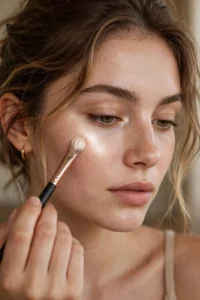
- Less is more. Start with a small amount in the centre of the face and blend outward with a damp sponge or fingers. You can always add a touch more where you need it.
A common beginner mistake is applying foundation like a mask, edge to edge. Blending from the centre outward uses less product exactly where heavy makeup looks worst.
Step 3: Concealer Without the Creasing
Under-eye darkness is a top concern after 50, but thick concealer in the creases draws attention to the area.
- Use a lightweight, hydrating concealer. Thin formulas in a shade close to your skin tone (not dramatically lighter) brighten without caking.
- Apply in a triangle, sparingly. A small amount at the inner corner and a touch along the under-eye, blended with a fingertip — the warmth helps it melt in.
- Set with a whisper of powder. A tiny amount of finely-milled translucent powder, pressed in with a small brush, keeps concealer in place. Skip heavy baking, which dries the area out.
Step 4: Eyes That Look Awake, Not Heavy
Eye makeup for mature beginners should open the eye up rather than weigh it down.
- Keep lids simple. A soft wash of a satin or matte neutral shadow across the lid, slightly deeper in the outer corner, defines the eye without creasing the way glitter and shimmer can.
- Soften your liner. Harsh black liquid liner can look severe on mature eyes. A dark brown pencil, smudged gently along the lash line, defines while staying soft.
- Curl and mascara. Curling lashes before mascara makes the single biggest difference for tired-looking eyes. One or two coats of a lengthening mascara opens the eye; skip waterproof daily formulas, which are drying and hard to remove.
- Fill brows lightly. Brows thin with age, and filling them frames the face. Use short, hair-like strokes with a pencil or powder a shade lighter than your natural brow colour.
For more eye-specific techniques, our tutorial on making eyes look bigger with makeup covers placement tricks that work beautifully on mature eyes.
Step 5: Blush, Lips, and the Finishing Touches
- Cream blush over powder. Cream formulas melt into mature skin and look like a natural flush; powder blush can sit on top of texture. Smile, apply to the apples, and blend upward toward the temples.
- Moisturising lip colour. Matte liquid lipsticks are unforgiving on mature lips. A satin lipstick, tinted balm, or gloss keeps lips looking smooth. Define the lip line with a liner close to your natural lip colour to prevent feathering.
- Set lightly, not heavily. A light mist of setting spray or the faintest dusting of powder on the T-zone is enough. Over-powdering is the fastest way to age a makeup look.
A Simple 10-Minute Routine to Start With
You do not need twenty products. A beginner routine that works:
- Moisturiser and sunscreen (already absorbed)
- Hydrating primer
- Tinted moisturiser or sheer foundation, blended with fingers
- A touch of concealer under the eyes
- Cream blush on the cheeks
- One neutral eyeshadow, soft brown liner, mascara
- Brow pencil, a few strokes
- Tinted lip balm
That is it. Master this before buying anything else — most mature-skin makeup problems are solved by technique and prep, not by more products.
What to Avoid
- Heavy matte foundation — emphasises texture and lines.
- Glitter and chunky shimmer on lids and cheeks — settles into creases.
- Dark, harsh lip liner far outside the natural lip line — reads dated.
- Skipping moisturiser to “make makeup last” — on mature skin, it does the opposite.
- Copying trends built for young skin — cut creases, heavy baking, and ultra-matte everything are designed for different skin.
FAQ
Should I wear foundation every day after 50?
Only if you want to. A tinted moisturiser or even just sunscreen plus concealer where needed is plenty for daily wear. Full foundation is for occasions, not an obligation.
What is the best foundation finish for mature skin?
A satin or luminous finish is the safest choice. It reflects light, which softens the look of fine lines, and it does not cling to dry patches the way matte formulas can.
How do I stop concealer from settling into under-eye lines?
Use less product, choose a hydrating formula, and set with the smallest amount of finely-milled powder. Applying concealer only where you actually have darkness — rather than all the way across the under-eye — also helps.
Is powder blush or cream blush better for mature skin?
Cream blush is generally better for mature skin because it blends into the skin and mimics a natural flush. Powder blush can emphasise texture, especially on drier cheeks.
Keep It Enjoyable
Makeup after 50 should be fun, not a chore and not a battle against your own face. Start simple, buy slowly, and judge every product by one question: does my skin look comfortable and like me?
If you are curious how your features and proportions read on camera, the free AI face-rating tool at https://russella.co.uk/ analyses your photo for face shape, symmetry, and features — a handy, objective check when you are refining a look that photographs well.