Midface Ratio / fWHR: Proportions, and Camera Distortions

The definitive clinical and photographic analysis of facial width-to-height ratio (fWHR), compact midfaces, evolutionary biology, and optical lens geometry.
If you have ever analyzed your face in the mirror or explored modern facial aesthetics, you have likely encountered terms like “compact midface” and “fWHR” (Facial Width-to-Height Ratio). While classical art focused broadly on golden ratios, contemporary evolutionary psychologists and craniofacial surgeons consider the proportions of the midface to be the single most defining architectural foundation of perceived youth, physical appeal, and masculine or feminine dimorphism.
What exactly is the midface ratio? How does it differ from the broader scientific metric of fWHR? Why do smartphone selfies make the central third of your face look artificially stretched and long? And can you calculate your facial proportions accurately from a digital photo?
In this guide, we demystify the mathematics behind the midface ratio and fWHR, explore how lens compression and wide-angle optics distort facial height, evaluate long versus short midfaces, and explain how automated landmark calculators analyze your facial geometry.
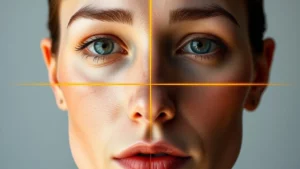
- Midface Ratio Defined: In clinical aesthetics, the midface ratio evaluates the vertical distance between the pupils and the upper lip relative to the horizontal distance between the pupils (Interpupillary Distance, or IPD). A balanced ratio hovers around 1.0.
- fWHR Defined: Facial Width-to-Height Ratio compares maximum cheekbone width (Bizygomatic diameter) to upper facial height (eyebrows to upper lip). A ratio between 1.80 and 2.05 is biologically linked to facial compactness and youthfulness.
- Compactness Signals Vitality: Evolutionary biology shows that humans intuitively perceive a shorter, compact midface as younger and healthier, whereas an elongated midface visually drags the facial center downward.
- Selfies Falsify Your Midface: Wide-angle smartphone front cameras held at arm’s length elongate the central vertical axis by up to 25–30%, creating an optical illusion of a “long midface.”
- Harmony Outweighs Single Numbers: Eye shape, nose projection, cheekbone support, and dental alignment create overall harmony that transcends any isolated measurement.
Anatomical Architecture
What Is Midface Ratio?
The Midface Ratio refers to the geometric proportion of the central third of the human face. Anatomically, the midface spans from the infraorbital region (the floor of the eye sockets) down to the base of the upper lip (stomion or subnasale), supported primarily by the maxilla and zygomatic bones.
In aesthetic anthropometry and modern looksmaxing analysis, the midface ratio is most commonly calculated as:
Midface Ratio = Vertical Distance (Pupils to Upper Lip) ÷ Horizontal Distance (Between Pupils / IPD)
The vertical drop from the eyes to the mouth equals or is slightly shorter than the width between the pupils. This creates a visually youthful, balanced, and compact central facial zone.
The vertical distance between pupils and lips noticeably exceeds the interpupillary distance. The central third appears stretched, often giving the impression of maturity or fatigue.
Evolutionary Biometrics
What Is fWHR?
fWHR stands for Facial Width-to-Height Ratio. It is one of the most extensively researched biometric indicators in evolutionary psychology, behavioral anthropology, and physical attractiveness modeling.
Unlike total facial height (which includes the forehead and chin, both of which vary wildly with hairline recession and jaw posture), fWHR isolates the static, skull-locked midface region that is sculpted by testosterone and growth hormones during puberty.
Studies pioneered by researchers at institutions worldwide have linked higher fWHR with masculine bone density, perceived physical prowess, and assertive charisma. In women, balanced fWHR highlights cheekbone projection and delicate lower-face tapering.
Mathematical Formula
How Is Facial Width-to-Height Ratio Calculated?
Calculating fWHR requires two precise anatomical measurements across perpendicular cranial axes:
fWHR = Bizygomatic Cheekbone Width (Horizontal) ÷ Upper Facial Height (Vertical)
The maximum horizontal distance between the most prominent lateral curves of the left and right zygomatic arches (cheekbones), measured just below the eyes.
The vertical distance from the superior orbital margin (top edge of the eyebrow or glabella) down to the vermilion border of the upper lip (labiale superius).
For example, if your bizygomatic width is 140 mm and your upper facial height is 72 mm, your fWHR is 140 ÷ 72 = 1.94, placing you squarely within the biologically optimal zone.
Biological Significance
Facial Width-to-Height Ratio Explained
Why does fWHR receive so much scientific attention? The answer lies in sexual dimorphism and craniofacial development:
| fWHR Score Range | Morphological Classification | Perceived Aesthetic & Biological Traits |
|---|---|---|
| > 2.05 | Robust / Very Wide | High pubertal testosterone, heavy bone density, assertive, square facial architecture. |
| 1.85 – 2.05 | Optimal Harmony (Masculine & Feminine) | Striking aesthetic balance, prominent cheekbones, youthful midface compactness. |
| 1.70 – 1.84 | Moderate / Balanced | Classical oval aesthetic, approachable, graceful oval contours. |
| < 1.70 | Elongated / Dolichofacial | Visually narrow cheekbones, vertically dominant center, mature appearance. |
During adolescence, testosterone stimulates bone deposition along the zygomatic arches, broadening the midface horizontally. In females, estrogen maintains a softer, tapered jaw while preserving cheekbone prominence, yielding an ideal fWHR of around 1.80 to 1.95.
Measurement Protocol
How to Measure Midface Ratio
You can calculate your personal midface ratio at home using a calibrated digital photo and this 5-step protocol:
Capture a Level Frontal Portrait
Position your camera at eye level, 6 to 8 feet away using 2x optical zoom. Keep your gaze straight and expression relaxed.
Measure Interpupillary Distance (IPD)
In an image editor or measuring app, record the pixel distance between the exact centers of your left and right pupils. This is your Horizontal IPD.
Measure Midface Vertical Drop
Draw a horizontal line connecting both pupils. Measure vertically downward from this pupillary line to the cupid’s bow of the upper lip. This is your Vertical Height.
Execute the Division
Divide the Vertical Height by the Horizontal IPD (Vertical ÷ Horizontal).
Interpret Your Result
A score between 0.95 and 1.05 represents an ideal compact midface. Scores above 1.10 indicate an elongated midface structure.
Comparative Anatomy
Long Midface vs Short Midface
How do a long midface and a short midface alter your overall facial aura and perceived age?
Visual Impact: Features sit closely together. Associated with “neoteny” (youthful retention of childlike proportions), large-looking eyes, and high aesthetic harmony.
Key Traits: Shorter philtrum, compact nasal length, prominent forward cheekbones. Celebrities: Jennie Kim, Leonardo DiCaprio (youth), Margot Robbie.
Visual Impact: The distance between the eyes and mouth is visibly extended. Can create an elegant, regal, and mature aura, but may appear fatigued if cheek projection is weak.
Key Traits: Longer nasal dorsum, extended philtrum, narrower cheekbone width. Celebrities: Sarah Jessica Parker, Adam Driver, Liv Tyler.
Harmonic Interplay
Does Midface Ratio Affect Facial Proportions?
Yes, profound aesthetic ripple effects occur across the entire face based on midface dimensions:
- Perceived Eye Size: An elongated midface creates wide negative space between the eyes and mouth, making the eyes appear smaller in comparison. A compact midface makes eyes pop as a dominant facial anchor.
- Nose Harmony: The nose occupies the center of the midface. In an elongated midface, even a normal-sized nose can appear disproportionately long, often prompting individuals to seek unnecessary rhinoplasties.
- Lower Third Balance: If the midface is vertically long, the chin and lower jaw must be equally tall to avoid looking stunted, often throwing off the Rule of Thirds.
Metric Comparison
Midface Ratio vs Golden Ratio
While the Golden Ratio looks for a 1 : 1.618 (Φ) relationship between hierarchical segments, the midface ratio targets an approximately 1 : 1 equality between pupillary spacing and pupillary-to-lip vertical drop.
The Golden Ratio is an overarching proportional philosophy that evaluates the relationship of smaller parts to larger wholes across the entire skull. Midface ratio and fWHR are localized biometric formulas focused specifically on the compact horizontal dominance of the maxilla and zygomas.
Aesthetic Comparison
Midface Ratio vs Facial Thirds
Classical plastic surgery divides the face into three equal horizontal zones: Forehead (Upper Third), Glabella to Subnasale (Middle Third), and Subnasale to Chin (Lower Third).
The midface ratio and fWHR offer a significant clinical upgrade over the classical Rule of Thirds:
- Accounts for Horizontal Width: The Rule of Thirds only measures vertical height, completely ignoring cheekbone width. fWHR captures the 2D aspect ratio of the skull.
- Immune to Hairline Shift: The upper third depends heavily on the hairline, which recedes with age. Midface metrics are anchored to fixed orbital and dental bone landmarks.
Computer Vision Engineering
Midface Ratio Calculator Explained
Modern web calculators (like the AuraFace biometric engine) analyze midface ratios and fWHR using a client-side 478-landmark 3D mesh model. Here is the automated calculation workflow:
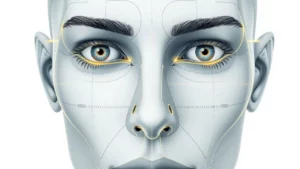
The neural network localizes lateral cheekbone nodes (Landmarks 454 & 234) to calculate maximum bizygomatic width.
The engine pinpoints pupil centers (Landmarks 468 & 473) and the upper lip vermilion junction (Landmark 0) to calculate vertical height.
The algorithm de-rotates 3D head pitch and roll to ensure tilt does not distort horizontal or vertical pixel measurements.
The engine divides width by height to output your exact fWHR and midface compactness index down to two decimal places.
Optical Validity
Can You Measure Midface Ratio From a Photo?
You can measure midface ratio from a photo, but only if optical distortion is eliminated. In casual photography, two-dimensional images flatten 3D curvature and distort true bone ratios.
For an optically valid calculation:
- The camera must be placed at least 6 to 8 feet away.
- Use a telephoto lens or 2.5x–3x zoom (equivalent to 70mm–85mm) to flatten perspective.
- Keep your head in the neutral Frankfort Horizontal Plane with no chin elevation or depression.
Optics & Illusions
Why Does My Midface Look Long in Photos?
If you think your midface looks unusually long in smartphone selfies, you are experiencing an optical illusion called perspective foreshortening and wide-angle barrel distortion.
Smartphone front-facing cameras use ultra-wide lenses (typically 22mm–26mm equivalent) so multiple people can fit into a handheld selfie. When you hold an ultra-wide lens close to your face (12 to 18 inches):
- The center of your face bulges forward toward the camera.
- The nose and the vertical distance from eyes to mouth expand along the vertical axis by 20% to 30%.
- The cheekbones curve backward away from the lens, making your face appear narrower horizontally.
This dual optical error—stretching the vertical height while compressing cheekbone width—artificially lowers your calculated fWHR and creates the illusion of an elongated midface that does not exist in reality.
Focal Length Optics
How Camera Lens Changes Midface Proportions
Focal length dictates how facial dimensions are projected onto a flat digital sensor:
Causes center bulging, stretches the nose, extends the midface vertically, and shrinks cheekbone width. Worst for measuring.
Approximates the field of view of the human eye. Minimal distortion when shot from 5 feet away.
Flattens facial planes, captures true cheekbone width, and provides clinically accurate midface and fWHR ratios.
Software Audit
How Accurate Are Midface Ratio Calculators?
Automated midface calculators are remarkably precise at measuring pixel distances, but their accuracy depends entirely on input photo quality:
- Head Tilt Errors: Tilting your head down by just 3 degrees visually compresses the midface, artificially inflating your fWHR score. Tilting your head up stretches the midface, deflating the score.
- Smiling Dynamics: Smiling pulls the upper lip upward and pushes cheek fat pads upward, artificially shortening the measured vertical midface. Analysis must always be performed in a neutral resting expression.
- 2D Landmark Limitations: Free mobile filters that do not calculate 3D head rotation produce variance errors of up to 10–15%.
Common Questions
Frequently Asked Questions
Can you shorten a long midface naturally?
Bone structure cannot be shortened without invasive maxillofacial surgery (such as a Le Fort I osteotomy with maxillary impaction). However, you can create powerful visual illusions of a compact midface through styling: horizontal eyebrow shaping, contouring beneath the cheekbones, shorter haircuts with bangs or curtain layers, and choosing glasses with thicker frames that break up the vertical midface zone.
What is a good midface ratio for women?
For women, an ideal midface ratio (pupil-to-lip vertical drop divided by interpupillary distance) is typically between 0.90 and 1.00, with an fWHR between 1.80 and 1.95. This reflects youthful midface compactness, high cheekbone dominance, and delicate facial tapering.
What is a good midface ratio for men?
For men, a midface ratio between 0.95 and 1.05 and an fWHR between 1.90 and 2.10 is considered aesthetically optimal. The higher fWHR reflects robust lateral cheekbone expansion and masculine jaw width sculpted by pubertal testosterone.
Does mouth breathing cause a long midface?
Yes, chronic childhood mouth breathing alters craniofacial growth—a condition known as “adenoid facies” or long face syndrome. Lack of proper tongue posture against the palate causes the upper jaw (maxilla) to grow downward vertically rather than forward and outward, resulting in an elongated midface, recessed chin, and crowded teeth.
Why do runway models often have long midfaces?
High-fashion modeling often values dolichocephalic bone structure, which creates an avant-garde, statuesque, and aristocratic look. A slightly longer midface photographically projects sophistication and high editorial drama on the runway.
Midface ratio and fWHR are fascinating biometric metrics that reveal the evolutionary blueprint of facial architecture. However, human beauty is never defined by a single fraction.
A face is an organic mosaic of bone, soft tissue, eye vitality, and genuine expression. Before stressing over smartphone selfies, remember that camera lenses stretch dimensions dramatically. Celebrate your unique proportions and appreciate your face as a cohesive whole.