
Best Sunglasses for Round Face Female
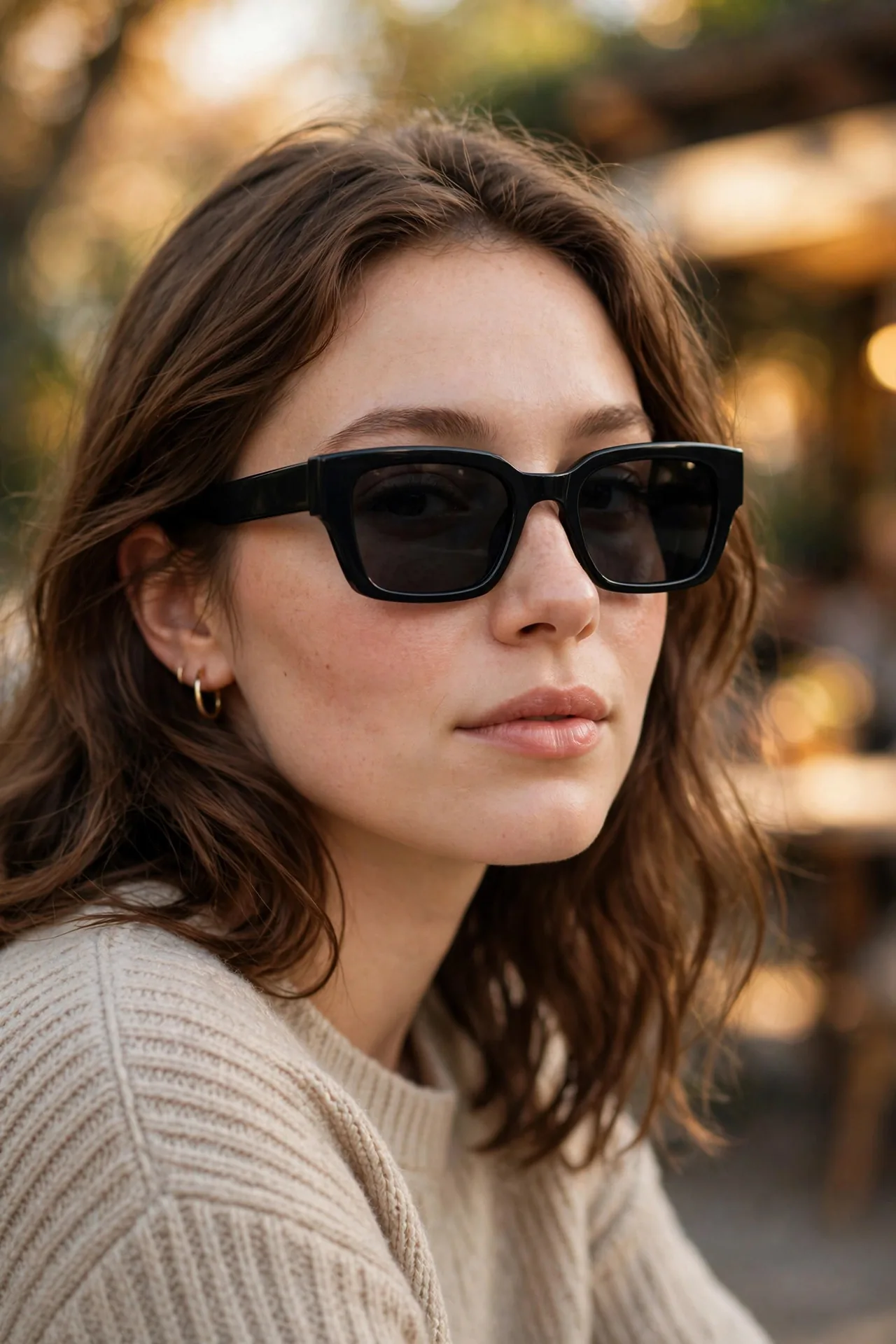
The best sunglasses for a round face, female guide starts with one simple principle: contrast. Round faces are defined by soft, curved lines — full cheeks, a gentle jawline, and roughly equal width and length. Angular frames introduce the straight lines and sharp edges that balance those curves, giving the face a more defined, sculpted look. Before you start shopping, it helps to confirm your face shape — a quick check with Russella’s face shape detection tool can tell you in seconds whether your face reads as round, so you can buy with confidence instead of guessing.
Why Angular Frames Work on Round Faces
Sunglasses sit across the widest part of the face — the cheekbones — so their silhouette directly influences how the face is perceived. Straight top lines, sharp corners, and geometric shapes break up the continuous curve of a round face. The goal is not to hide the face’s natural softness but to add structure: a strong brow line, a defined temple edge, or an upward sweep draws the eye outward and upward, making the face look longer and more angular.
Understanding your facial proportions makes this easier. The way the face divides into horizontal thirds influences where frames should sit — the facial thirds guide explains how forehead, midface, and lower face balance each other, which helps you choose frame depths that keep those proportions harmonious.
The Best Sunglasses Styles for a Round Face
Rectangular Frames
Rectangular frames are the classic recommendation for round faces, and for good reason. Their straight horizontal lines and sharp corners create maximum contrast with a curved face. Look for rectangles that are slightly wider than they are tall — the horizontal emphasis lengthens the face visually. Thin metal rectangles give a sharp, modern look; thicker acetate versions add boldness.
Cat-Eye Frames
Cat-eye frames are one of the most flattering choices for women with round faces. The upswept outer corners lift the eye line and add dramatic angles exactly where round faces need them — at the temples. Cat-eyes also pull attention upward and outward, away from the fullest part of the cheeks. Both oversized vintage-style cat-eyes and subtle modern takes work well, as long as the corners are clearly defined rather than softly rounded.
Wayfarer and Trapezoid Styles
The wayfarer silhouette — straight across the brow with a slight trapezoid tilt — adds the angularity round faces benefit from. Classic wayfarers have crisp corners that frame the eyes without following the face’s curves. Trapezoid and D-frame variations follow the same logic: straight top, defined edges, and a width that extends toward the temples.
Browline and Geometric Frames
Browline frames put a strong horizontal bar across the top of the lens, which anchors the upper face and adds definition. Geometric shapes — hexagonal, octagonal, or squared aviators — also work because their straight edges and corner points contrast with soft facial curves. The key with any geometric frame is that the angles are genuine: a softly rounded hexagon behaves more like a round frame and offers less contrast.
Frame Sizing and Fit Tips
Style matters, but size decides whether the sunglasses actually flatter your face. Keep these fit rules in mind:
- Frame width: The frame should be at least as wide as the broadest part of your face. Frames that are too narrow leave empty space at the temples and emphasize roundness; frames that extend slightly beyond the face’s edges make the face look slimmer.
- Lens height: Avoid oversized lenses that cover too much of the cheeks — deep lenses can shorten the face. A moderate lens height keeps the lower face visible and preserves balance between the facial thirds.
- Bridge fit: The bridge should rest comfortably on the nose without pinching or sliding. An adjustable or well-shaped bridge keeps frames level — crooked or slipping sunglasses break the clean lines that angular frames are meant to create.
- Temple arms: Arms should sit flat against the head without bowing outward or pressing in. If the temples flare, the frame is too narrow; if they dig in, it is too wide.
- Lens color: Darker lenses (black, dark grey, deep brown) add more visual contrast than very light or mirrored lenses, which can soften the frame’s edge. Tinted gradients are a good middle ground — dark at the top, lighter at the bottom.
Styles to Wear With Care
Not every frame is off-limits, but some styles need extra caution on round faces:
- Small round frames: Tiny circular lenses echo the face’s curves and can make a round face look rounder. If you love round frames, go oversized — larger rounds change the proportion game and read as a fashion statement rather than a match for the face shape.
- Oval frames with no corners: Soft ovals follow the face’s curves without adding any contrast. They can still work in bold, oversized versions, but subtle narrow ovals rarely flatter round faces.
- Frames narrower than your face: Regardless of shape, undersized frames emphasize fullness at the temples and cheeks.
Trying-On Checklist
Use this checklist in-store or when unboxing an online order:
- Do the frames look at least as wide as your face from the front?
- Are there visible angles — straight top lines, defined corners, or upswept edges?
- Do the lenses end above the fullest part of your cheeks rather than covering them?
- Does the bridge sit comfortably with no pinching or sliding when you tilt your head?
- Do the temple arms rest flat without bowing out?
- Look at your canthal tilt — the angle of your eyes — and check that the frame’s upper line roughly follows or complements it rather than fighting it.
- Check the three-quarter view: do the frames add definition, or do they disappear into the face’s curves?
Take a photo in natural light from the front and the side. Cameras are more objective than mirrors, and comparing photos of different styles side by side makes the best choice obvious.
Confirm Your Face Shape First
Frame advice only works when it matches your actual face shape. If you are unsure whether your face is round, oval, or heart-shaped, run a free analysis at Russella first — the AI face-analysis tool maps your facial structure so you can shop for sunglasses with certainty instead of trial and error.
Frequently Asked Questions
What sunglasses suit a round face female best?
Angular frames suit round faces best: rectangular, cat-eye, wayfarer, browline, and geometric styles. The straight lines and sharp corners contrast with the face’s natural curves, adding definition and making the face appear longer and slimmer.
Should round faces avoid round sunglasses?
Small round frames tend to emphasize roundness and are the hardest style to pull off. Oversized round frames are a different story — at a large scale they read as a bold fashion choice and can work well, especially with a defined brow or thicker rim.
How wide should sunglasses be for a round face?
The frame should be at least as wide as the broadest part of your face, ideally extending just slightly beyond it. Frames that are narrower than the face leave gaps at the temples and emphasize cheek fullness.
Do cat-eye sunglasses flatter round faces?
Yes — cat-eye frames are one of the most flattering options for round faces. Their upswept outer corners lift the eye line and add sharp angles at the temples, which balances the softness of full cheeks.
What lens color is best for round faces?
Darker lenses — black, dark grey, or deep brown — add more contrast against a round face than very light tints. Gradient lenses are a versatile middle ground, dark at the top and lighter at the bottom.