Best Haircuts for Circle Faces (Round Face Guide)
Best Haircuts for Circle Faces (Round Face Guide)
A circle face is the same as a round face: roughly equal width and length with soft, curved jawlines. The most flattering haircuts add height on top and length on the sides, such as long layered cuts, textured lobs, and crown-volume pixies. Avoid chin-length blunt cuts that emphasize width. This guide covers the best options with circle-face specific advice.
- Circle face = round face (same shape, different name people use)
- Best cuts: long layers, textured lobs, pixies with crown height
- The golden rule: add height on top, keep length past the jaw, use texture to break the circle
- Avoid: chin-length blunt bobs, center parts with no layers, one-length cuts
- For the complete in-depth guide, see our round face haircut pillar
Is a Circle Face the Same as a Round Face?
Yes. “Circle face” and “round face” describe the identical face shape. The difference is purely terminology: “round face” is the beauty industry term, while “circle face” is how many people naturally describe their face when they are unsure of the technical vocabulary.
If you have been searching for “circle face haircut” because “round face” did not sound quite right, you are in the right place. Your face is roughly as wide as it is long, with a soft jawline that curves rather than angles, a rounded forehead, and full cheeks. These are the defining characteristics of the round face shape.
Understanding this terminology matters because it unlocks a much larger body of advice. All the guidance written for “round faces” applies directly to you. This post gives you the quick, actionable version, and links to our comprehensive round face haircut guide for the full deep dive.
Some people worry that “circle” implies an extremely round face, while “round” might mean slightly less so. In practice, face shapes exist on a spectrum, and the cutting principles are the same regardless of where you fall on it. The advice below works for all variations.
Quick Answer: Best Cuts for Circle Faces
If you want the short version before reading the details:
Best overall: Long layered cut with face-framing pieces starting below the jaw. This is the safest, most universally flattering option.
Best medium: Textured lob (long bob) at collarbone length with a side part. Reliable, modern, and low-maintenance.
Best short: Textured pixie with significant height at the crown and tapered sides. Bold but stunning when done right.
Best bangs: Side-swept or long curtain bangs. Avoid blunt straight-across fringes.
Best part: Deep side part or off-center part. Avoid severe center parts without face framing.
The sections below break these down by length with specific details.
Short Options for Circle Faces
Short hair works for circle faces when it follows two principles: height on top and closeness on the sides.
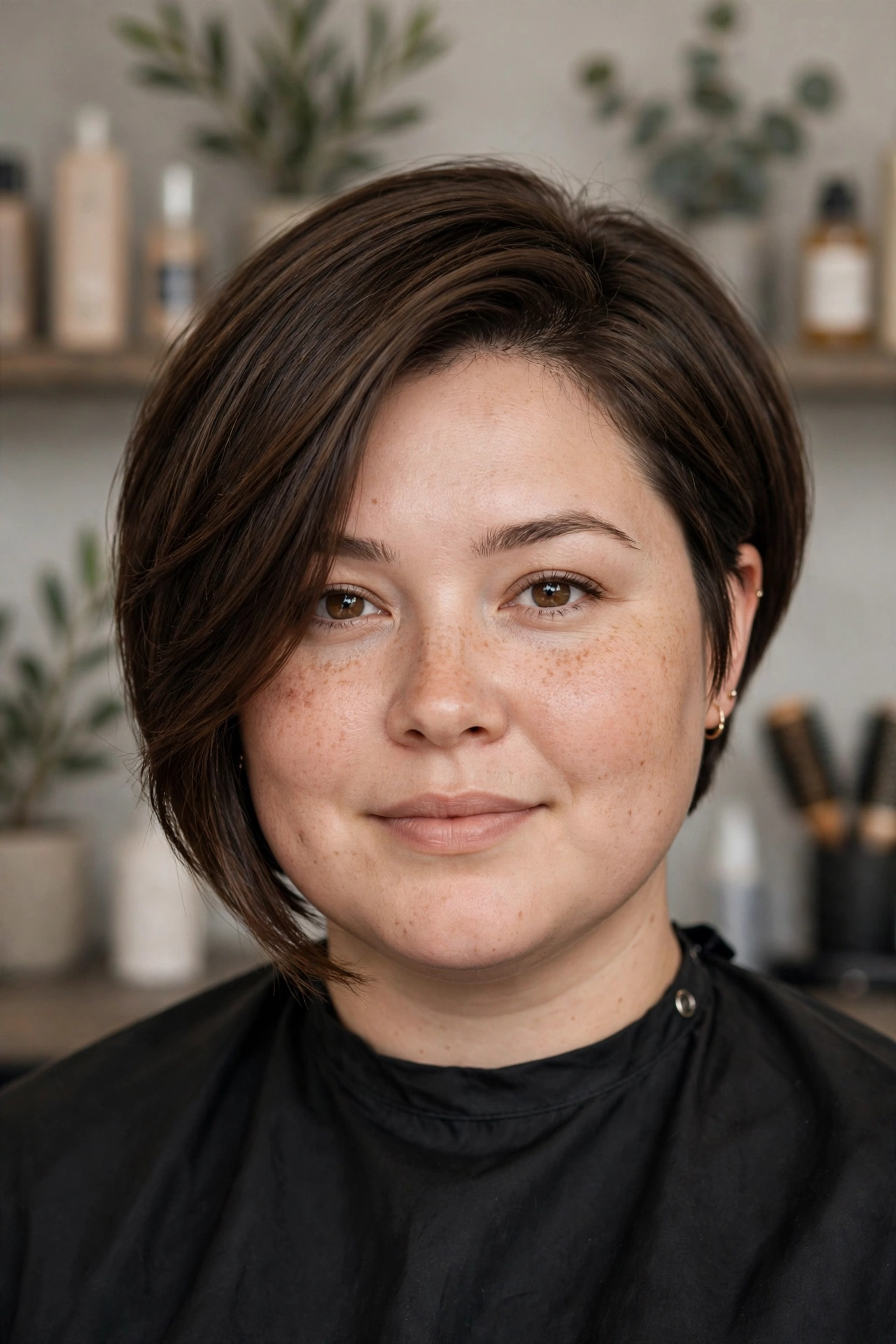
Textured pixie: The top should have choppy texture and volume, styled upward or to the side. The sides should be tapered close to the head. A longer fringe swept diagonally adds a slimming line across the forehead. This cut is high-impact and requires confidence, but it showcases the face beautifully.
Asymmetrical short bob: Longer on one side (at least 1-2 inches difference), with the overall length staying above the jaw. The asymmetry breaks the circular symmetry of the face. Keep the texture choppy, not blunt.
What to avoid in short cuts: Bowl cuts, rounded bobs that cup the face, and any style that is wide at the sides. These echo the circular shape instead of contrasting with it.
Medium Options for Circle Faces
Medium length (shoulder to collarbone) is the most forgiving zone for circle faces.
Textured lob: The lob should hit at or below the collarbone, with long layers and point-cut ends. A side part is essential. The layers add movement that prevents the cut from looking like a solid shape around the face.
Shaggy midi: Choppy layers throughout with curtain bangs. The texture is the key feature here; it breaks up the round silhouette with visual interest. Works especially well for thick hair that needs weight removal.
Layered cut with face framing: Medium length with face-framing layers starting below the chin. The framing pieces should be long enough to fall past the jawline, creating vertical lines. See our face framing guide for technique details.
Long Options for Circle Faces
Long hair is naturally flattering for circle faces because it adds vertical length. But the cut still requires intention.
Long layers: Layers should start below the chin, never at the cheekbones. The longest layers can fall to the waist if desired, but the shortest face-framing pieces must clear the jaw. This creates the elongating effect that balances the round shape.
V-cut: The V shape at the back creates a strong vertical line that the eye follows downward. This is particularly effective for straight or slightly wavy hair where the shape is visible.
What to avoid in long cuts: One-length long hair with no layers (creates a curtain that frames and emphasizes the round face), and layers that start too high (at the cheekbones, adding width).
Styling Tips for Circle Faces
Your haircut is the foundation, but daily styling makes the difference between a cut that works and a cut that truly flatters.
Master the side part. A deep side part is the single fastest way to slim a circle face. It creates instant asymmetry, breaking the symmetrical roundness. If you have always worn a center part, the change will feel dramatic at first, but the slimming effect is immediate and significant. Train your part by blow-drying in the new direction while hair is damp.
Volume at the crown, not the sides. When blow-drying, lift the roots at the crown with a round brush, directing hair upward. Avoid adding volume at the sides near the cheekbones, as this widens the face. A volumizing mousse applied only at the roots on top gives lift without bulk on the sides.
Embrace texture. Whether through the cut itself (point cutting, razor cutting) or styling (texturizing spray, sea salt spray), texture breaks up the smooth circular silhouette. Sleek, flat styles emphasize roundness; textured, piece-y styles disrupt it.
Consider highlights strategically. Face-framing highlights (lighter pieces around the face) draw the eye vertically. Balayage that is lighter toward the ends also elongates. Avoid horizontal highlight patterns like chunky stripes, which add visual width.
Circle Face Haircuts by Hair Texture
Straight hair: You have the most versatility, but also the highest risk of the “curtain effect” where hair hangs flat and frames the roundness. Combat this with layers for movement, texturizing at the ends, and always styling with some root lift. A flat iron can be your enemy if used to press everything sleek and straight.
Wavy hair: Natural waves are advantageous for circle faces because they add texture that breaks the silhouette. Enhance your waves with layered cuts that encourage the wave pattern. Avoid brushing out waves into frizz, which adds width. Use a diffuser when blow-drying to maintain wave definition.
Curly hair: Curls add beautiful volume, but placement matters. Aim for volume on top and through the lengths rather than concentrated at the sides near the cheeks. A layered curly cut with longer layers prevents the dreaded triangle shape (flat on top, wide at the bottom) that emphasizes roundness. Consult a curl specialist for the best layering approach.
Fine hair: Avoid over-layering, which can make fine hair look sparse. Instead, opt for blunt perimeters with subtle internal layers for movement. A textured lob is often ideal: the blunt ends create the illusion of thickness while the texture prevents severity. Volumizing products at the roots add the crown height that slims.
Thick hair: Weight removal is essential. Thick hair left unlayered will add width at the sides through sheer bulk. Ask for internal layers, thinning through the mid-lengths, and texturized ends. Long layers work better than short choppy ones for very thick hair, as they remove weight without creating excessive volume.
Growing Out a Bad Haircut
If you currently have a cut that emphasizes your circle face (like a chin-length blunt bob), you do not need to suffer through the grow-out. Strategic trims can reshape as you grow.
Ask your stylist for a “reshaping trim” rather than a full cut. They can add face-framing layers to a growing bob, texturize blunt ends, and adjust the shape to be more flattering at each stage. Growing from chin to shoulder takes approximately 4-6 months, and reshaping trims every 8 weeks keep it looking intentional.
During grow-out, styling becomes even more important. A deep side part, root volume, and textured ends can make an awkward in-between length look deliberate. Hair accessories like headbands (worn back, not across the forehead) can also help manage the transition.
The Full Guide: Round Face Haircut Pillar
This post covers the essentials, but our comprehensive round face haircut guide goes much deeper, including:
The three rules stylists use for round faces (with detailed explanations of crown height, safe length zones, and texture techniques). Specific styling tricks that slim instantly without a new cut. Exact phrasing to use with your stylist, including technical terms like “point cutting” and “internal layers.” Detailed texture-specific advice for straight, wavy, curly, fine, and thick hair.
If you found this quick guide helpful, the pillar post will give you everything you need to walk into a salon with confidence. The principles are identical because circle face and round face are the same shape; the pillar just provides more depth, more options, and more troubleshooting.
Bookmark both pages: use this one for quick reference and the pillar when you are planning a salon visit or considering a significant change.
Frequently Asked Questions
What is a circle face shape?
A circle face shape is the same as a round face shape: the face is approximately as wide as it is long, with soft curves at the forehead, cheeks, and jawline rather than defined angles. People often say “circle face” when they are unsure of the beauty industry term “round face.” The cutting and styling principles are identical.
What haircut suits a circle face?
Cuts that add height on top and length on the sides: long layered cuts, textured lobs at collarbone length, and pixies with crown volume. The key principles are avoiding width at the cheekbones, keeping hair past the jawline (or very short), and using texture to break up the circular silhouette. Side parts are more flattering than center parts.
Is circle face the same as round face?
Yes, they are the same face shape with different names. “Round face” is the standard beauty industry term; “circle face” is the colloquial description many people use. All advice, cutting techniques, and styling tips for round faces apply directly to circle faces. If you search for either term, you will find relevant guidance.
What should circle faces avoid?
Chin-length blunt bobs (the number one offender, creating a horizontal line at the widest point), center parts with no face-framing layers, one-length cuts with blunt ends, bowl cuts, and any style that adds width at the cheekbones. Also avoid excessive crown flatness, which emphasizes the round proportions.
Best bangs for circle face?
Side-swept bangs and long curtain bangs work best because they create diagonal lines that break the circular symmetry. The bangs should be long enough to sweep fully to one side or blend into face-framing layers. Avoid blunt straight-across bangs (horizontal line emphasizes width) and very short baby bangs. For more bang guidance, see our full round face guide.