Foundation for Olive Skin Tone: Your Complete Shade-Matching Guide
If you have olive skin, you already know the struggle: foundation that looks perfect in the bottle turns orange, pink, or ashy on your face within an hour. Olive skin tone is one of the most misunderstood undertones in the beauty world, and most shade ranges simply are not built with you in mind. This guide walks you through exactly how to find a foundation for olive skin tone that actually works — from identifying your undertone correctly to the formulas and application tricks that keep your base looking natural all day.
What Does Olive Skin Tone Actually Mean?
Olive skin is not about how light or dark you are — it is an undertone, a greenish or yellowish-green cast beneath the surface of the skin. People with olive undertones can range from very fair to deep, and the defining trait is that their skin often pulls neither clearly warm nor clearly cool in traditional shade systems.
Common signs you have an olive undertone:
- Gold jewellery and silver jewellery both look fine on you, or neither looks obviously better.
- Your veins appear blue-green rather than clearly blue or green.
- Foundation in “warm” shades turns orange on you; “cool” shades turn pink or ashy.
- You burn then tan, or tan easily without much burning.
- In natural light, your bare skin has a slightly greenish or yellowish-green cast.
Olive skin is common across Mediterranean, Middle Eastern, South Asian, East Asian, and Latin American backgrounds, but anyone can have it. If you have ever thought “nothing matches me,” olive undertones are likely the reason.
Why Most Foundations Fail on Olive Skin
The mainstream shade system — warm, cool, neutral — leaves olive skin in a gap. Here is what usually goes wrong:
- Warm foundations are built around golden and peach pigments. On olive skin they oxidise into an orange mask.
- Cool foundations lean pink or rosy. On olive skin they can look chalky or turn the face noticeably pink against the neck.
- Neutral foundations are often just a midpoint between warm and cool, which still misses the green cast entirely.
Some brands have started adding an “olive” or “golden-neutral” category — start your search there. Without an olive option, the shade-mixing tricks later in this guide can still get you a match.
How to Confirm Your Undertone Before You Shop
Before buying anything, confirm what you are working with. These quick tests cost nothing:
The White Paper Test
Hold a sheet of plain white paper next to your bare face in daylight. If your skin looks yellowish-green next to it rather than clearly yellow (warm) or pink (cool), olive is likely.
The Vein Check
Look at the veins on the inside of your wrist in natural light. Blue-green or green veins point toward warm or olive undertones; clearly blue or purple veins point cool.
The Jewellery Test
Try on gold and silver pieces. If both flatter you equally — or you notice your skin looks best with neither extreme — that neutrality-with-a-green-cast is classic olive.
The Wrong-Foundation Memory
Think back to the last foundation that looked “off.” If warm shades went orange and cool shades went pink, and you ended up mixing two bottles to survive, that lived experience is data.
For a fuller walkthrough of undertone testing, our guide on how to find your undertone breaks down warm, cool, and neutral with photo-friendly steps you can do at home.
Shade-Matching Tips That Actually Work for Olive Skin
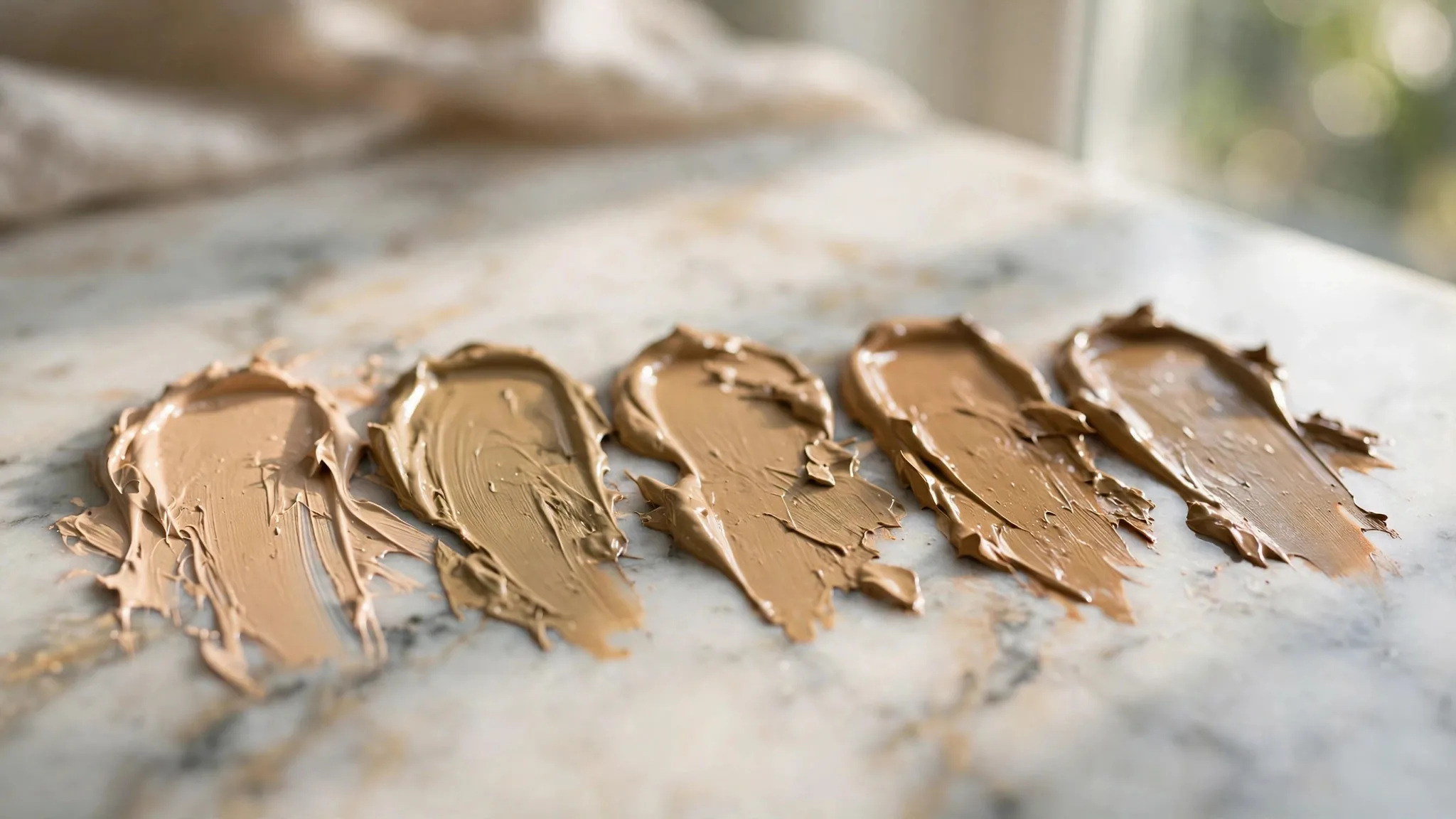
Always swatch on your jawline and neck
Your face can be redder or more flushed than your neck and chest. Swatch three candidate shades along the jawline, blend, and check in natural daylight after ten minutes — oxidation shows up fast on olive skin.
Look for the words that signal olive-friendly shades
Shade names and descriptions containing “olive,” “golden olive,” “natural olive,” “green beige,” “golden neutral,” or “sand” are the ones to try first. Some brands label these under the “N” (neutral) family with a green modifier.
Test for oxidation, not just the wet colour
Many foundations darken and shift warmer as they dry. Apply your swatch, walk away, and come back after 20–30 minutes. If it has turned orange or noticeably darker, it is not your shade — no matter how good it looked at first.
Consider mixing
A pump of a golden shade mixed with a neutral shade can create a custom olive match. This works well with liquid foundations and is often cheaper than hunting for a unicorn shade in a limited range.
Choosing the Right Foundation Formula for Olive Skin
The undertone is only half the battle — formula affects how the colour wears through the day.
- Liquid foundations with a natural or satin finish tend to be most forgiving, because they blend and let your real undertone show through rather than sitting on top of it.
- Sheer to medium coverage flatters olive skin best. Heavy full-coverage formulas emphasise any shade mismatch, while a sheerer base disappears into the skin.
- Watch out for high-SPF formulas if you are often photographed — some mineral SPF bases cause flashback. Our post on makeup for flash photography explains which ingredients to check.
- Oily olive skin often does well with oil-free or long-wear liquids, since excess oil can deepen oxidation. A light powder through the T-zone helps.
- Dry olive skin benefits from hydrating or dewy formulas; a parched surface makes any shade look patchy and ashy.
Application Tricks for a Seamless Base
Even a perfect shade can look wrong applied badly. These habits make the difference:
- Moisturise and prime first. A smooth canvas prevents foundation from clinging to dry patches, which reads as uneven colour.
- Start in the centre of the face. Most redness and discolouration sit around the nose and mouth — build coverage there and blend outward, so you use less product overall.
- Blend down the neck. The biggest giveaway of a wrong match is a jawline line. Carry a whisper of product down onto the neck and blend thoroughly.
- Use a damp sponge for sheer formulas. It sheers out edges and makes shade transitions invisible.
- Set strategically. A translucent powder on the T-zone controls the oil that worsens oxidation, without adding colour that could shift the match.
FAQ
What foundation shade is best for olive skin tone?
There is no single universal shade, since olive skin ranges from fair to deep. Look for shades labelled olive, golden olive, or green beige within your depth. Without an olive option, a golden-neutral shade is the closest alternative.
Is olive skin warm or cool?
Olive is a warm-leaning undertone because of its yellow-green cast, but it does not behave like a standard warm undertone — warm foundations often turn orange on it. Most makeup artists treat olive as its own category.
Why does foundation turn orange on olive skin?
The formula’s pigments oxidise and shift warmer as they dry, and the base lacks the green cast your skin has, so the warm pigments dominate. Olive-labelled shades and oxidation testing before buying solve most cases.
Can I wear pink-toned foundation if I have olive skin?
It is risky. Pink or rosy bases tend to clash with the green-yellow cast and can make the face look flushed next to the neck. A tiny amount of pink in a blush or lip is fine, but keep pink pigments away from your base layer.
Try Before You Commit
Swatch in daylight, wear-test for an hour, and keep your receipts — many stores accept returns on used foundation precisely because shade matching is hard.
And if you want a second opinion on how your base and features photograph together, try the free AI face-rating tool at https://russella.co.uk/. Upload a photo to analyse your face shape, symmetry, and features — it is a genuinely useful check for seeing how your makeup reads in a real photo, which is the ultimate shade-match test.