The PSL Scale & Looksmaxxing: Rating Systems, AI Face Analysis

An objective analysis of the Gaussian PSL bell curve, 1–10 attractiveness inflation, automated AI landmark scoring, and the mathematics of facial aesthetics.
Over the past decade, the vocabulary of human physical evaluation has experienced a radical transformation. Terms once confined to obscure internet subcultures—such as “PSL Scale,” “Looksmaxxing,” “Canthal Tilt,” and “fWHR”—have permeated mainstream culture, TikTok trends, and digital dating optimization.
What exactly is the PSL Scale, and what does PSL mean? Why does a casual “7 out of 10” on social media translate to an ultra-rare top 0.1% score on a true mathematical bell curve? How do online face rating communities differ from automated AI landmark analyzers, and are any of these rating systems truly objective?
In this guide, we demystify the origins and mechanics of the PSL Scale, dissect the statistical inflation of traditional 1–10 beauty scales, contrast subjective human ratings against automated AI geometric calculations, and explore what facial geometry reveals about physical aesthetics.
- What PSL Means: An acronym originating from historic aesthetic forums (Puahate, Sluthate, Lookism) that established a strict, uninflated Gaussian normal distribution (bell curve) for evaluating male and female facial structure.
- The Inflation Fallacy: On everyday dating apps or social ratings, a “7/10” is casually used to mean “average / pretty good.” On the true PSL scale, a 5.0 is the exact 50th percentile (true average), while a 7.0 represents an elite runway model sitting two standard deviations above the population (>97.7th percentile).
- Hard Maxxing vs Soft Maxxing: “Looksmaxxing” is divided into non-invasive optimizations (skincare, gym, low body fat, hairstyle, posture) versus surgical interventions (rhinoplasty, jaw surgery, implants).
- AI vs PSL: Human PSL ratings carry social biases, mood variance, and internet community cynicism. AI face raters evaluate cold geometric ratios—bilateral symmetry, facial thirds, and fWHR—without human malice or emotional subjectivity.
- Geometry vs Real Attractiveness: Bone structure provides a biological baseline, but human attraction is dynamic, heavily shaped by eye contact, voice, confidence, and personality.
Origins & Taxonomy
What Is the PSL Scale?
What Does PSL Mean?
The PSL Scale is a standardized, uninflated facial attractiveness rating system named after the three internet subculture message boards where it originated: Puahate, Sluthate, and Lookism.
Frustrated by the perceived dishonesty and runaway inflation of mainstream rating platforms (where virtually everyone was labeled an 8 or 9 out of 10), members of these early forums designed a rating framework grounded in Gaussian normal distribution (the bell curve) and classical craniofacial anthropometry.
Under the PSL framework, human faces are evaluated primarily on underlying bone structure (mandibular projection, zygomatic arch width, orbit support, and facial thirds) rather than superficial styling or cosmetics.
Statistical Distribution
PSL Scale Explained
What Is a PSL Score?
A PSL Score is a numerical rating anchored to standard deviations (σ) from the population mean. Unlike casual 1–10 scales, the PSL scale operates on a strict statistical curve where 5.0 represents the exact mathematical median (50th percentile):
| PSL Score | Community Classification | Statistical Population Percentile | Morphological Characteristics |
|---|---|---|---|
| < 4.0 | Sub-Tier / Sub-5 | Bottom 16% (< -1.0 σ) | Significant craniofacial deficiencies, severe asymmetry, recession. |
| 4.0 – 4.7 | Low-Tier Normie (LTN) | 16th to 40th Percentile | Below-average bone definition, soft jawline, minor imbalances. |
| 4.8 – 5.2 | Mid-Tier Normie (MTN) | 40th to 60th Percentile (True Average) | The statistical human norm. Balanced features without striking bone dominance. |
| 5.3 – 5.9 | High-Tier Normie (HTN) | 60th to 84th Percentile | Pleasing aesthetics, clear skin, good jawline, minor aesthetic flaws. |
| 6.0 – 6.9 | Chadlite / Model-Tier | 84th to 97.7th Percentile (+1.0 to +2.0 σ) | Strong facial harmony, high cheekbones, positive canthal tilt, compact midface. |
| 7.0 – 8.0+ | Chad / Elite Runway Supermodel | Top 2.3% to Top 0.1% (+2.0 to +3.0 σ) | Flawless sexual dimorphism, exceptional jaw width, striking ocular symmetry. |
The Inflation Trap
PSL Rating vs 1–10 Beauty Scale
The fundamental reason people feel confused or insulted by online ratings is the massive divergence between Casual 1–10 Scales and the PSL Bell Curve:
Operates like school academic grading (where a 70% is a ‘C’ or baseline average). Society treats 1–4 as virtually non-existent, lumps average people into the 6–7 range, and reserves 8–10 for attractive peers. Result: Complete distortion of the median.
Forces ratings into a strict Gaussian normal distribution. Being rated a 5.0 is not an insult—it means you look better than 50% of the entire human species. A 6.0 is already top 15%, and a true 7.0 is runway-tier. Result: Zero emotional inflation.
What Does a 7/10 Face Rating Mean?
On social media, being called a “solid 7” means you are cute and approachable. On the PSL scale, a 7.0 represents an aesthetic titan—someone possessing near-flawless facial thirds, hollow cheeks, an optimal 1.9–2.0 fWHR, positive canthal tilt, and a prominent chin button. Elite supermodels like David Gandy, Sean O’Pry, or young Alain Delon sit in the 7.0 to 7.8 range on the PSL scale.
Diagnostic Anatomy
How Does a PSL Rating Work?
How Do Online Face Rating Scales Work?
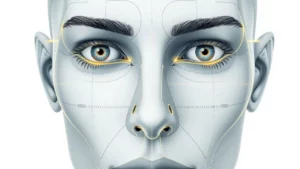
Human raters in online aesthetic communities evaluate specific craniofacial features across distinct anatomical hierarchies:
Evaluated for positive canthal tilt, compact eyelid hooding without upper eyelid exposure, deep-set orbits, and horizontal intercanthal spacing.
Evaluated for gonial jaw angle sharpness (~110°–120°), forward mandibular projection, chin-to-philtrum height ratio (2:1), and lack of submental fat.
Evaluated for high bizygomatic cheekbone width, compact midface ratio (fWHR ~1.9–2.0), and straight nasal bridge with balanced alar base.
Algorithms vs Internet Communities
PSL vs AI Face Rating
AI Face Rating vs PSL Rating
How does an automated AI face rating tool compare against an online human PSL rating?
| Evaluation Dimension | Human PSL Forum Rating | AuraFace AI Geometric Engine |
|---|---|---|
| Core Methodology | Subjective consensus by forum members. | 478 3D landmark geometric vector analysis. |
| Emotional Bias | High (cynicism, harsh critique, social gatekeeping). | Zero (unbiased mathematical calculation). |
| Measurement Precision | Visual eyeball estimation from 2D photos. | Sub-pixel Euclidean trigonometric derivation. |
| Photographic Control | Often fooled by camera tilt, lighting, and focal length. | 3D pose de-rotation normalizes pitch, yaw, and roll. |
| Constructive Utility | Can lead to dysmorphia and unhealthy obsession. | Provides objective ratios for styling and grooming. |
Perceptual Psychology
Why Do Face Rating Scores Differ?
Are Online Face Ratings Objective?
No human rating is ever 100% objective. If you submit the same photo to three different rating platforms or communities, your score will fluctuate wildly due to three core factors:
- Subjective Personal Taste: Human raters possess personal archetypal preferences (e.g., preference for delicate neotenous features versus hyper-masculine angular jaws).
- Optical Lens Artifacts: A selfie taken with a wide-angle lens (24mm) distorts your midface by 30%, causing human raters to penalize your bone structure for a camera flaw.
- In-Group Subculture Norms: Communities dedicated to “looksmaxxing” apply hyper-critical scrutiny that penalizes normal human anatomical diversity.
The Holistic Reality
Facial Geometry vs Subjective Beauty Ratings
It is vital to distinguish Facial Geometry from Human Attractiveness:
Facial geometry is the empirical measurement of bone and soft-tissue coordinates—your intercanthal distance, your gonial angle in degrees, your facial thirds percentage. These can be measured objectively with clinical calipers and AI landmark engines.
However, real human attractiveness is an emotional, dynamic, and multi-sensory experience. It incorporates vocal resonance, conversational wit, eye contact, body language, physical fitness, personal style, and social confidence. An individual with a “5.2” PSL bone structure who maintains vibrant health, clear skin, and magnetic charismatic confidence will consistently outperform a rigid, unexpressive “6.8” in the real world.
Common Questions
Frequently Asked Questions
Can you increase your PSL score naturally?
Yes, through what the community terms “softmaxxing.” Reducing body fat percentage to 10–14% reveals underlying cheekbones and jawline definition. Optimizing skin health, adopting flattering hairstyles for your face shape, fixing forward-head posture, and grooming eyebrows can increase your real-world rating by 1.0 to 1.5 points on any scale.
Is the PSL scale scientifically recognized by doctors?
The cultural terminology (“Chad,” “Normie,” “PSL”) is internet slang, but the underlying anatomical metrics (fWHR, gonial angle, canthal tilt, intercanthal distance, facial thirds) are identical to the cephalometric frameworks used daily by maxillofacial and plastic surgeons.
Why is a 5/10 considered good on the PSL scale?
Because 5.0 represents the exact center of a Gaussian normal distribution. Being a true 5.0 means you have balanced, normal human facial proportions with no disfiguring craniofacial anomalies. It is a solid foundation that elevates quickly with fitness and styling.
Does looksmaxxing cause body dysmorphia?
It can. Over-analyzing millimeter bone deviations, obsessing over selfie angles, and seeking validation on hyper-critical internet forums can trigger Body Dysmorphic Disorder (BDD). It is essential to approach self-improvement with a healthy mindset focused on general health, fitness, and self-confidence.
How does AuraFace AI compare to online rating forums?
AuraFace AI runs completely client-side in your browser via WebAssembly with zero data storage. It evaluates objective 3D landmark geometry and discloses its mathematical formulas, providing educational styling insights without forum toxicity or privacy risks.
Understanding facial geometry and the mathematics of aesthetic scales can be an enlightening intellectual exercise. It illuminates why certain hairstyles, grooming habits, and lighting setups flatter our features.
However, never allow an internet rating or an algorithmic score to define your self-worth. Focus on what you can control: your health, your fitness, your personal style, and your character. Real-world attraction is an art form that no spreadsheet can ever replicate.