
Best Haircut for Round Face Male: Volume on Top, Short Sides
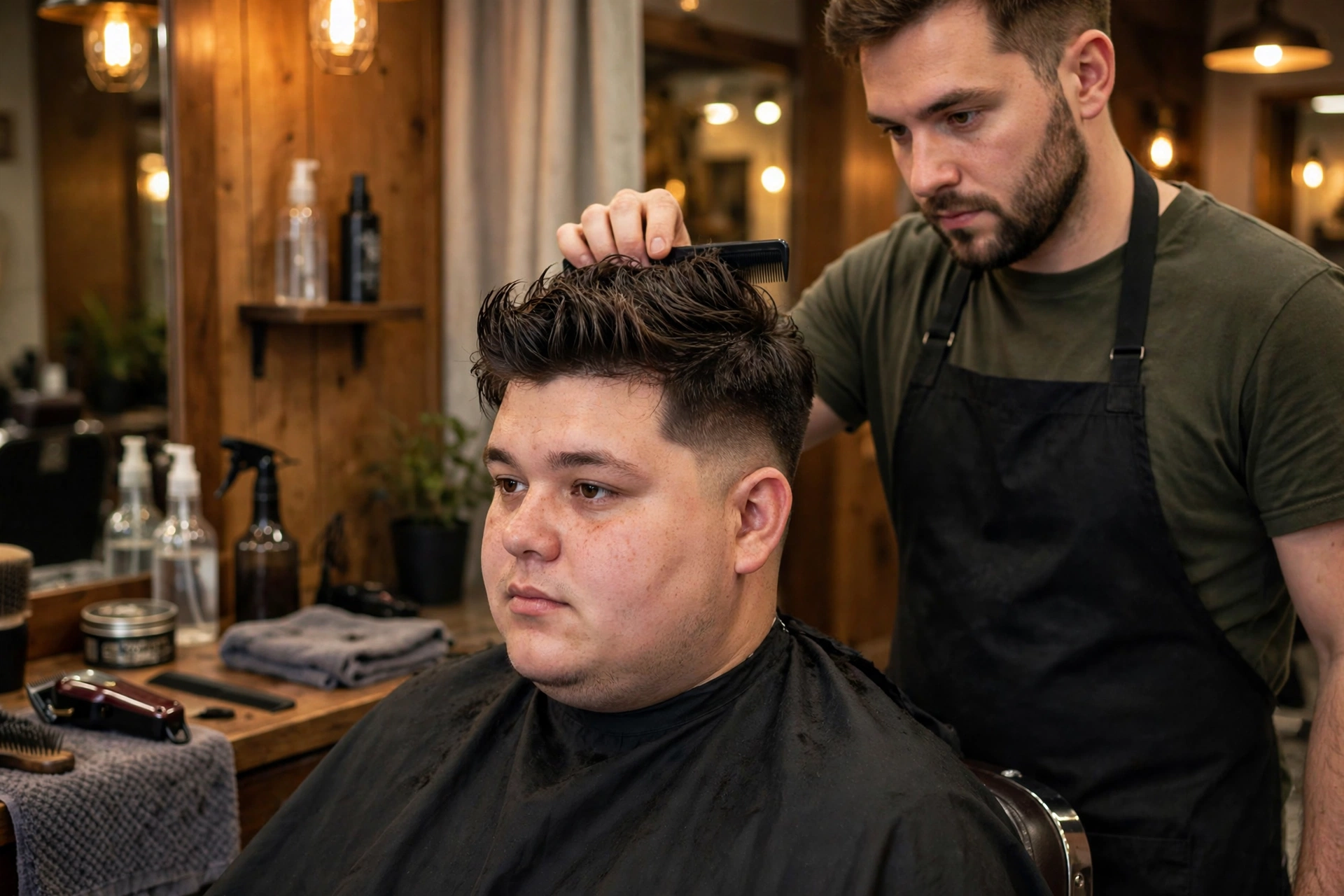
Long layers and side parts elongate round faces; avoid chin-length bobs.
Key Takeaways:
- Volume on top with short, tapered sides is the core formula for round faces.
- Textured quiffs, modern pompadours, and faux hawks all add flattering height.
- Side parts with volume create asymmetry that slims fuller cheeks.
- Avoid chin-length cuts and center parts that widen the face visually.
Let us be honest: most best haircut guides are written for one imaginary face. Yours is round, with soft fullness, so you need best haircut picked for that reality. These selections add definition and the illusion of length, which is exactly the point.
The classic formula, “volume on top, short sides”, directly counteracts roundness: height stretches the face vertically while tight sides remove width. Nearly every flattering cut here is a variation on that theme.
The Core Principle: Build Up, Trim In
A round face reads as wide and short. A haircut that adds vertical inches above the forehead and removes horizontal inches at the temples and sideburns rebalances those proportions toward the oval ideal. Height can come from length, from styling product, or from texture, but it has to come from somewhere. And the sides should stay close: every millimeter of width at the sides is width added to an already-wide face.
Second: angles. Cuts with defined lines, a crisp fade, a hard side part, textured ends, lend structure the face lacks naturally. Soft, rounded cuts repeat the face’s curves and emphasize roundness.
The Best Haircuts for Round Male Faces
Textured Quiff
The quiff is the quintessential round-face cut: significant height swept up and back from the forehead, sides faded or tapered short. The upward volume lengthens the face dramatically, and the textured (not slick) finish adds the angularity that defines. Ask your barber for length on top (enough to style upward), a mid or high fade on the sides, and texture cut into the top rather than a blunt edge. Style with a matte product for a natural, piece-y finish.
Pompadour (Modern, Not Retro)
A modern pompadour, height at the front, tapered sides, less grease and drama than the 1950s original, is a quiff with more forward volume. It adds maximum vertical presence, making it one of the strongest elongating cuts available. Keep the sides tight (a fade or close taper) so all the visual weight sits on top. It demands daily styling effort; the textured quiff gives most of the effect with less work.
Faux Hawk / Textured Crop with Height
A faux hawk concentrates volume along the center strip of the head, the most vertically emphatic shape a haircut can take. On a round face, a textured (not spiky-gelled) faux hawk with faded sides adds height and edges simultaneously. Keep the center strip textured and matte, structured height, not costume.
Side Part with Volume
A classic side part, but with lift at the part rather than hair plastered flat. The asymmetry of the part breaks up the face’s symmetry (roundness reads partly as symmetry), and volume at the crown adds the needed height. Ask for a taper or fade on the sides and enough top length to build height. Note that side parts and middle parts behave very differently on round faces, the side part’s asymmetry is the flattering choice.
High Fade with Textured Top
Less a specific style than a foundation: closely faded sides (high fade) with a textured, forward- or upward-styled top. The high fade’s crisp line adds angular structure at the temples, and the textured top supplies height. This is the most versatile option, it works with straight, wavy, and curly hair, and it grows out gracefully.
Cuts to Avoid
- The bowl cut and rounded crops. Hair curving around the head in an unbroken arc is roundness amplification, the single worst silhouette for this face shape.
- Long, flat sides. Hair hanging straight down past the ears adds width exactly where the face is widest and drags the eye sideways.
- Center parts with flat tops. A middle part on flat hair splits the face into two equal round halves. (Volume changes this equation, but flat is the danger zone.)
- Buzz cuts and very short all-over cuts. With no hair to add height or angles, roundness is fully exposed, the oblong-face haircut guide shows how the brief flips for long faces.
- Curtains and floppy fringes. Hair falling forward over the forehead shortens the visible face and frames the cheeks, width emphasized, length hidden.
How to Brief Your Barber
Use this script with your barber:
- Name the goal: “I want to add height on top and keep the sides tight, my face is round and I want to elongate it.”
- Specify the sides: “Mid/high fade (or taper), taken close, I don’t want width at the temples.”
- Specify the top: “Leave enough length to style up with texture, cut texture into it, not a blunt straight edge.”
- Specify the finish: “Matte, textured finish, not slicked flat.”
Bring a photo of the cut you want on a similar face shape. Barbers work best from visuals, and “textured quiff” means slightly different things to different barbers. A reference photo removes the ambiguity.
Styling Products and Daily Routine
The cut is half the battle; styling maintains the height through the day:
- Matte clay or paste for textured, natural-looking height, the best all-rounder for round faces.
- Sea salt spray on damp hair before blow-drying builds volume at the roots with minimal effort.
- Blow-dry upward. Drying the top hair up and back (rather than letting it air-dry flat) sets the volume that elongates the face. Two minutes with a dryer beats any product applied to flat-dried hair.
- Avoid heavy gels and wet-look products that plaster hair flat to the skull, flat is the enemy of the vertical line you’re building.
The Beard Partnership
Hair and beard should tell the same story. A beard style for round faces, length at the chin, short at the cheeks, extends the face downward while your haircut extends it upward. The face gets stretched from both ends, and the combined effect is dramatically more slimming than either change alone. Keep the beard’s cheek lines sharp and angular, crisp lines echo the fade and define the soft face.
If you’re still mapping your face shape, our free AI face analysis tool on the homepage measures your proportions from a photo, useful confirmation before you commit to a new cut, since round and square faces take different barber instructions.
Frequently Asked Questions
What is the best haircut for a round face male?
A textured quiff or modern pompadour with faded sides, volume on top elongates the face while short sides remove width. A high fade with a textured top is the most versatile version of the same formula.
Should round-faced men keep hair short on the sides?
Yes. Tight, faded, or tapered sides are essential, width at the sides emphasizes the face’s widest dimension. Keep the length and volume on top where it adds flattering height.
Is a middle part bad for round faces?
A flat middle part splits the face into two round halves. One with real volume on top can work, but a side part’s asymmetry is the safer, more slimming choice.
Can round-faced men have long hair?
It’s difficult but not impossible. Long hair needs serious volume at the crown and layers that avoid adding width at the cheeks, worn flat and long, it emphasizes roundness. Most round faces look better with the volume-on-top, short-sides formula.
How often should I get a trim to maintain the shape?
Every 3–4 weeks. The elongating effect depends on the contrast between tight sides and voluminous top, as the sides grow out, width creeps back and the benefit fades. Regular maintenance keeps the geometry working.