Scarf Styles for Round Face Female: Draping Techniques That Elongate
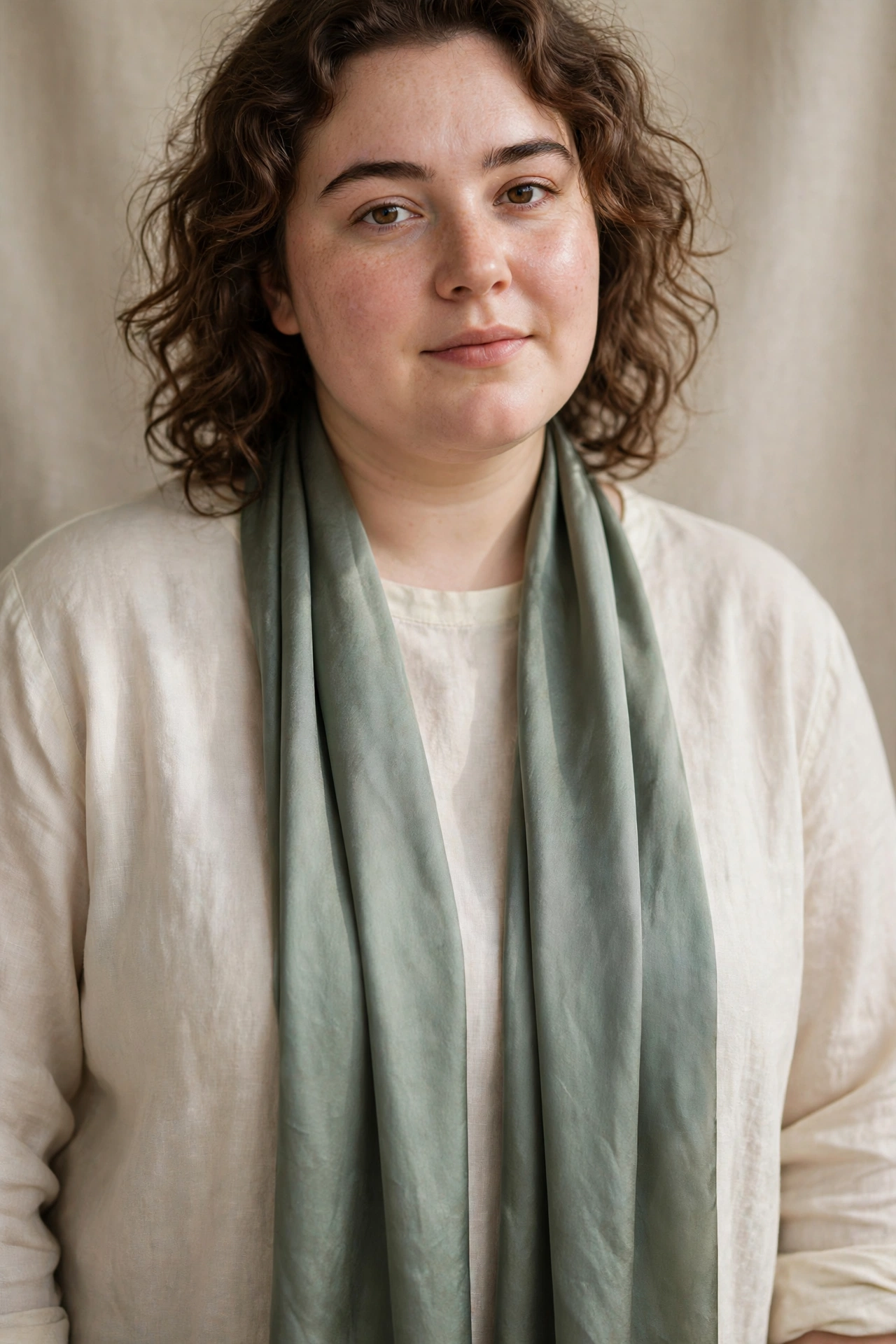
Long, vertical scarf drapes elongate round faces.
Key Takeaways:
- Long loop drapes and waterfall folds create vertical lines that elongate.
- The asymmetric side toss breaks up roundness with diagonal movement.
- Open V drapes expose the neck and draw the eye downward.
- Avoid bulky wraps around the neck that add width to the lower face.
Most scarf styles advice ignores face shape completely, which is why so many women with round faces end up with scarf styles that fight their features. The fix is simpler than you think: choose scarf styles that add definition and the illusion of length. Here is exactly what works.
The good news: elongating drapes all rely on one trick, long vertical lines that lead the eye down rather than across. Master that, and any scarf can flatter a round face.
The Golden Rule: Vertical Lines Elongate
Every flattering scarf style for a round face does the same thing, it creates a long vertical line (or two) running down the front of the body. The eye follows that line downward, which makes the neck look longer and the face look slimmer by association. This is the same reason a long pendant necklace slims a round face while a choker emphasizes its width.
Avoid bulk at the sides of the face and horizontal volume around the chin, a thick loop scrunched to the ears frames the face in a circle, while an open drape with hanging ends does the opposite. Keep this contrast in mind while choosing each style below.
Pair the drape with a neckline that lengthens the neck, the same vertical-line principle, multiplied.
5 Draping Techniques That Elongate a Round Face
1. The Long Loop Drape
Fold a rectangular scarf in half lengthwise, drape it around your neck, and pull the ends through the loop, but let the loop sit low on the chest with the ends hanging as long as possible. The two hanging ends form parallel vertical lines that draw the eye straight down past the bust. For maximum elongation, use a long, narrow scarf (at least 180 cm) in a fluid fabric like silk, modal, or lightweight wool. It suits every dress code and works year-round.
2. The Waterfall Fold
Hold the scarf by its center, let the ends fall, and drape the folded center over the back of your neck so the fabric cascades down your chest in soft folds, smooth and close to the collarbone, not bunched at the throat. The waterfall’s layered folds create multiple thin vertical lines, which is why it reads as lengthening even in heavier fabrics.
3. The Asymmetric Side Toss
Drape the scarf evenly around your neck, then toss one end over the opposite shoulder so that one end hangs long down your back and the other falls down your front. The asymmetry is the point: a single long line down one side of the torso breaks the face’s symmetry of roundness and pulls attention diagonally. It works beautifully with chunky knits that would otherwise add too much volume, since most of the bulk ends up behind the shoulder. Keep the front-hanging end as long as the scarf allows.
4. The Open V Drape
Simply lay the scarf open across your shoulders like a shawl, letting both ends hang straight down in front without any knot at all. The open front forms a natural V shape at the neckline, echoing the slimming geometry of a V-neck top. This is the easiest drape of all and one of the most effective, because there is zero bulk near the face, the fabric starts below the jawline.
5. The High Knot with Hanging Ends
Tie a loose knot high on the chest, at the sternum or just below the collarbone, and let both ends hang long beneath it. The knot anchors the eye at a point well below the chin, which visually extends the neck, while the hanging ends continue the vertical line downward. Keep the knot small and loose; a tight, bulky knot at the throat has the opposite effect, shortening the neck and crowding the jaw.
Choosing the Right Scarf: Fabric, Size, and Pattern
Fabric matters as much as the drape. Fluid, lightweight fabrics, silk, modal, viscose, fine merino, fall in clean vertical lines and are the easiest to style for elongation. Stiff or very bulky fabrics can work, but only in the drapes that keep volume away from the face (the asymmetric toss and the open V). As a rule, the rounder the face, the lighter the fabric should be near the chin.
Size is the second lever. Long, narrow scarves (often sold as “skinny” or “long” scarves) are purpose-built for vertical draping and are the safest choice.
For patterns, vertical stripes, elongated paisleys, and lengthwise color-blocking reinforce the downward line. Large horizontal stripes or bold checks wrapped around the neck are the one pattern choice to avoid, since they emphasize width exactly where you want length.
Draping Mistakes That Add Width
- The tight snood coil. Wrapping an infinity scarf in multiple tight loops right up under the chin creates a thick horizontal ring that makes the lower face look wider and the neck disappear.
- Ends tucked into the coat. Tucking scarf ends inside your coat or sweater removes the vertical line entirely and leaves only the bulky wrapped portion visible, all width, no length. Let the ends hang free.
- The chin-bunch. Pushing the scarf up to cover the lower face on cold days is warm, but it frames the cheeks in fabric and emphasizes roundness. Pull it down to the neck and let a hat suited to round faces handle the warmth instead.
- Symmetrical bulk at the jaw. Any knot tied right at the jawline or a thick fold sitting on the cheekbones adds width at the face’s widest point. Keep knots and folds at the chest or below.
Hijab and Headscarf Styling Notes
If you wear hijab, the same elongation principles apply with a few adaptations. Wrapping the hijab with a slightly higher, softly peaked fold at the forehead adds height above the face, which visually lengthens it, a flat, tight wrap across the forehead shortens the face instead. Let one side of the hijab fall longer down the chest to create the asymmetric vertical line. Loose, fluid hijab fabrics like chiffon drape more slimmingly than stiff cotton when styled with soft folds around the face opening.
Combine the drape with the right makeup techniques for a slimmer-looking round face and the effect compounds, contouring defines the structure while the scarf extends the line.
If you are ever unsure whether your face reads as round, oval, or something in between, try our free AI face analysis tool on the homepage, a quick photo gives you your shape and proportions, so every styling choice starts from facts instead of guesswork.
Frequently Asked Questions
What is the most slimming way to wear a scarf with a round face?
The long loop drape with ends hanging freely down the chest, the parallel vertical lines pull the eye downward, lengthening the neck and slimming the face. Keep the loop loose and low.
Should round faces avoid infinity scarves?
Not entirely, avoid the tight coil around the neck. Worn as one long loop hanging low, an infinity scarf creates the same elongating line as any long scarf.
Do chunky knit scarves suit round faces?
Yes, with the right drape, the asymmetric side toss keeps bulk behind the shoulder, and the open V keeps volume below the jawline. Avoid thick coils around the chin.
What scarf patterns are best for a round face?
Vertical stripes, lengthwise color-blocking, and elongated prints like vertical paisleys. They reinforce the downward line your drape creates. Avoid bold horizontal stripes wrapped around the neck.
Can a scarf really change how round my face looks?
It changes perception, which is what matters in photos and first impressions. Vertical draping alters the proportions the eye registers, a longer neck and slimmer jawline read as a less round face.