
Middle Part vs Side Part for Round Face Male: Which Is Better?
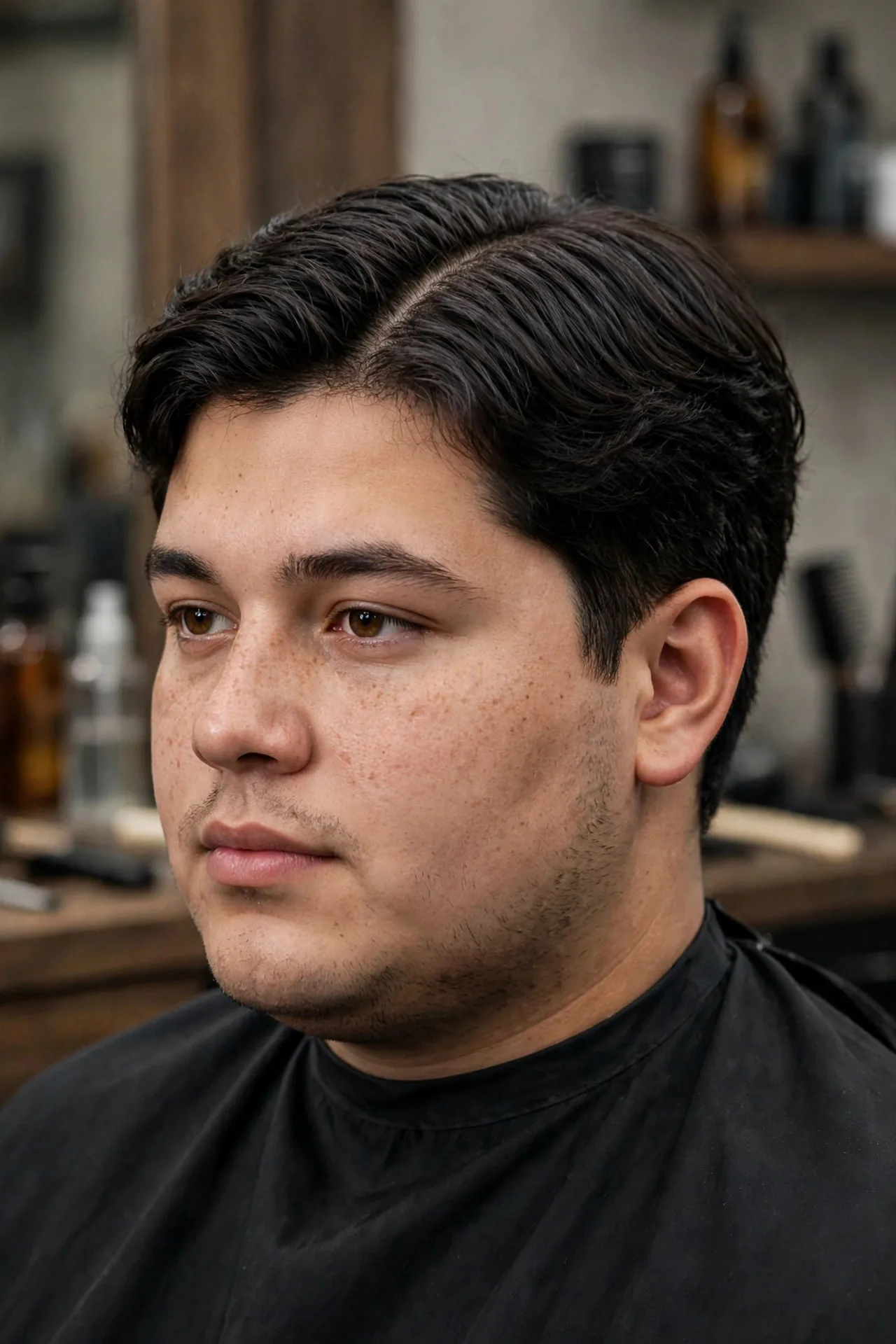
The Parting Problem: Why It Matters on a Round Face
Side parts add asymmetry that slims round faces; middle parts emphasize width.
Key Takeaways:
- Side parts add asymmetry that visually slims a round face.
- Middle parts emphasize width and symmetry, which widens round faces.
- A deep side part with volume on top gives the most slimming effect.
- Middle parts can work if paired with height and textured sides.
- For most round faces, the side part is the safer choice.
The right middle part vs side part will make round faces look more balanced in seconds, because they add definition and the illusion of length. The wrong ones do the reverse. This guide cuts through the noise with picks matched to your features.
The middle part and the side part each interact with a round face in completely different ways. One tends to add length; the other tends to add angles. Neither is universally better, because your hairline, forehead height, and hair texture all get a vote. This guide compares the two head-to-head.
It can help to know your starting point. Checking your facial thirds gives you a clearer picture of what your part is working with.
How the Middle Part Interacts With a Round Face
A middle part splits the hair evenly down the center, letting it fall in two curtains on either side of the face. On a round face, this has a lengthening effect that many men find flattering.
Why It Elongates
The center part creates a strong vertical line from the hairline down through the forehead. That vertical emphasis visually stretches the face, counteracting the width of round cheeks. The two side panels also act like curtains, partially covering the widest part of the cheeks and narrowing the face’s apparent width.
The Hairline Factor
A middle part puts your hairline on full display. If your hairline is straight and even, the symmetry reads as intentional and sharp. If it is receding or uneven, a middle part draws attention to it, weigh that honestly before committing.
The Forehead Factor
A middle part exposes the full forehead. On a round face with a medium-to-tall forehead, this is usually flattering, the exposed forehead adds to the sense of length. If your forehead is on the shorter side, a middle part can compress the face vertically and make it read rounder.
Best Hair Textures for a Middle Part
Medium to thick hair with natural wave holds a middle part best, with enough body to fall away from the center. Very fine, flat hair can struggle, without root volume, a middle part can look limp and expose scalp. Wavy and curly textures look particularly good since side volume balances roundness.
How the Side Part Interacts With a Round Face
A side part sweeps the bulk of the hair to one side, creating an asymmetric shape with diagonal lines across the forehead.
Why It Adds Angles
The side part’s biggest advantage on a round face is asymmetry. A round face is all curves; the side part introduces a diagonal line that breaks up that roundness and adds the illusion of structure. The swept fringe shortens a tall forehead while volume on top adds height, both help a round face look longer.
The Hairline Factor
A side part is more forgiving of an imperfect hairline than a middle part. Because the hair sweeps across rather than splitting away from the center, a slightly uneven or receding hairline is partially camouflaged. If your hairline is a concern, the side part is usually the safer choice.
Best Hair Textures for a Side Part
The side part is the most texture-versatile option. Straight hair takes a crisp side part beautifully, thick hair gets welcome direction, and fine hair benefits because the side part naturally creates the illusion of volume at the part line.
Head-to-Head: Middle Part vs Side Part
| Factor | Middle Part | Side Part |
|,|,|,|
| Lengthening effect | Strong, vertical center line stretches the face | Moderate, top volume adds height |
| Slimming the cheeks | Strong, side curtains narrow the cheeks | Mild, asymmetry distracts from width |
| Hairline forgiveness | Low, hairline fully exposed | High, sweep camouflages unevenness |
| Texture versatility | Needs medium+ density or wave | Works with most textures |
| Styling effort | Low once trained | Low, often easier to maintain |
Styling Steps: The Middle Part
Getting a clean middle part takes training if your hair is used to falling elsewhere.
- Start with damp hair. Parts set easiest when hair is damp, not soaking.
- Find your center. Use the bridge of your nose as a guide and draw the part back with a comb.
- Blow-dry into place. Dry each side forward and down, directing airflow away from the part.
- Add light hold. A matte clay or cream keeps the part defined without looking stiff.
- Train it daily. Reset the part each morning for a week or two, hair has memory and will cooperate.
Keep volume at the crown and avoid tucking both sides behind your ears, the curtain effect is what slims the cheeks.
Styling Steps: The Side Part
The side part is a classic, quick and forgiving.
- Start with damp hair. Damp hair sets best.
- Pick your side. Work with the direction your hair already wants to fall, not against it.
- Comb into place. Draw a line from the temple back and sweep the bulk across. Slightly messy looks modern; razor-sharp reads formal.
- Build volume on top. Blow-dry the top upward and over for lift, height elongates a round face.
- Finish with product. A matte paste or clay gives hold with natural texture.
The Verdict: Which Should You Choose?
If your hairline is even, your forehead is medium to tall, and your hair is reasonably dense, the middle part usually wins for elongating a round face, the vertical line and cheek-slimming curtains are hard to beat.
If your hairline is uneven or receding, your hair is fine or straight, or you want the lowest-maintenance option, the side part is the smarter pick. Its asymmetry adds flattering angles and is kinder to real-world hairlines.
But face shape is not the only factor. Your hair’s texture, density, and growth patterns, plus your personal style and how much morning effort you will actually put in, matter just as much. The best part is the one you will maintain.
Want a second opinion on your proportions before you commit? Run a quick scan with the free AI face-analysis tool, it is meant as fun, light entertainment, and ordinary asymmetry is completely normal.
One more thing worth remembering: no part or cut changes your underlying structure. Face-scoring systems like the PSL scale used in looksmaxxing communities are entertainment only, never a measure of your worth.
Frequently Asked Questions
Can a middle part make a round face look worse?
It can, in specific cases. If your forehead is very short, a middle part can compress the face vertically and emphasize roundness. Very fine, flat hair can also struggle, since limp curtains expose the cheeks rather than framing them. If either applies, try the side part first.
Which part is better if my hairline is receding?
The side part, in most cases. Sweeping hair across the forehead partially covers a receding hairline or uneven corners, while a middle part splits hair away from the center and puts the hairline on display.
How long does my hair need to be for a middle part?
The top needs to be long enough to fall to the sides, typically a few inches at minimum. Very short hair will not stay in a middle part and will spring back. If you are growing it out, the side part is the easier transitional style.
Does a side part ever go out of style?
The side part has been a men’s staple for decades because it is adaptable, classic, professional, or modern depending on texture and finish. Trends cycle, but a well-executed side part never looks wrong. Choose what suits your face and routine over what is trending.